


.webp)
AI in recruitment uses machine learning, natural language processing, and predictive analytics to automate and improve hiring tasks across the recruitment lifecycle. You've likely encountered it without realizing it — chatbots answering candidate questions at midnight, algorithms ranking applicants by fit, software suggesting interview times based on everyone's calendars.
The picture looks different depending on where you sit. Tellent's 2026 country-level research across France, Germany, and the Netherlands found that recruiters and candidates often view AI in recruitment very differently.
The studies covered different respondent groups in each market, but a consistent pattern emerged: many recruiters already see AI as useful in day-to-day hiring, while many candidates remain wary of algorithms being involved in decisions about their future.
|
About the research: Tellent’s 2026 country-level research draws on:
|
This guide covers what AI in recruitment actually looks like in practice, where teams see the clearest returns, what European recruiters and candidates told us, and how to evaluate whether your organization is ready.
Key takeaways
- AI in recruitment works best as a decision-support layer — surfacing better information for humans to act on, not replacing human judgment at the point of hire.
- European recruiters are already using AI daily, but trust remains conditional: 88% of German HR professionals want the final hiring decision to remain with them, and only 21% of Dutch candidates say they'd retain trust in a process involving AI.
- The clearest returns come from high-volume, repetitive tasks — resume screening, interview scheduling, and candidate communications — not from automating judgment calls.
- Algorithmic bias is a real risk, not a theoretical one. The criteria you set matter as much as the tool you choose, and regular auditing is non-negotiable.
- Hiring is one decision in a longer chain. The data you build during recruitment — candidate strengths, evaluation notes, team concerns — compounds in value when it connects to how you manage and develop people after they join.
What is AI in recruitment?
AI in recruitment uses machine learning, natural language processing, and predictive analytics to automate and improve hiring tasks across the recruitment lifecycle.
Here's what powers these tools:
- Machine learning: Algorithms that improve over time by analyzing patterns in your hiring data, identifying trends that may be relevant to specific roles.
- Natural language processing (NLP): Technology that reads and interprets text, enabling AI to parse resumes, analyze job descriptions, and generate written content.
- Predictive analytics: Statistical models that forecast outcomes, like trends that may affect offer acceptance or long-term retention.
Why is AI changing how teams hire?
Hiring teams face a consistent set of pressures: too many applicants, not enough time, and fierce competition for top candidates. According to SHRM research, 85% of employers using automation or AI report that it saves time and increases efficiency.
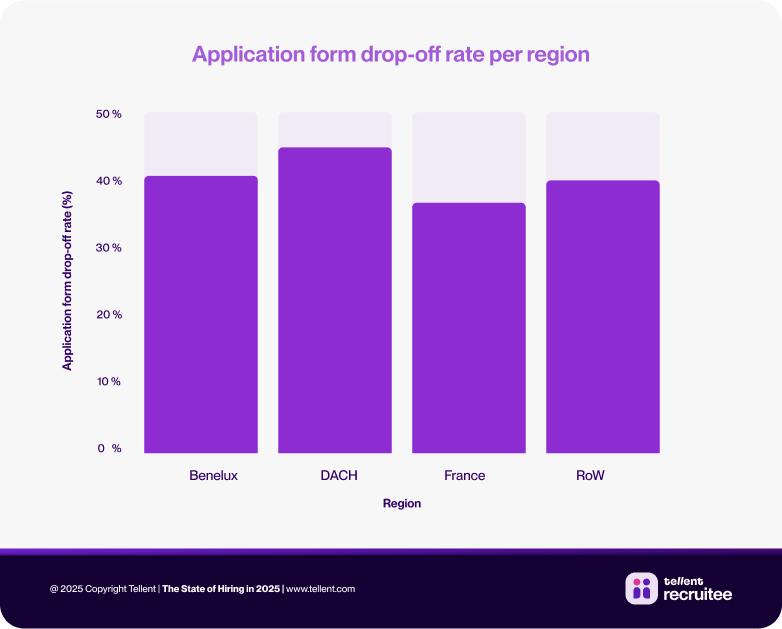
The opportunity is real: our State of Hiring 2025 report, based on data from over 5,000 companies worldwide, found that 41.2% of candidates abandon applications before completing them, and career site conversion rates range from below 5% in some regions to over 11% in others.
AI addresses these gaps by handling high-volume, repetitive tasks so recruiters can focus on what actually matters — building relationships and making smart hiring decisions.
Scaling hiring without scaling headcount
Growing companies often need to fill more roles without adding recruiters. AI can support this by helping with resume screening, candidate outreach, and interview scheduling. A lean team can manage significantly more requisitions when AI handles the administrative load.
That adoption is already happening at scale. In Tellent's May 2026 survey of 557 French recruiters conducted by OpinionWay, 69% said the AI built into their tools is useful or indispensable — a signal that for many hiring teams, AI has already moved from experiment to infrastructure.
Reducing time to hire
Manual bottlenecks — reviewing hundreds of applications, coordinating calendars, sending follow-up emails — slow down hiring. Our State of Hiring 2025 report shows the average time to hire globally is 40.1 days, with teams conducting an average of 5.5 interviews per hire. AI can shorten these steps, especially in high-volume roles, by helping teams review information faster and move quickly when the right candidate appears.
Improving candidate experience
Candidates expect quick responses and clear communication. As noted above, 41.2% of candidates abandon applications before completing them — often due to slow communication or unclear next steps. AI chatbots can answer questions instantly, provide application status updates, and guide applicants through the process even outside business hours. This responsiveness strengthens your employer brand and keeps candidates engaged.
Making data-driven decisions
AI recruitment tools surface insights that would take humans hours to compile. You can see which sourcing channels provide candidates who match your criteria, where applicants drop off in your funnel, and how long each hiring stage actually takes.
|
Traditional Recruitment |
AI-Powered Recruitment |
|
Manual resume screening |
AI-assisted candidate matching |
|
Reactive sourcing |
Proactive talent pool building |
|
Gut-feel decisions |
Data-informed recommendations |
|
Limited personalization |
Tailored candidate communications at scale |
How does AI work across the hiring process?
AI adds value at every stage of the recruitment process. Here's where teams are seeing the clearest returns:
Workforce planning and demand forecasting
Before you post a single job, predictive analytics can help you anticipate hiring needs. AI analyzes patterns in attrition, growth plans, and market trends to forecast which roles you'll need to fill and when.
Job ad creation and optimization
Writing compelling job descriptions takes time. Generative AI tools can draft job ads in seconds, helping improve clarity, inclusive language, and search visibility.
This matters more than ever: our State of Hiring 2025 report found that 72.7% of jobs are now hybrid, and unclear expectations around work models cause candidates to drop out 14% more frequently late in the process. AI helps you craft clear, specific job ads that set proper expectations from the start. You review and refine rather than starting from scratch.
Candidates are increasingly using AI on their side of the process, too. In Panel Inzicht's 2026 survey of 1,000 Dutch candidates aged 18 to 67 conducted on behalf of Tellent, 48% said they've used ChatGPT-style tools in their own job search. That changes what "good" job content looks like: candidates running AI-assisted searches are scanning for clarity and specificity, not filler language.
Candidate sourcing and talent pools
AI sourcing tools scan databases, social platforms, and your existing applicant pool to surface qualified candidates proactively. Instead of waiting for applications, you're building a pipeline of potential hires before roles even open.
Resume screening and matching
This is where AI delivers some of its most immediate value. AI-based recruitment tools parse resumes, extract relevant information, and surface candidates that match your defined criteria. Recruiters review those suggestions and retain full control over all decisions.
That value comes with a practical tension worth naming. Among the French recruiters surveyed, 82% said AI tends to standardize candidate profiles — making it harder to differentiate between applicants. The implication isn't that AI screening doesn't work; it's that the criteria you set matter as much as the tool itself.
Interview scheduling and coordination
The back-and-forth of scheduling interviews frustrates everyone involved. AI can reduce this friction by syncing calendars, suggesting available times, and sending invites automatically — reducing scheduling time from days to minutes.
Candidate assessment and evaluation
AI can help structure evaluation criteria, giving hiring teams a more consistent way to compare candidates. Tellent Recruitee's AI Evaluation Insights consolidates team comments into clear summaries, helping you spot patterns and make well-informed decisions quickly. Customizable evaluation form templates help teams apply the same criteria more consistently across candidates.
Some tools support structured review of interview or assessment inputs, but teams should be cautious with tools that analyze, filter, rank, or evaluate candidates. Under the EU AI Act, recruitment and selection systems that materially influence candidate outcomes may be classified as high-risk, which makes explainability, documentation, bias controls, and human oversight essential.
What distinguishes a guidance layer from a scoring engine is explainability: the best tools surface patterns and consolidate information in ways recruiters can interrogate and override, rather than producing verdicts that require trust without understanding.
%20-%202025%20-%20Tellent%20Intelligence/EN%20Tellent%20Intelligence_Ai%20Insights%20for%20Recruitement.png?width=1332&height=1564&name=EN%20Tellent%20Intelligence_Ai%20Insights%20for%20Recruitement.png)
Offer management and onboarding
The final stages of hiring also benefit from AI. Automated workflows can generate offer letters, collect e-signatures, and trigger pre-onboarding tasks, ensuring nothing falls through the cracks between acceptance and day one.
What should you look for in AI recruiting tools?
With so many AI recruitment tools available, the best starting point is not the feature list. It is the use case.
A tool that helps draft a job ad creates a different risk from one that ranks applicants. A chatbot that answers candidate questions creates a different risk from a model that evaluates interview responses. Before choosing a platform, map where AI will sit in your hiring process and how much influence it will have over candidate outcomes.
Look for tools that give your team:
-
Clear explanations
Recruiters should understand why a recommendation appears, what criteria were used, and what information influenced the output. -
Human control
AI should support decisions, not make them on its own. Recruiters and hiring managers need the ability to review, challenge, edit, or ignore AI-generated outputs. -
Auditability
For higher-risk use cases, your team should be able to track how AI was used, which criteria were applied, and who made the final decision. -
Bias and quality controls
Ask vendors how they test for bias, how often they review outputs, and what safeguards are in place when candidate data is incomplete or inconsistent. -
Candidate transparency
Candidates should understand when AI is used in the process, what it is used for, and how human review fits into the decision-making process. -
Data protection and retention controls
AI recruitment tools process sensitive candidate information. Make sure the system supports GDPR-aligned consent, retention, deletion, and access workflows. -
Workflow fit
The best AI tool is one your recruiters will actually use. It should integrate with your ATS, communication tools, interview workflows, and reporting processes without forcing your team into a completely new way of working.
When evaluating vendors, ask practical questions:
-
Which hiring tasks does the AI support?
-
Does it rank or filter candidates?
-
Can recruiters override outputs?
-
Are recommendations explainable?
-
What data is used?
-
Where is data stored?
-
How are bias risks monitored?
-
Can we produce an audit trail if a candidate or regulator asks for one?
What does AI recruiting actually deliver?
The most honest answer is that AI in hiring improves decision quality when it's implemented well — and adds noise when it isn't. The difference comes down to whether AI is being used to surface better information for humans to act on, or to shortcut the judgment step entirely. Used well, here's what teams can realistically expect.
- Faster screening and shortlisting: AI cuts the time recruiters spend manually reviewing applications, especially for high-volume roles.
- More consistent candidate evaluation: Structured, AI-supported evaluation workflows reduce variability in how interviewers apply criteria.
- Better candidate experience: Responsive, personalized AI communications create a strong impression even when you're handling hundreds of applicants.
- Improved hiring outcomes: Data-driven matching helps teams make more informed choices based on role-relevant criteria.
- Stronger compliance and audit readiness: AI recruitment tools with built-in compliance features help teams prepare for audits and manage requirements across different markets. Tellent Recruitee's GDPR automation handles consent management and data deletion requests automatically, protecting candidate privacy and maintaining transparency without manual paperwork.
What challenges do teams face with AI?
AI isn't a magic solution. Implementing it effectively requires navigating real challenges.
Data quality and integration complexity
AI is only as good as the data it's trained on. If your candidate data is incomplete, inconsistent, or siloed across systems, AI recommendations will suffer. Integration with existing tools can also be technically challenging.
Our State of Hiring 2025 report reveals another critical consideration: mobile experience. Most job searches now start on a phone, yet many application forms remain clunky on mobile devices. When combined with poor data quality, this creates a double barrier that AI alone can't fix — you need both clean data and a mobile-optimized candidate experience.
Algorithmic bias and fairness concerns
AI can perpetuate or amplify bias if trained on historical hiring data that reflects past discrimination. Without careful design and regular auditing, you risk automating unfairness.
This isn't theoretical: the survey of German HR and recruiting professionals using AI (conducted by YouGov for Tellent) found that data protection and compliance concerns were the single biggest barrier to wider AI adoption, cited by 38% of those planning to use AI in recruitment.
Change management and team adoption
Some recruiters worry that AI will replace them or don't trust its recommendations. Getting buy-in requires demonstrating value and positioning AI as a tool that enhances their work rather than threatens it. The concern that AI will replace human judgment is widespread.
Among the surveyed German HR professionals who regularly use AI, 88% said they always want the final hiring decision to be their own — not the AI's — even though most also said they believed AI helps reduce human bias and produce explainable recommendations.
As Marieke Drees, VP of People at Tellent, has put it: "In Germany, we notice that the adoption of AI is slowing down. People are more critical and want their data not to be stored on a cloud somewhere in America. So it's always good to make it very clear — for example, when they apply — to what extent AI is actually used in the recruitment process."
Cost and ROI uncertainty
Especially for smaller teams, the investment in AI tools can feel risky. Building a clear business case with measurable outcomes helps address this concern.
Regulatory and compliance risks
Emerging AI hiring regulations require bias audits and candidate notifications in some jurisdictions. Staying compliant means understanding the legal landscape and choosing tools that meet requirements.
Is AI in recruitment high-risk under the EU AI Act?
In many cases, yes. Under the EU AI Act, AI systems used for recruitment or selection are generally treated as high-risk when they are used to place targeted job advertisements, analyze or filter job applications, or evaluate candidates.
The reason is simple: hiring decisions affect people’s access to work, income, and opportunity. When AI influences those decisions, regulators expect a higher standard of transparency, oversight, documentation, and risk management.
That does not mean every AI feature used by a recruitment team is automatically high-risk. A tool that simply drafts a job description, translates a message, summarizes internal notes, or helps schedule interviews may carry a different risk profile than one that ranks applicants, filters candidates, recommends who should move forward, or evaluates interview responses. The key question is whether the AI system materially influences a decision about a person’s access to employment.
The AI Act also allows some Annex III systems to fall outside the high-risk category where they do not pose a significant risk to health, safety, or fundamental rights, for example, because they perform a narrow procedural task, improve a previously completed human activity, detect patterns without replacing or influencing human assessment, or perform a preparatory task. But there is an important limit: systems that profile natural persons are always considered high-risk under Article 6.
For hiring teams, the practical takeaway is this: classify the use case, not just the tool. The same AI platform may support lower-risk tasks, such as drafting candidate emails, and higher-risk tasks, such as screening applications against role criteria.
Before adopting AI in recruitment, teams should document where AI is used, what data it processes, whether candidates are informed, how humans review outputs, and how the system is monitored for bias or inconsistent outcomes.
A simple way to assess risk is to ask:
|
AI recruitment use case |
Likely risk level |
What hiring teams should check |
|
Drafting job descriptions |
Lower |
Human review, inclusive language, accuracy |
|
Translating candidate messages |
Lower |
Quality control, tone, confidentiality |
|
Interview scheduling |
Lower |
Data access, calendar permissions, candidate experience |
|
Summarizing interviewer feedback |
Medium |
Accuracy, human review, audit trail |
|
Screening or filtering applications |
High-risk likely |
Explainability, bias testing, documentation, human oversight |
|
Ranking candidates by fit |
High-risk likely |
Criteria transparency, auditability, human accountability |
|
Evaluating interview answers or assessments |
High-risk likely |
Validity, bias controls, explainability, candidate rights |
|
Inferring emotions or personality from video interviews |
Prohibited for workplace or hiring emotion inference, except narrow medical or safety reasons. Other personality-related uses require legal review. |
Do not use for emotion inference in hiring or workplace contexts. Seek legal review for any personality-related assessment. |
The safest approach is to keep AI as a decision-support layer. AI can help recruiters organize information, identify patterns, and reduce administrative work, but humans should remain accountable for hiring decisions.
That principle also aligns with candidate expectations. Trust in AI-assisted hiring remains conditional, especially when candidates feel algorithms are making decisions about their future.
The implementation timeline also matters. The European Commission states that rules for AI systems used in certain high-risk areas, including employment, apply from 2 December 2027 (although this may vary depending on the country). That gives hiring teams time to prepare, but not time to ignore the issue: procurement, vendor reviews, data governance, and internal AI policies should start before enforcement arrives.
What are the ethical considerations in AI hiring?
The question of fairness in AI hiring deserves deeper attention. Should AI be involved in decisions that affect people's livelihoods, and under what conditions?
1. Understanding algorithmic bias
Algorithmic bias enters recruitment AI through historical hiring data. If past hiring favored certain demographics, the AI learns to replicate those patterns.
2. Ensuring transparency and explainability
Candidates and regulators increasingly expect to understand how AI makes recommendations. "Black box" algorithms that can't explain their decisions create legal and ethical risks.
Read how Tellent approaches AI development for a behind-the-scenes look at our approach to transparent, human-supervised AI.
3. Balancing automation with human judgment
AI works best as a decision-support tool, not a decision-maker. The most effective implementations keep humans in the loop for final hiring decisions, using AI to surface information and recommendations rather than replace judgment entirely.
Candidate expectations reinforce this. In Panel Inzicht's survey of Dutch candidates, only 21% said they'd retain trust in a hiring process that uses AI. That number is a useful benchmark: the margin for error on "AI handled this" is narrow, and the case for keeping humans visible in the process is stronger than most tools marketing materials suggest.
4. GDPR and candidate data protection
For companies hiring across borders, data protection regulations add another layer of complexity. AI tools that process candidate data need to comply with GDPR and local privacy laws, including requirements around consent, data retention, and the right to explanation.
How is AI changing the recruiter role?
Is AI going to take your job? The short answer is no, but it will change what you do.
From admin to strategic work
AI frees recruiters from busywork like resume screening, scheduling, and data entry. This allows recruiters to focus on higher-value activities: building relationships with candidates, advising hiring managers, and shaping talent strategy.
New skills recruiters need
As AI handles more tactical work, recruiters benefit from developing new capabilities:
- Data literacy: Understanding metrics and interpreting AI recommendations.
- AI tool management: Knowing how to configure, monitor, and optimize AI systems.
- Candidate experience design: Creating human touchpoints that complement automation.
Why AI augments, not replaces, recruiters
Human judgment, empathy, and relationship skills remain essential. AI can't understand team context through conversation, sell a candidate on your company's mission, or navigate sensitive negotiations. The recruiters who thrive will be those who leverage AI to amplify their uniquely human strengths.
What AI hiring trends are shaping the future?
Where is AI in recruiting headed? Here are the trends shaping the next few years:
1. The rise of generative AI
Generative AI is moving beyond content creation into more sophisticated applications — drafting personalized candidate communications, creating interview guides tailored to specific roles, and even simulating candidate conversations for recruiter training.
2. AI agents and autonomous workflows
The next frontier involves AI agents that can execute multi-step recruiting tasks independently. With clear rules and human oversight in place, AI agents could handle multi-step workflows for routine roles: identifying a skills gap, sourcing candidates, drafting outreach, and scheduling interviews.
3. Hyper-personalization at scale
AI enables tailored candidate experiences without requiring manual effort for each applicant. From personalized job recommendations to customized career site content, candidates increasingly expect experiences that feel relevant to them specifically.
4. Predictive workforce planning
AI-powered talent acquisition is shifting from reactive requisition-filling to proactive workforce planning. Organizations are using AI to anticipate skills gaps, identify internal mobility opportunities, and build talent pipelines before needs become urgent.
Is your team ready for AI recruitment?
Before jumping into AI adoption, evaluate where you stand.
Audit your current tech stack
Start by reviewing your existing tools. What's working well? Where are the gaps? Identify redundancies and integration challenges that might complicate AI implementation. If you don't have an applicant tracking system yet, that's often the best place to start — modern ATS platforms come with AI features built in.
Identify high-impact opportunities
Not every hiring task benefits equally from AI. Prioritize high-volume, repetitive tasks where automation delivers the clearest ROI — typically resume screening, scheduling, and initial candidate communications.
Build internal alignment
AI adoption works best when hiring managers, leadership, and IT are aligned. Make the case for AI by connecting it to business outcomes: faster hiring, better candidate quality, and reduced recruiter burnout. Collaborative hiring becomes easier when everyone understands how AI supports — rather than replaces — human decision-making.
How Tellent Recruitee supports responsible AI recruitment
Tellent Recruitee provides AI and automation features inside a collaborative ATS, helping hiring teams reduce admin while keeping recruiters in control of the process.
Its AI-supported features include:
|
Feature |
How it helps |
|
Draft job descriptions faster, with guidance for clearer and more inclusive language |
|
|
Review applications against defined criteria with explainable outputs and human oversight |
|
|
AI Evaluation Insights |
Consolidate team feedback into summaries that help recruiters spot patterns |
|
AI Writer |
Create candidate messages, including personalized and empathetic rejection emails |
|
Automate routine steps such as scheduling, follow-ups, and stakeholder updates |
|
|
Support consent management, retention, and candidate data deletion workflows |
These features are designed to support recruiters rather than replace them. The goal is to make hiring teams faster, more consistent, and better informed while keeping final decisions with people.
Building a smarter AI hiring strategy
AI in recruiting is not about replacing human judgment. It is about giving hiring teams more time, better information, and a process that can scale with growth.
Start by identifying where AI can have the biggest impact on your specific challenges. For most teams, that means high-volume, repetitive tasks such as job ad creation, application review, scheduling, candidate communication, and feedback consolidation. From there, build alignment across recruiters, hiring managers, leadership, and IT so everyone understands where AI is used, what it supports, and where human accountability remains essential.
Hiring is one decision in a longer chain. The data you collect about a candidate — their strengths, the role they were evaluated for, the concerns your team flagged — becomes the foundation for how you manage and develop that person once they're in.
Tellent's Hire, Manage, and Grow modules are designed to keep that context connected, so people decisions don't reset at the point of offer. Better hiring decisions compound into better retention, better performance conversations, and a clearer picture of your workforce over time.

.jpg?width=1000&name=%5BEN%5D%20Recruiting%20automation%20-%20Website%20image%20-%201220x740%20(1).jpg)