




Ask three interviewers what they thought of the same candidate, and you can easily get three different answers. One liked how confident she was. Another wanted more technical depth. The third had doubts but couldn't say where they came from. None of these answers are wrong, exactly. They simply judged the candidate against a different picture of the role, so the debrief turns into a debate about impressions instead of a comparison of evidence.
This is what tends to happen in unstructured interviews. Interviewers are free to follow the conversation wherever it leads, which feels natural in the room but leaves nothing consistent to compare candidates against afterward.
Add the pressure to fill roles quickly, candidates with well-rehearsed answers, and employment laws that expect you to justify every hiring decision, and you can see how strong candidates get turned down while weaker ones get the offer. That combination is fertile ground for poor hiring decisions.
Structured interviews solve this by asking every candidate for a role the same core questions and rating their answers against the same criteria. And interview scorecards are what hold that process together.
Below, you'll learn how to build an interview scorecard, how to use it without the interview feeling like an interrogation, and how to run a debrief where disagreements are settled by evidence, not by whoever speaks first.
Key takeaways
-
Agree on job-related criteria with the hiring manager before the first interview is booked.
-
Describe what each score looks like for each criterion, so a 4 means the same to every interviewer.
-
Have each interviewer score the candidate on their own before the debrief.
-
Write notes that record what the candidate said or did, not just your verdict.
-
Let the scorecard inform the hiring decision. The hiring team still makes it.
What is an interview scorecard?
A typical scorecard covers a handful of criteria, such as a technical skill, problem-solving, or how someone handles a difficult customer, and gives each one its own rating scale and space for notes. Because every interviewer fills in the same form, you can put candidates side by side at the end of the process and explain why one came out ahead.
The purpose of interview scorecards
The purpose of a scorecard is to question candidates on specific requirements that are essential to the job that they’re being interviewed for and evaluate their responses.
Almost every role you fill, from a first-line hire to a senior leader, will involve at least one interview. In fact, when we look at the research, the UK’s Chartered Institute of Personnel and Development (CIPD) found that almost all UK organizations that hired in the past year (96%) used some form of interview.
Yet, the same report also shows that only 7% collect data on whether their assessment methods predict job performance. The survey covers UK employers, but the CIPD notes that the broader trends are relevant wherever you're based, so this can apply to anywhere in the EU.
The point is, however, that while most companies lean heavily on interviews, very few check whether those interviews are picking the right people.
An interview scorecard gives you that starting data: the same criteria, rated the same way, for every candidate. Specifically, interview scorecards help you:
-
Align interview questions with job requirements. Scorecards help interviewers evaluate candidates on role-specific criteria, drawing targeted questions from the job description.
-
Standardize candidate evaluations. With a scorecard, interviewers rate each candidate on the same set of requirements, creating a consistent, structured interview process.
-
Improve decision-making accuracy and fairness. When everyone rates the same criteria on the same scale, you're comparing like with like.
-
Reduce hiring bias. Guidance from the US Office of Personnel Management (OPM) notes that more structured interviews show higher agreement between interviewers and smaller outcome differences between candidate groups. In other words, structured scorecards reduce the room for personal bias by focusing every assessment on job-relevant competencies and qualifications.
-
Streamline the interview process. Scorecards provide interviewers with a structured framework, improving focus during interviews and helping them cover every key area.
The role of scorecards in structured interviews
Disclaimer: scorecards only help when interviewers use them properly.
Used well, a scorecard shapes the whole structured interview process, from the moment a role opens to the moment the team decides who moves forward, guiding hiring managers through the same evaluation steps for every candidate.
Here’s how hiring teams use them before, during, and after the structured interview process.
First, the hiring manager collaborates with the recruitment team to identify essential job criteria, such as skills, experience, and values alignment, based on the job description. Those criteria go on the scorecard, each with a rating scale (usually 1 to 5) and a short description of what each score looks like. Every interviewer then walks in knowing what they're assessing and what a good answer sounds like.
During the interview, interviewers use the scorecard to evaluate responses for each evaluation area, taking notes on specific examples or relevant behaviors. Say problem-solving is one of the criteria. Every candidate gets the same problem-solving question, and the interviewer rates each answer against the agreed descriptions, such as whether the candidate broke the problem down, weighed up options, and explained what they'd do first. That way, a 4 from one interviewer means much the same as a 4 from another.
After interviews, the hiring team reviews all scorecards and compares ratings and comments across candidates. Where scores line up, the decision comes quickly. Where they don't, the notes show why, so the discussion centers on what the candidate actually said rather than on who argues hardest. The hiring manager can then explain which candidates are moving forward and why, to colleagues and, if it comes to it, to the candidates themselves.
The five steps later in this article walk through each of these stages in more detail.
Key components of an interview scoring sheet
Every scorecard should be built around the role in front of you, but most good ones share the same building blocks. Start with these seven and adapt them to the way your team hires:
-
Job-specific evaluation criteria. These are the skills, competencies, and qualifications the role genuinely depends on, agreed with the hiring manager before interviews start. Keep the list short enough that each criterion gets its own question. In practice, three to five per interview round is usually enough, and if you need more, spread them across rounds.
-
A rating scale. Most teams use 1 to 5. Here, each point must be described for each criterion, so a 4 means the same thing to every interviewer.
-
Behavioral indicators. These are short examples of what a strong, average, and weak answer sounds like, as in behaviorally anchored rating scales. They give interviewers something concrete to measure against and stop ratings drifting from one person to the next.
-
Notes section. Next to each rating, interviewers write down what the candidate actually said or did to earn it. This is what gives the score its meaning in the debrief.
-
Overall recommendation. A summary section for a “hire” or “no hire” recommendation, with a final score or average rating. It makes each interviewer commit to a view before the group discussion starts.
-
Candidate and interview details. Basic information like candidate name, interviewer(s) name(s), date, and job title to keep records organized. It sounds basic, but it keeps your records straight when you're comparing several candidates across several rounds.
-
Values alignment. Optional section to rate alignment with defined company values, using the same evidence-based anchors as the other criteria. Hold them to the same standard as everything else, with anchors that describe behavior, because without a clear definition, "culture fit" too easily ends up meaning "similar to us."
As for format, scorecards can live wherever your team already works. You can run scorecards as digital forms in an applicant tracking system (ATS) or human resources information system (HRIS). Spreadsheets, PDFs, and printable templates work too, including for in-person interviews.
The main point here is that everyone uses the same scorecard, regardless of format.
Pros and cons of using interview scorecards
Now, once you introduce scorecards to recruiters and hiring managers, you are likely to get pushback and fear that they will make the process too rigid and impersonal. It's a fair concern, so it's worth weighing up the pros and cons before you bring scorecards into your process.
Benefits of interview scorecards
A few of these benefits came up earlier when discussing the purpose of scorecards, such as fairer comparisons and less room for bias. But it helps to see them all together, along with some less obvious ones:
-
Clarifying job requirements. Building the scorecard means the hiring team has to agree on what the role really needs before interviews start. And disagreements come out early, rather than after a strong candidate has been turned down.
-
Setting realistic hiring expectations. If the wish list describes someone who doesn't exist at the salary on offer, it becomes obvious as soon as you try to describe what a 5 looks like. Catching that early helps avoid vacancies that stay open for months and the strain that puts on the rest of the team.
-
Promoting collaborative hiring. Everyone on the hiring team works from the same criteria going in and shares one record coming out, so the hire becomes a team decision rather than one person's call.
-
Keeping interviews focused and consistent. With the criteria in front of them, interviewers spend their time on what the job requires, which makes each interview easier to compare with the next.
-
Enabling fair panel assessments. On a panel, each member scores what they observed before the group discussion, so the final assessment draws on several independent views rather than the loudest one.
-
Checking consistency across interview rounds. When a candidate meets different people over several rounds, scorecards show whether their answers hold up or shift from one conversation to the next.
-
Making it easier to remember each candidate. After a long day of back-to-back interviews, candidates start to blur together. Notes tied to specific criteria bring each conversation back far more reliably than memory.
-
Reducing personal bias. Scorecards leave less room for snap judgments in the interview itself, and the debrief makes it easier to spot ratings based on impressions rather than evidence.
-
Standardizing assessments across teams. Once you have a format that works, every team can use it, so hiring standards stay consistent as the company adds people, departments, or new locations.
-
Supporting interviewer training. A scorecard that consistently leads to strong hires becomes a training tool in its own right, showing new hiring managers what a strong answer sounds like.
Negatives on interview scorecards
While interview scorecards offer many benefits, they also come with challenges and drawbacks. Most of the drawbacks below stem from how scorecards are used rather than from the scorecard itself, so each one has a fix:
-
Limiting natural conversation. If interviewers read questions straight off the form, the conversation can feel stilted, and it gets harder to build rapport or follow up on something unexpected. Treat the scorecard as a guide rather than a script and leave room for follow-up questions. Step 3 in the next section covers how.
-
May stifle spontaneity and candor. Sticking rigidly to a scorecard can make an interview feel overly formal, so candidates hold back, and you see less of their personality or creativity. A relaxed opening and genuine follow-ups go a long way toward keeping things human.
-
Increasing preparation time. Building job-specific criteria and anchors takes time upfront, which can feel like a lot for a small HR team. But it's work you do once per role, and you usually win the time back in shorter, less circular debriefs.
-
Can create a false sense of objectivity. While scorecards aim to reduce bias, their effectiveness still depends on the consistency of each interviewer’s scoring approach, which may vary. This can create the illusion of full objectivity where it may not actually exist. Behavioral anchors, independent scoring, and a debrief that focuses on the gaps all help close that distance.
-
Requires thorough training for interviewers. Reusing the same template across roles or departments leads to generic ratings that miss what each position actually needs. Keep a shared format, but agree on fresh criteria with the hiring manager for each opening. A short calibration session, where interviewers rate the same sample answer and compare their scores, helps everyone apply the scale the same way.
-
May lead recruiters to overlook job-specific requirements. Using the same scorecard template across roles or departments can lead to generic evaluations that don’t address each position's unique needs. That is why it’s important to create new scorecards for each job opening that closely align with job requirements and ideal candidate personas.
-
Risk of overemphasis on scoring over qualitative insights. Relying too heavily on scorecard scores can cause interviewers to focus too much on numbers, potentially overshadowing valuable qualitative feedback. Give the notes and discussion as much weight as the score, and keep the final decision with people, not the spreadsheet.
How to create and use an interview scorecard
Knowing why scorecards help is one thing. Getting them to work in practice is another. The five steps below take you through the process in the order you'll use it, from agreeing on criteria with the hiring manager to settling disagreements in the debrief.
1. Crystallize the job criteria before interviews begin
Before anyone books an interview, sit down with the hiring manager and agree on what the job criteria are. That means the skills, competencies, and values a successful candidate will show, each phrased as something an interviewer can observe during the interview. Skip this step, and every interviewer arrives with their own picture of the role, so their scores won't be comparable afterward.
Take a requirement like "good communicator." It sounds clear enough, but no two interviewers will rate it the same way, because it doesn't say what good communication looks like in this particular job.
Rewrite it as "explains a technical issue to a non-technical customer in under two minutes," and suddenly everyone knows what to listen for. From there, you can describe what each point on the scale looks like:
-
5: Explains the issue in plain language, checks the customer has understood, and says what happens next.
-
3: Gets the main point across but leans on jargon or skips the next step.
-
1: Stays technical, loses the thread, or doesn't adapt to the listener.
When it comes to crystallizing the job criteria, it's tempting to pull the criteria straight from the job description, but that often misses what matters most. Marieke Drees, VP of People at Tellent, explains why she builds the evaluation form after the hiring manager intake:
Once you have a draft, run a simple test on each criterion: if two interviewers heard the same answer, would they give it the same rating? If not, sharpen the wording before you move on.
2. Be consistent with your interview structure
With the criteria agreed, the next step is turning each one into a question. Give every criterion one core question and ask it of every candidate. That consistency is what makes the answers comparable. If one candidate talks about a project that failed and another about a project they're proud of, you're no longer comparing like with like.
Kamila Kashayeva, Team Lead Talent Acquisition at Tellent, suggests working backward: decide what you want to hear first, then write the question that will draw it out. If you want to understand how someone handles setbacks, for example, you might ask, "Tell me about a time a project went off track." Then plan your follow-ups in advance, such as "What was your role?" and "What was the outcome?"
Also, be mindful not to ask too many closed questions. "Are you good under pressure?" invites a quick yes and tells you very little. Improvised follow-ups cause problems too, because they can change the direction of the question entirely, leaving one candidate answering something the others were never asked. Planning your follow-ups keeps every candidate on the same track.
3. Stay flexible and engage with the candidate
Consistent questions don't have to mean a rigid interview, though. Instead, think of the scorecard as a guide, not a script, letting candidates expand on their answers, and respond to what they say as you would in any good conversation.
Marieke is clear about where she draws the line:
She also believes gut feeling has its place, as long as you can explain it. So if something about a candidate bothers you, pin down the behavior behind it and write that down before you rate. "Not convinced" becomes "gave two different reasons for leaving her last role." The first is a feeling. The second is something the panel can actually discuss.
However, flexibility does have its limits. If the conversation flows so well that you never get to one of the criteria, that candidate ends up with a gap on their scorecard that nobody else has. So follow the conversation where it goes, but check you've covered every criterion before you wrap up.
4. Use notes and record observations to give depth to evaluations
Take notes as you go, focusing on what the candidate said or did rather than how you felt about it. Because a rating without notes is hard to defend in a debrief and, after a week of interviews, hard to remember, too.
A note that says "great energy" gives the panel nothing to work with, while "described how she cut onboarding time for three new clients by building a shared checklist" gives them something concrete to discuss. Marieke also recommends giving the scorecard a second look:
If that second look does change your mind, make sure your notes support the new rating, not just a fresh impression. Because candidates can always submit a data subject access request (DSAR), under Article 15 of the General Data Protection Regulation (GDPR), requesting a copy of the personal data you hold about them.
The European Data Protection Board’s right-of-access guidelines use a job interview as an example, stating that the employer must provide the interview summary, including the interviewer's subjective comments about the applicant. National exemptions can limit this, but it's safest to assume that anything you write could one day be read by the candidate.
 Team notes on a candidate profile in Tellent Recruitee
5. Review results and share notes with your hiring team
Ask every interviewer to submit their scorecard before the debrief, then review the results as a group. In Marieke’s process, everyone fills in evaluations separately, so each person feels freer to write down how they feel. If the combined scores show big differences, she sets up a call with the hiring team to talk them through.
That call should start with the gaps. If one interviewer rated problem-solving a 2 and another gave it a 5, that's the first conversation to have, with each person sharing the evidence behind their score. More often than not, the explanation turns out to be simple: one interviewer asked a follow-up the other didn't, or they read the scale differently.
How the conversation starts matters, too, so be careful about letting the most senior person speak first. Once a manager has shared their view, it's hard for a more junior colleague to push back, and observations that don't fit that first opinion often go unsaid.
This isn't just a matter of office politics. A 2025 study in the journal Erkenntnis modeled how groups deliberate and found that whoever speaks first pulls the final decision toward their own view. When that first speaker is also the most influential person in the room, the effect roughly doubles. That's why collecting scores before anyone speaks matters so much: it keeps each person's view intact.
Interview scorecard template and worked example
With the five steps in place, it helps to put everything on one page, as a scorecard is much quicker to fill in when the criteria, anchors, and questions sit side by side.
The template below gives each criterion its own row, with what each point looks like, the question to ask, and space for the rating and evidence. Copy it into your own document and replace the bracketed fields with the criteria you agreed on with the hiring manager.
Illustrative scenario: scoring a customer success manager
To see how this works in practice, take an example of a candidate interviewing for a customer success manager role. After the intake meeting, the hiring manager and recruiter agree on three criteria: customer communication, problem-solving, and account prioritization.
Two people interview the candidate: the hiring manager (Interviewer A) and a senior customer success manager (Interviewer B). Each asks one core question per criterion and rates the candidate independently. Here's how their scores compare:
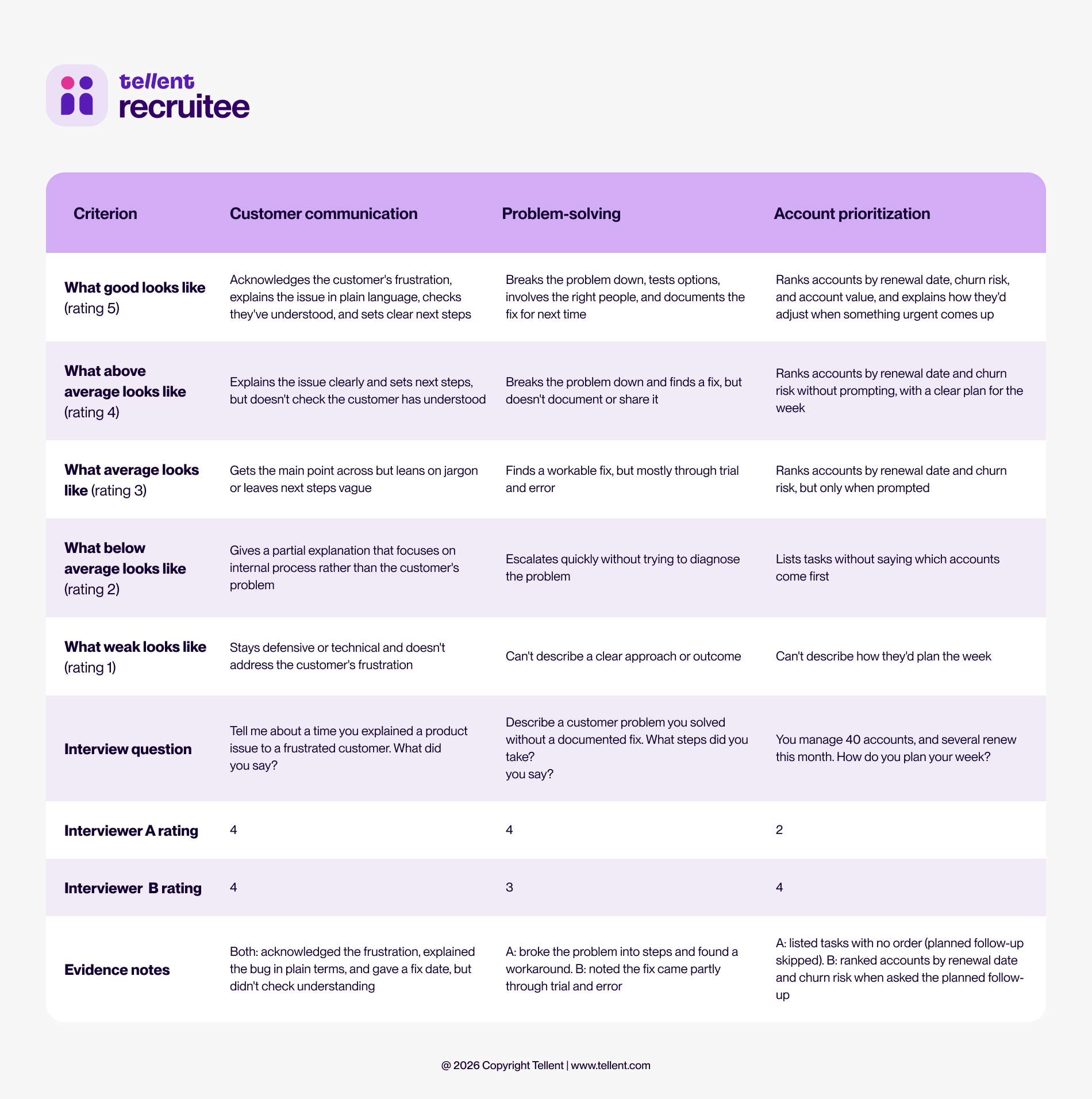
The debrief opens with the 2-versus-4 gap on account prioritization. Interviewer A rated a 2 because the candidate listed tasks without saying which accounts came first. Interviewer B rated a 4 because, in the planned follow-up, the candidate ranked accounts by renewal date and risk of churn.
Interviewer A had skipped that follow-up, so the team reviews Interviewer B’s evidence notes and agrees the answer supports a 3: the candidate did prioritize by renewal date and churn risk, but only when prompted. With solid scores across all three criteria, the team gives the candidate an overall "Yes" recommendation, which means they move forward to the next interview round.
Because account prioritization is the one area still in question for that candidate, the team makes it the focus of that round, so the next interviewer can probe it properly with the planned follow-ups.
Without scorecards, this could easily have gone another way. Interviewer A's doubts might have sunk the candidate, or Interviewer B's enthusiasm might have carried them through, and nobody would have spotted the missed follow-up that explained the difference.
Screening, interview-round, and final-stage scorecard variants
The worked example covers a single interview round, but most hiring processes have several stages, and each one is trying to find out something different. That's why one scorecard rarely fits them all. At Tellent, Marieke adapts the scorecard to what each stage needs to answer:
-
Screening scorecard. At the start of the process, the recruiter call checks the must-haves and practical points, such as notice period and salary expectations, so interviewers don't need to cover them again later.
-
Interview-round scorecard. Once a candidate is through screening, interviewers use this one to rate the competencies the hiring manager prioritized during the intake, like the three criteria in the example above.
-
Final-stage or case-study scorecard. When candidates present a case at the end, the criteria come from the case itself, so the panel judges the work against what the case actually asked for.
The type of role you're hiring for matters, too. If you're recruiting in volume, for roles in retail, logistics, or customer service, a short screening scorecard with clear must-haves helps you work through large applicant pools quickly without lowering the bar.
Specialist roles, such as engineers or finance leads, usually call for more detailed descriptions at each point on the scale, as well as at least one interviewer who can properly judge the technical answers.
To help you get started, here’s a simple interview scorecard template with the best practices listed above. Update and adapt the questions and evaluation criteria as needed for your own structured interviews.
Click on the link below to access the template. Make a copy of the document to edit and use it for your own interview process.
Where an applicant tracking system fits in your scorecard process
If you've ever tried to run scorecards over email, you'll know how quickly it unravels. Forms get buried in inboxes, interviewers fill them in days later or not at all, and someone always ends up working from an old version.
Tellent Recruitee moves that work out of inboxes and onto the candidate profile. With its candidate assessment and evaluation tools, you can build an evaluation template for each role, so there's only ever one version. Each template can carry your own rating scales and custom questions, too, so everyone assesses candidates on the same criteria.
Multiple team members can leave evaluations and comments on the same candidate profile, so when it's time for the debrief, the evidence is already there. And instead of nudging hiring managers for feedback, you can have evaluation tasks assigned to them automatically as soon as a candidate reaches a certain stage in the pipeline.
 Evaluations and scores collected on a candidate profile in Tellent Recruitee
None of this takes the decision out of your hands. The hiring team still makes the call. Tellent Recruitee simply keeps a clear record of the criteria, ratings, and notes behind it, which makes the decision easier to explain to colleagues and much simpler to pull together if a candidate ever asks to see their data.
Putting interview scorecards into practice
Interview scorecards aren't complicated, but they do ask for a little discipline. Agree on the criteria before anyone books an interview, describe what each score looks like, let every interviewer rate on their own, and settle any gaps with evidence rather than opinion.
Do that, and the scorecard won't replace your judgment. It will give the hiring team something solid to base it on.
At Tellent, Marieke’s team now uses structured evaluation templates for around 90% of roles, built up from a simple starting template.