


.webp)

Hiring rarely feels broken at first. It just slowly turns into one long, confusing email thread.
You chase feedback. Calendars clash. Your day-to-day starts revolving around digging through messages to figure out where candidates stand. And before you know it, staying on top of things takes more effort than hiring itself.
That’s where an applicant tracking system (ATS) comes in.
Not to eliminate hiring work, but to move it out of inboxes, spreadsheets, and scattered tools into one system — so manual tasks, slow handoffs, and poor visibility don’t quietly cost you candidates, credibility, or momentum.
With the right ATS in place, teams hire faster, collaborate more easily, and make clearer decisions. Reporting and visibility turn hiring from reactive to intentional, so recruiting isn’t guesswork.
But when is the right time to invest in an ATS? This guide aims to answer that — taking you through 10 signs showing when you need an ATS. We also cover whether the investment is even worth it. Let’s dig in.
10 signs it’s time to invest in an ATS
Hiring processes fray slowly as volume increases, coordination gets harder, and manual work starts creeping into places it shouldn’t.
The signs below are practical signals that manual hiring processes are limiting speed, visibility, and decision quality — even if things still feel “mostly manageable.”
If you recognize several of these patterns, you likely already have your answer to when you need an ATS.
From there, investing in an ATS is less about adding a new expense — it’s about redirecting budget toward problems you’re already paying for in time, delays, and inefficiency.
1. You’re hiring more frequently than before
This is the earliest and clearest trigger: your hiring is ongoing, not occasional.
Manual hiring works when you fill one or two roles a year. But spreadsheets start to break when recruiting becomes continuous. Or when you’re planning to grow headcount in the next 12–18 months, and recruiters work with multiple hiring managers from across multiple departments.
That tipping point often shows up when:
- You’re hiring 25–40 people per year (or more)
- You have over 3 roles open at a given time
- More than two people are involved in hiring decisions
- Each role attracts dozens or hundreds of applicants
- You need to revisit past candidates or provide basic reporting
At this stage, hiring volume itself becomes the constraint. Even well-maintained spreadsheets can’t keep up — compromising visibility, creating handoff issues, and making it harder to run multiple roles in parallel.
2. Roles stay open longer than planned
When roles consistently take longer to fill, it signals friction in the hiring process — not just a tight talent market.
These delays add up quickly. Scheduling stretches out. Feedback loops slow down. And candidates wait longer between steps. Over time, this extends hiring cycles beyond what the business can afford.
In fact, organizations with hiring cycles longer than 40 days experience a 12% increase in candidate drop-off according to our State of Hiring Report 2025 — reinforcing that speed is crucial for retaining top candidates.
This is also where hiring efficiency comes under leadership scrutiny, as open roles create productivity gaps, stretch existing teams, and slow growth in revenue-impacting roles.
3. Your hiring process lives in your inbox
When there’s no shared system, visibility breaks down before anything else.
Hiring activity spreads across emails, messages, documents, and personal notes. There’s no single place to see candidate status, role progress, or next steps.
Updates rely on memory. Forecasting becomes guesswork.
And as more people get involved, coordination becomes fragile — hiring managers work from different information, and you easily miss hand-offs.
The result? Decisions slow down because no one has a complete view of the process.
4. Candidates keep falling through the cracks
If strong candidates are disappearing mid-process and it’s hard to pinpoint where or why, that’s a clear sign your hiring workflow needs more structure.
Without centralized tracking, losing candidates is inevitable.
When there’s no single view of who applied and where they are in the process, it’s easy to miss follow-ups. You lose context to conversations you’ve had, and candidates stall between stages without clear ownership.
The impact shows up directly in candidate experience and hiring outcomes. Delayed updates and inconsistent follow-through can disengage candidates, causing them to lose interest or accept offers elsewhere, especially in competitive markets.
5. Candidates complain about slow communication
At this point, the impact becomes visible externally — confirming your workflows can no longer support the speed and consistency candidates expect.
With manual follow-ups, responding quickly becomes harder. Feedback takes longer to share. And updates slip as hiring volume increases.
From the candidate’s perspective, this feels like uncertainty or ghosting — encouraging them to move forward with teams that communicate faster and more clearly.
Additionally, candidates share their negative experiences with their peers, both privately and on platforms like Glassdoor — impacting how people perceive your organization.
6. You need data to improve your hiring but can’t easily find it
When leadership asks for metrics like time to hire, pipeline health, or diversity, the data technically exists — but it’s scattered.
Pulling it together is time-consuming, adding more manual work to your already full plate as you dig through inboxes and spreadsheets, then sharing insights that are already outdated.
This creates blind spots. You can’t clearly see where candidates drop off, which stages slow hiring down, or where to focus effort. Even basic questions become hard to answer:
- Where do candidates come from?
- Are job boards actually working?
- Which channels are providing us with more candidates?
- Are referrals driving better hires?
Without clear reporting, teams spend time and budget without knowing what’s effective — leading to reactive decisions instead of informed improvements.
7. You’re drowning in manual admin
Your hiring process can no longer scale when admin work outweighs actual recruiting.
Instead of focusing on sourcing and candidate quality, your time goes into keeping things moving:
- Scheduling interviews after multiple back-and-forth emails with multiple stakeholders
- Manually sorting and re-sorting CVs as you screen candidates
- Chasing interview feedback from hiring managers across email and chat
Ultimately, progress starts depending on reminders, follow-ups, and memory — not a shared system.
This kind of workload doesn’t just slow hiring. It pulls attention away from higher-value work, like engaging candidates and partnering with hiring managers.
8. You’re finding it hard to retain talent
Without a centralized process or talent pool, teams hire reactively. You fill roles quickly, never revisit past candidates to re-engage strong fits for future roles, and make decisions with limited context.
Naturally, this increases the risk of mis-hires over time.
Meanwhile, all that manual admin crowds out strategic work. Instead of improving your job role definitions, interview quality, or candidate matching, you spend time coordinating logistics and chasing updates. The result is a cycle of short-term fixes rather than intentional hiring.
The impact? You start seeing roles reopening, the need for frequent backfills, and team frustration just grows. But without any clear data proving your point, it’s difficult to connect mis-hires to process gaps or prove where things are going wrong.
9. Sourcing has become harder than screening.
When sourcing takes more effort than evaluating candidates, it’s a sign your tools and methods aren’t keeping pace with role complexity.
This usually happens when roles become more specialized, but sourcing stays generic:
- Inbound volume stays high, but quality drops. Job boards still deliver applications, but fewer candidates meet the real requirements.
- Manual sourcing hits a ceiling. Searching LinkedIn, messaging candidates one by one, and posting across channels doesn’t scale as roles or competition increase.
And competition compounds the issue. More companies target the same profiles, shrinking the pool of qualified candidates even when application numbers look healthy.
10. Compliance issues start to surface
When staying compliant requires extra manual checks or constant caution, it’s a sign your hiring process lacks built-in accountability.
Compliance pressure often appears as soon as hiring expands across regions, markets, or regulated roles.
What once felt manageable — storing CVs, sharing candidate details, tracking consent — becomes risky when data lives across inboxes, spreadsheets, and shared drives.
Requirements around data retention, access control, and documentation are harder to meet consistently without a structured system.
For teams hiring across locations, the pressure increases further. Different rules, reporting expectations, and audit requirements make ad-hoc workflows fragile.
Even if nothing has gone wrong yet, the lack of oversight creates unnecessary exposure.
When to consider an ATS even if you’re not actively hiring
An ATS isn’t only useful when roles are open. For many teams, it’s most valuable before hiring even starts.
Even without active vacancies, consider an ATS when:
- You want a ready-to-use talent pool: Store and organize past and prospective candidates, so you’re not starting from zero when a role opens.
- You want past hiring data to inform future decisions: Access hiring trends, sourcing performance, and diversity metrics to make more confident decisions when hiring resumes.
- Employer branding matters between hiring cycles: Maintain a consistent careers page and present your company clearly and professionally, even without active roles.
- Hiring becomes urgent without warning: When an employee leaves unexpectedly, having systems in place saves time, cost, and a last-minute scramble.
- You’re responsible for candidate data, even without open roles: Ensure GDPR-compliant data storage, consent management, and secure access — something emails and spreadsheets can’t reliably support.
- You want hiring context to persist internally: Preserve interview notes, feedback, and past hiring decisions so stakeholders can apply learnings to future roles.
The bottom line is: that even if hiring is episodic but predictable, recruiting software helps you stay ready instead of reactive.
So is an ATS worth the investment?
For teams on the fence, the real question isn’t whether an ATS is a nice-to-have — it’s whether it delivers measurable improvements in how hiring actually works.
In practice, the return on investment (ROI) shows up in four very concrete ways:
1. Time savings versus manual admin work
The most immediate benefit is time reclaimed from day-to-day logistics.
An end-to-end applicant tracking software reduces the hours you spend on:
- Managing duplicate CVs and conflicting notes
- Interview scheduling and rescheduling
- Manual reminders and follow-ups
- Initial candidate screening and sorting
- Chasing hiring managers for feedback
This isn’t abstract ROI. It’s the daily relief teams feel when recruiting work shifts from coordination to actual hiring. And the more roles you run in parallel, the faster those time savings compound.
Not to mention, all your reclaimed time can easily go into saving money in the long haul, as HR teams can commit time to analysis and reporting that, in turn, helps you optimize your processes. For instance, by identifying the most efficient way to hire, you save on spending on job boards that don’t get you the best candidates.
2. Faster time-to-hire
Speed is one of the clearest, most measurable returns.
Faster coordination, quicker feedback loops, and clearer ownership mean roles stay open for fewer weeks — reducing productivity gaps and business impact.
In fact, companies that streamline internal hiring approvals with tools like an ATS reduce time- to-hire by as much as 60%.
Take it from Livestorm, which reduced their time-to-hire from 60 days to 25 days by adopting a recruiting platform.

3. Reduced candidate drop-off
Candidate drop-off is another hidden cost many teams underestimate.
41.2% of candidates, nearly half, abandon the application process per our research in the State of Hiring Report 2025 — often due to:
- Redundant data entry
- Overly long or complex application forms
- Upfront assessments that slow momentum
- Lack of clarity around next steps, salary, or work model
Smaller teams are hit especially hard. Companies with fewer than 250 employees experience higher application abandonment (37.7%) than larger organizations, despite having fewer resources to waste on qualified candidates.
Reducing drop-off isn’t just about candidate experience — it directly improves the quality of candidates that make it through for every role you open and lowers time to hire.
Another way to improve your candidate experience and lower time to hire? Using an ATS to build and maintain an up-to-date career page.
For example, by using Tellent Recruitee, Incentro built a fast-loading, optimized career site that auto-updates:
The result? Incentro saw a 140% increase in applicants from their career site.
4. Better decision quality
The return isn’t just speed — it’s fewer hiring mistakes.
With structured feedback, consistent evaluation criteria, and shared visibility with decision-ready data, teams make clearer calls.
Interviews improve. Hiring becomes more intentional.
The result? The risk of mis-hires drops, lowering downstream costs such as re-hiring, onboarding churn, inflated cost per hire, and team disruption.
Over time, better decisions lead to stronger retention and fewer cycles of reopening roles that should never have been closed.
Or should you stick with free hiring tools?
On paper, spreadsheets like Google Sheets or Notion and inbox-based hiring appear cheaper than an ATS. There’s no upfront investment, no setup, no approval process.
But as soon as hiring becomes a reality — multiple roles, real competition, and real timelines — those free tools start introducing hidden costs that don’t show up on a budget line.
Ultimately, costing you more than a recruiting software, with teams end up paying through:
- Lost time and productivity from juggling spreadsheets and switching between tools
- Candidates lost to missed follow-ups or delayed responses
- Repeating the same scheduling and screening work for every role
- Rushed decisions as roles drag on
- Reactive hiring instead of planned recruitment
- Burned-out HR teams that spend more time coordinating than hiring
- Poor candidate impression that quietly damages the employer brand, costing organizations money in the long run
None of these costs is obvious in isolation, but together they add up.
Then there’s also the resources some teams put into hiring agencies or freelance recruiters to make time for productive work. The result? Again, you end up spending more money than what you’d spend on an ATS, which streamlines and automates your processes to give you room for productive work and save you the cost of hiring external help.
That’s why many teams find that an ATS isn’t an added expense — it’s a way to reduce inefficiencies they’re already paying for.
For example, teams using Tellent Recruitee as their ATS automate 80% manual tasks and spend 64% less time on hiring admin.
Take it from the team at CM.com that uses Tellent Recruitee as their ATS to save their time and costs:
Want to determine how valuable investing in an ATS would be for you? Use this ROI calculator (no sign-up required) to understand the return on your investment.
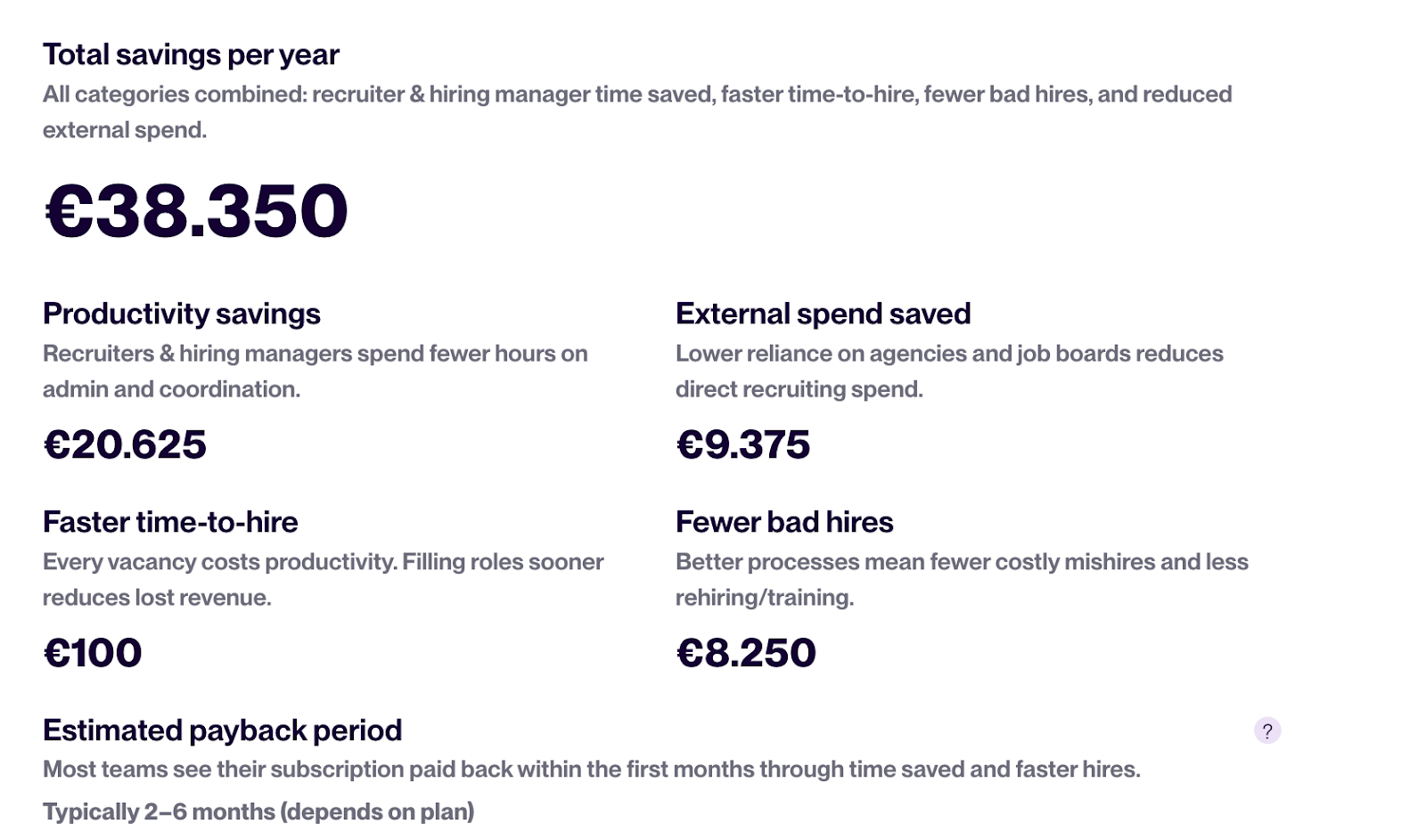
Example of estimated annual savings with Tellent Recruitee for a company with 100 FTE, 25 hires planned in a year and a time to hire of 50 days
Benefits of investing in an ATS
Once an ATS is in place, the biggest gains aren’t just operational — they change how hiring feels and functions day to day.
Here are the core benefits teams see most clearly:
- A single source of truth for hiring
All candidates, conversations, feedback, and decisions live in one place. You no longer rely on memory, inbox searches, or conflicting files to understand where roles stand. - Smoother collaboration with hiring managers
Shared access to candidate profiles, interview feedback, and hiring stages — paired with in-app prompts to review, score, or move candidates forward — keeps everyone aligned. It also reduces back-and-forth, fewer follow-ups, and faster decisions without constant chasing. - A more consistent, professional candidate experience
Automated updates, clear next steps, and consistent communication ensure candidates know where they stand — even when your hiring volume is high, or roles are complex. - More confidence in hiring decisions
Structured scorecards, centralized feedback, and decision-ready data replace gut feel with clarity. This makes decisions easier to explain, defend, and stand behind. - A hiring process that scales without breaking
Job roles, hiring pipelines, communication, and candidate evaluation templates and knock-out questions save time — keeping hiring consistent as roles, teams, and locations grow without you having to rebuild the process each time.
Together, these benefits turn hiring from a constant catch-up mode into a repeatable, scalable system your team can rely on.
So which ATS is best for you?
There’s no single best ATS — the right choice for your organization depends on how you hire today and what you expect to change next.
So before investing in an ATS, use the checklist below to narrow down what actually matters for your team:
- Your hiring volume and role complexity
Are you hiring occasionally or continuously? Are roles high-volume or specialized? Consider how many people are involved, how complex approvals are, and whether applicant volume is manageable. The right ATS should match both your hiring pace and process complexity.
- How collaborative is your hiring process
Do multiple hiring managers or interviewers need visibility and input? If decisions rely on shared context and clear ownership, choose an ATS built for collaboration — with task assignment, structured feedback, and shared visibility.
- The automation you actually need
Where is hiring slowing down today — scheduling, screening, follow-ups, or moving candidates between stages? Look for an ATS that supports the right level of automation, from simple stage-based actions to more advanced rules like automatic disqualification or HRIS syncing.
- Your reporting and visibility needs
What questions do leaders expect you to answer today, and which ones are hard to answer right now? Choose an ATS that gives you real-time visibility into pipeline health, time-to-hire, and sourcing performance, without pulling data into spreadsheets or BI tools.
- Ease of use and time to value
How quickly does your team need to be up and running? Consider an ATS you can adopt without heavy setup, long onboarding cycles, or dedicated admin support.
- Your geographic scope and compliance requirements
Are you hiring in one country or across multiple regions? If you operate internationally, make sure the ATS you select supports local compliance requirements, data protection rules, and region-specific hiring workflows from the start.
- How ready are you to scale
If headcount growth, new teams, or new locations are on the horizon in the next 12–18 months, choose an ATS that won’t force you to rebuild your process as hiring evolves.
Once you’re clear on these criteria, comparing tools becomes much easier.
Wrap up: Ready to make the call?
You don’t need hiring to be fully broken to invest in an ATS. But you also shouldn’t wait until everything is on fire.
The right moment usually sits in between, when:
- Manual work is starting to slow outcomes that matter
- Coordination takes more effort than hiring itself
- Delays, dropped candidates, and missed context become patterns, not one-offs.
At that stage, waiting rarely reduces costs — it quietly compounds them over time. Admin grows. Visibility shrinks. Pressure on HR rises as expectations increase across the business.
The goal of an ATS isn’t to overhaul hiring overnight. It’s to give structure, consistency, and visibility before friction turns into firefighting.
Ready to build the case internally? Use this free ROI calculator (no sign-up required) to put a number on how valuable investing in an ATS would be for your company.