



.webp)

Slow interview feedback is one of the biggest hidden delays in hiring, and its impact compounds quickly.
Companies with hiring cycles longer than 40 days see a 12% increase in candidate drop-off. So speed isn’t just operational — it directly impacts your ability to secure top talent.
In fact, when feedback moves fast, you improve more than just speed. You:
- Shorten time-to-hire
- Improve alignment across your hiring team
- Increase hiring confidence and candidate quality
- And strengthen candidate experience.
But simply pushing your team to “move faster” rarely speeds things up. The real fix? Building a structured, proactive hiring feedback process.
This guide shows you how to do that by centralizing and automating feedback sharing so decisions move faster without sacrificing evaluation quality. We’ll cover:
- Signs your feedback process is slowing down hiring
- How to get your hiring team to give feedback faster
- Common mistakes to avoid that slow down interview feedback
Let’s go.
TL;DR — Key takeaways:
|
Why hiring teams delay interview feedback
Slow interview feedback usually isn’t intentional. Delays happen because the process lacks structure and clarity. Common causes include:
- Feedback feels time-consuming or low priority. Interviewers default to their primary job responsibilities, and without a simple system in place, feedback gets pushed to the end of the day or forgotten.
- Hiring workflows don’t create urgency or accountability. If nothing happens when feedback is late, there’s no clear signal that submitting it quickly is required.
- Interviewers don’t have clear feedback expectations. When turnaround timelines, required detail, or submission guidelines aren’t defined upfront, feedback becomes optional instead of operational.
- Feedback processes are inconsistent across roles or teams. Different roles using different evaluation methods create confusion, slow comparisons, and increase decision time.
- Interviewers rely on memory instead of structured evaluation criteria. When feedback isn’t captured immediately using defined criteria, interviewers delay writing it or provide vague input that requires follow-up.
Signs interview feedback is slowing your hiring
Slow interview feedback is one of the most common hidden causes of long time-to-hire in SMBs.
Because hiring committees are lean, even small delays can slow decision-making, reduce candidate engagement, and create inconsistent hiring outcomes.
If you’re unsure whether feedback delays are affecting your hiring, ask yourself:
- Do interviewers consistently submit feedback within 24–48 hours?
- Can you easily see which interview feedback is still pending?
- Do interviewers clearly know which skills they’re responsible for evaluating?
- Is feedback required before candidates move to the next hiring stage?
- Do all interviewers use structured evaluation criteria?
- Do candidates wait several days between updates on the next stage?
- Do hiring decisions frequently require additional meetings or clarification before moving forward?
If you’re finding it hard to confidently answer these questions, hiring feedback across your team relies on individual habits rather than a structured process, which often leads to slower hiring cycles, inconsistent decisions, and candidate drop-off.
So, what is a good interview feedback turnaround time?
Hiring feedback should be submitted within 24 to 72 hours, depending on the interview stage and role seniority. Clear, stage-based timelines help teams move candidates forward without sacrificing thoughtful evaluation.
For most small and medium-sized teams, a good turnaround time looks like this:
- Screening interviews: Submit feedback the same day or within 24 hours.
- Panel or final interviews: Submit feedback within 24 to 48 hours.
- Senior or complex roles: Allow up to 48 to 72 hours, but avoid stretching beyond that unless necessary.
How to get your hiring team to give feedback faster
If you want faster hiring team feedback, you need to build speed and structure into your process — not rely on reminders alone. When feedback is clear, visible, and automated, hiring decisions move faster and delays stop compounding.
Here’s how to create a structured hiring team feedback process that reduces time-to-hire:
- Set clear expectations before interviews begin
- Standardize feedback sharing to reduce interviewer effort
- Build accountability into the hiring workflow
- Use structured debriefs only when needed
- Host mini workshops to train your team on giving effective interview feedback
1. Set clear expectations before interviews begin
Without clear timelines and submission standards, you end up chasing responses manually, and hiring delays follow.
The fastest way to improve feedback speed is to remove ambiguity before interviews are even scheduled:
Define clear turnaround timelines
Align with hiring managers to define stage-based feedback deadlines. Reinforce those expectations during every hiring kickoff and document them in interviewer briefings or prep materials.
When you define deadlines upfront, feedback becomes part of the workflow rather than an optional task.
Assign evaluation ownership in advance
Interviewers should know exactly what they are responsible for evaluating before they meet a candidate. Clear ownership reduces hesitation and speeds up feedback submission.
Make sure each interviewer:
- Knows which competencies or skills they are assessing
- Understands their role in the final decision (recommending, advising, or deciding)
- Avoids duplicating evaluation areas covered by others
Define what “complete feedback” means
Unclear standards lead to partial or vague input, which slows hiring decisions. Before interviews begin, define:
- Required rating or evaluation criteria
- Minimum level of written detail expected
- Whether feedback must be submitted before a debrief discussion
- Whether candidates can move forward without completed evaluations
2. Standardize feedback sharing to reduce interviewer effort
The more tools, inbox threads, and side conversations involved in your feedback sharing process, the less likely interviewers are to submit timely feedback.
The solution? Standardize feedback sharing. That is: use one accessible system to give, collect, and review all interview evaluations. Here’s how:
Centralize interviews and feedback sharing in one place
Use an Applicant Tracking System (ATS) to manage both interview scheduling and feedback sharing in the same system.
In Tellent Recruitee, for example, you can sync all team members’ calendars and schedule interviews from one place.
This creates a centralized view of upcoming interviews, reduces double-bookings, and provides a clear overview of who is interviewing whom and when.
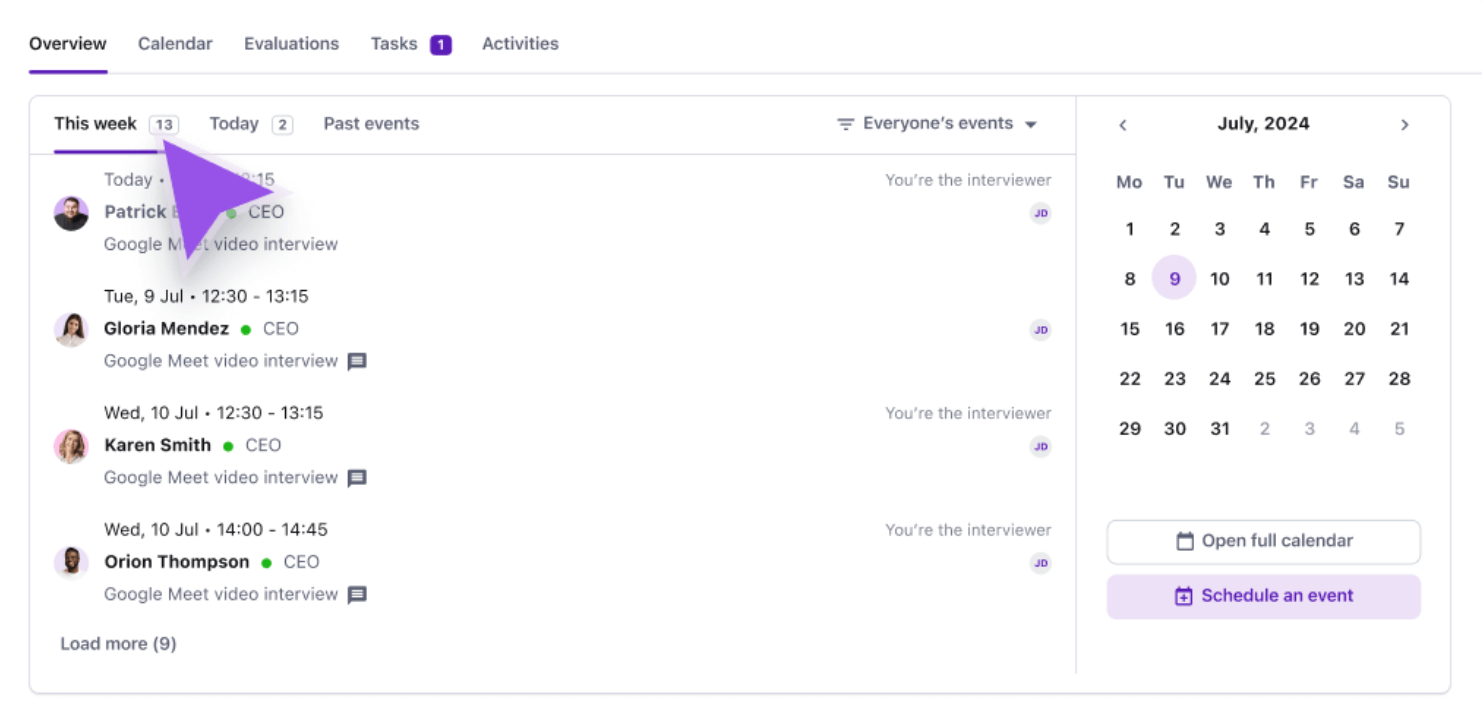
Schedule interviews with candidates directly from your ATS
Interviewers can also leave notes directly on the candidate profile in the same system where they complete evaluations (more on this below).
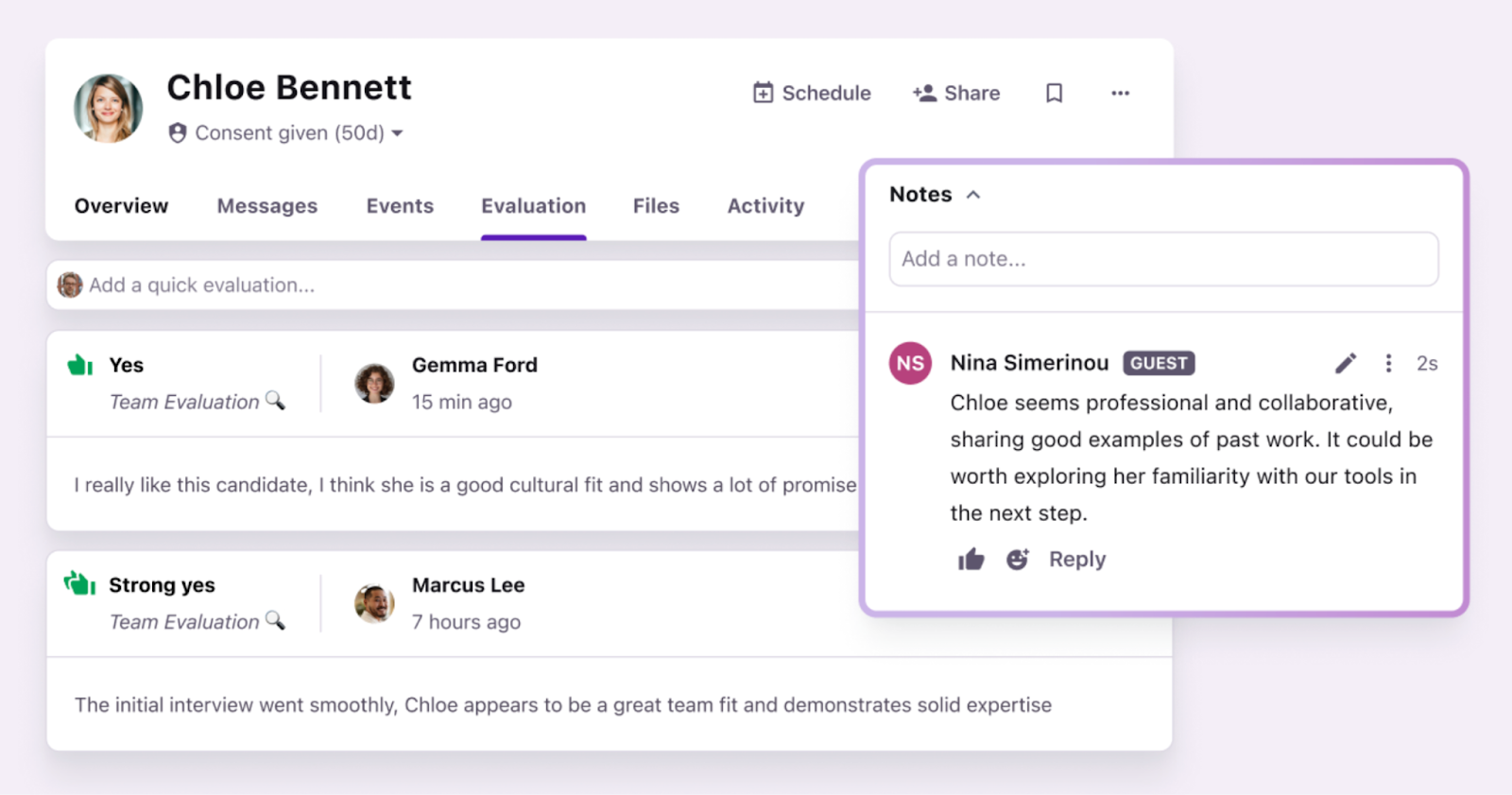
Add notes on each candidate you interview in one system
This reduces coordination friction, making it easier for the hiring team to submit evaluations immediately after interviews — rather than delaying feedback because it lives elsewhere.
It also allows your team to see what was discussed in previous rounds directly on the candidate profile, so they can avoid repeating questions and go deeper into essential competencies or decision criteria.
Structure how feedback is submitted
Structuring your feedback is what actually speeds up decisions by making evaluations quicker and easier to complete.
Start by building custom evaluation forms and scorecards for each role, so interviewers assess candidates using the same criteria, lowering the friction of submitting structured feedback and reducing bias.
Kamila Kashayeva, the Talent Acquisition partner at Tellent Recruitee prefers evaluation forms because they “let you ask every candidate the exact same questions, which makes evaluation consistent and fair.”
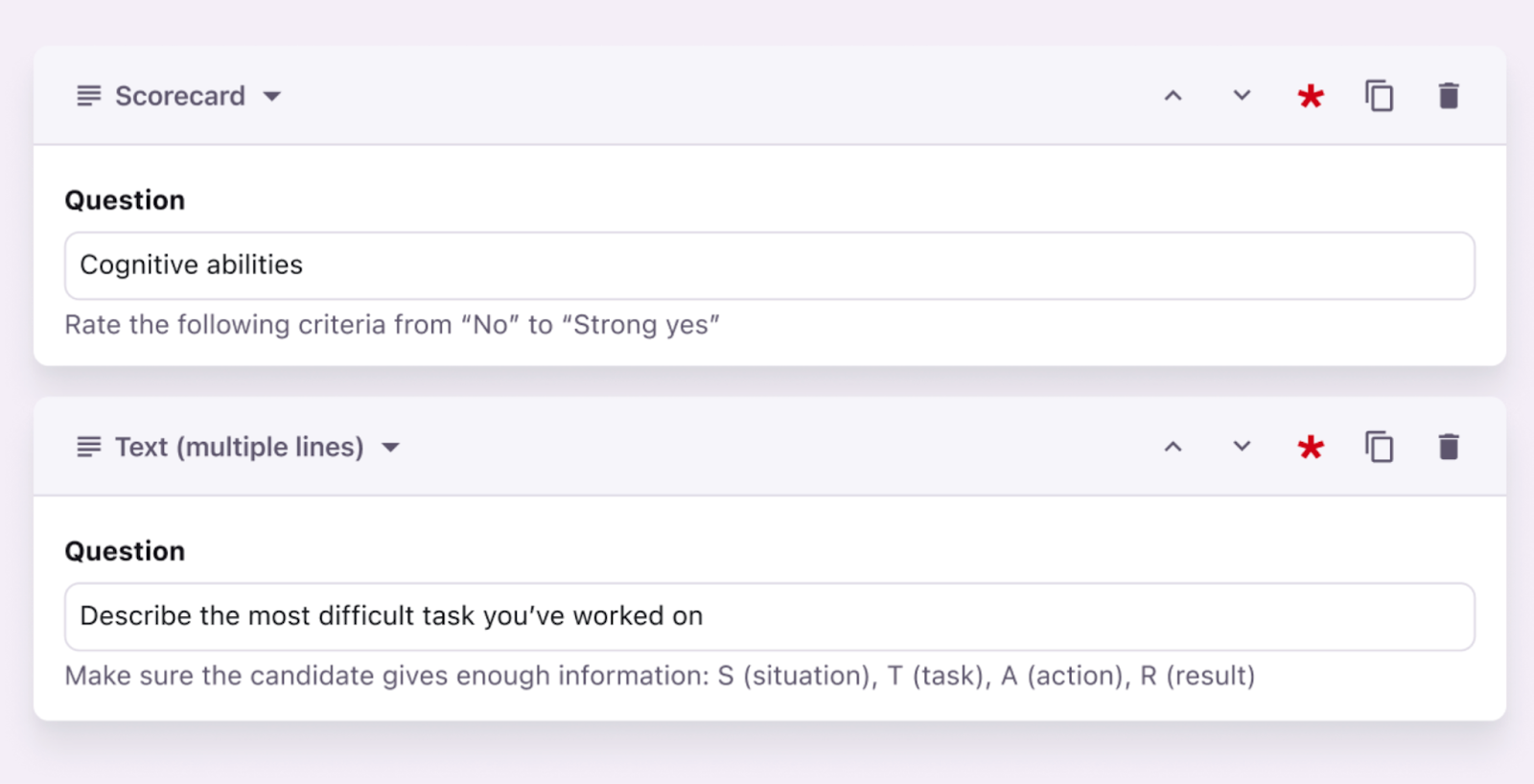
Custom candidate evaluation forms and scorecards for gathering hiring feedback
Each evaluation form ends with a final rating (for example, Strong yes, Yes, No, or Strong no), giving interviewers a clear way to summarize their recommendation.
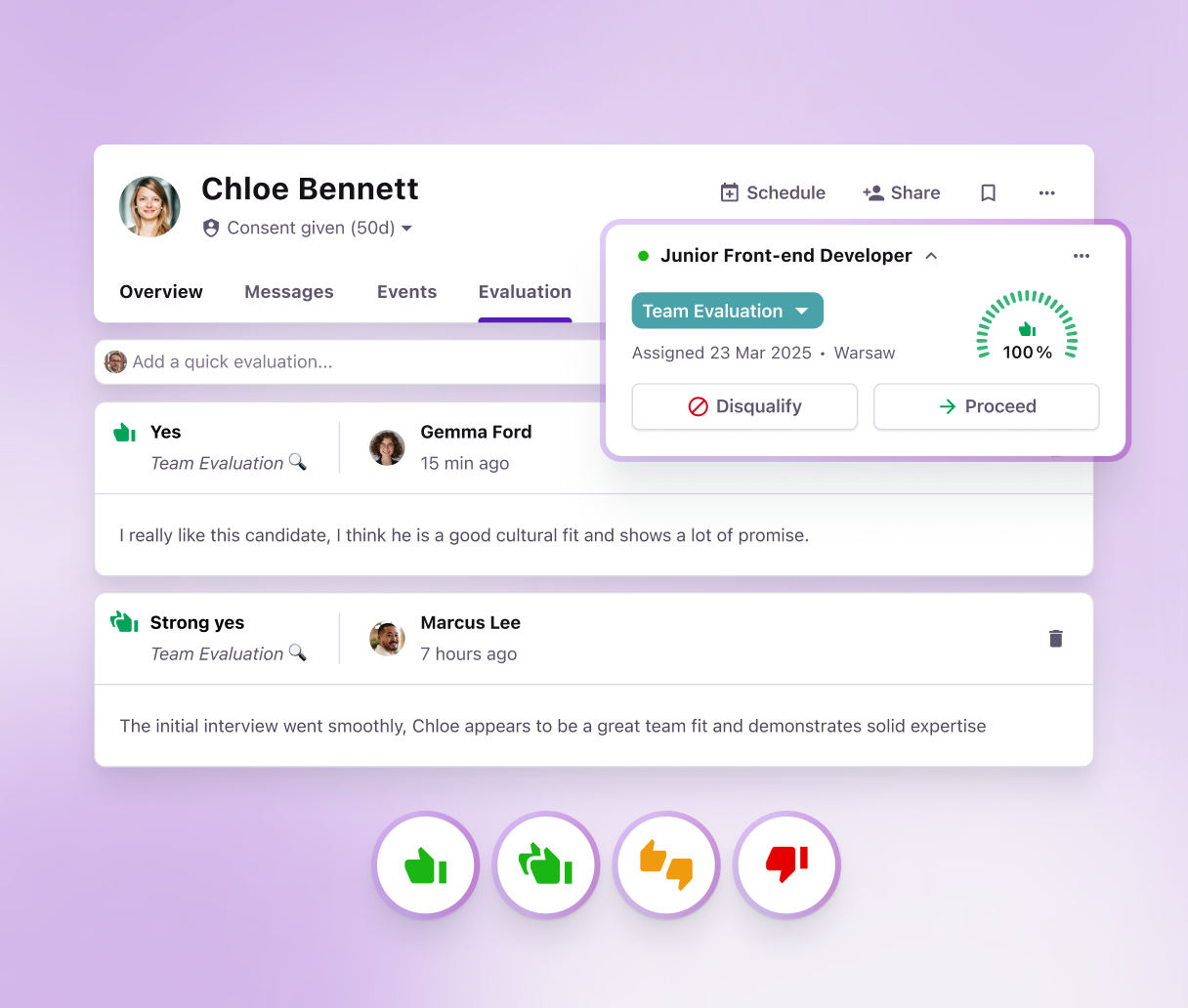
Evaluating candidates inside Tellent Recruitee: Add interview notes, quick evaluations, and give candidates an evaluation score
Tellent Recruitee then automatically converts all submitted ratings into an overall evaluation score, giving your hiring team a quick snapshot of how interviewers rated the candidate — without you having to manually compare feedback.
.png?width=768&height=556&name=EN%20Content_%20-%20article%20image%20-%203%20(1).png)
Tellent Recruitee gives you all candidates an evaluation score based on hiring team’s feedback
You can also simplify feedback sharing for busy or overbooked hiring managers with quick evaluations.
In Tellent Recruitee, for instance, interviewers can leave a simple thumbs up or thumbs down for each candidate, along with a short comment explaining their reasoning. This further lowers the barrier to submitting feedback, reducing hiring delays.
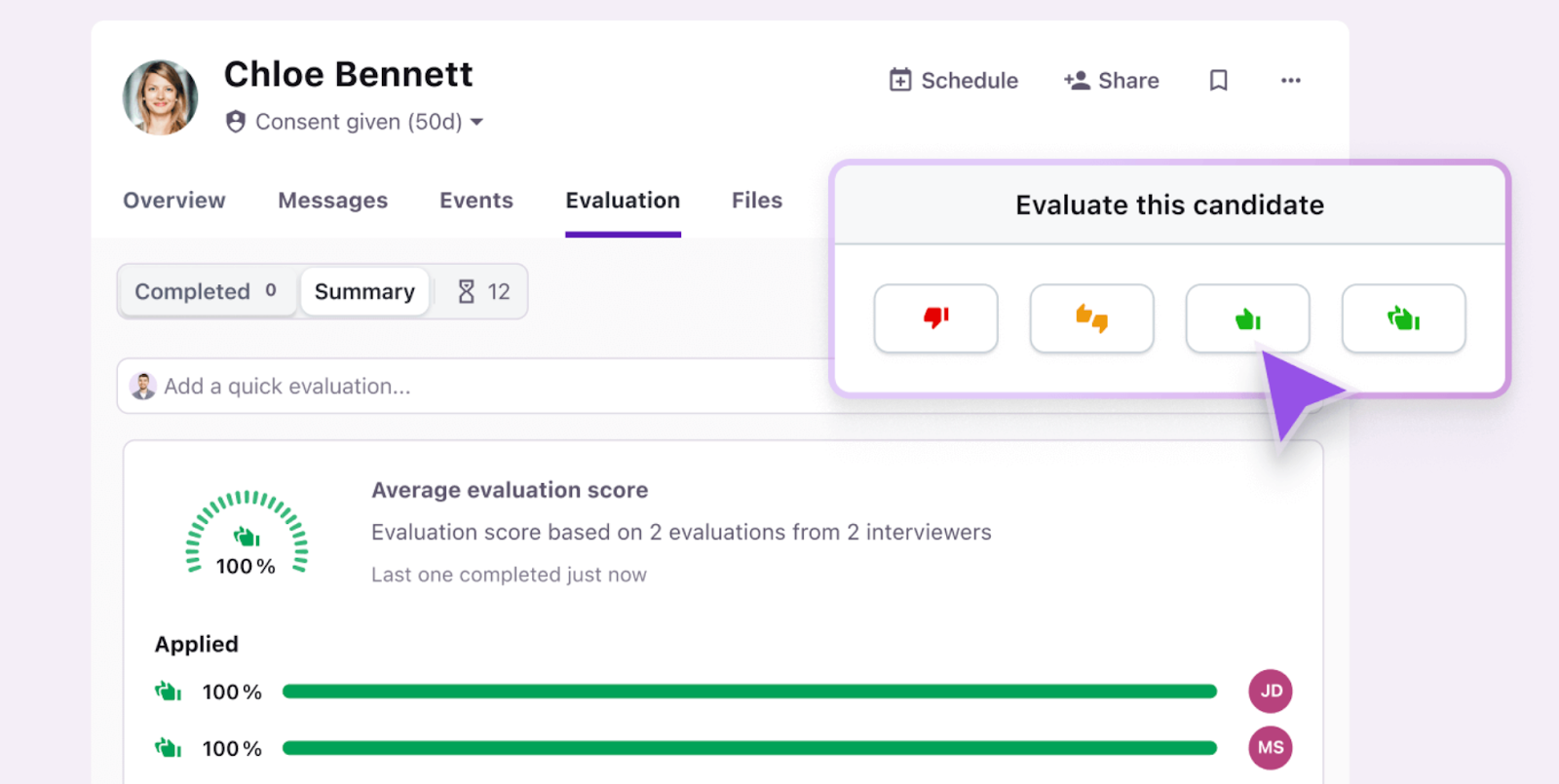
Quickly evaluate candidates with a thumbs up or down sign in Tellent Recruitee
3. Build accountability into your hiring workflow
When accountability depends on manual chasing, delays compound.
But when feedback completion is built into the hiring process itself, decisions move faster — improving communication timelines with candidates and, in turn, their overall experience with your company.
If you want hiring managers to prioritize feedback, you need to make feedback completion visible, owned, and required. Here’s what to do:
Define who owns fast feedback
In lean, fast-moving teams, fast feedback depends on clear ownership. Clarify who owns what part of the process, here’s an example:
- Recruiter: Coordinates interviews, gathers feedback, ensures process consistency, and drives timelines.
- Hiring manager: Defines role requirements, evaluates job fit, owns accountability for timely feedback, and makes the final hiring recommendation.
- 2–4 functional interviewers: Team members or cross-functional stakeholders who assess technical ability, collaboration, or culture fit, responsible for timely and complete evaluations.
- HR leadership or founders (for senior roles): Provide oversight or final input for strategic or high-impact hires.
Create visibility into feedback status
Interviewers are more likely to submit feedback when its status is visible, and hiring managers can quickly spot delays.
An ATS facilitates this by allowing you to tag team members on candidate profiles, asking for their feedback. Kamila also tags hiring managers to share her evaluation form and notes — offering more information from her side to guide them.
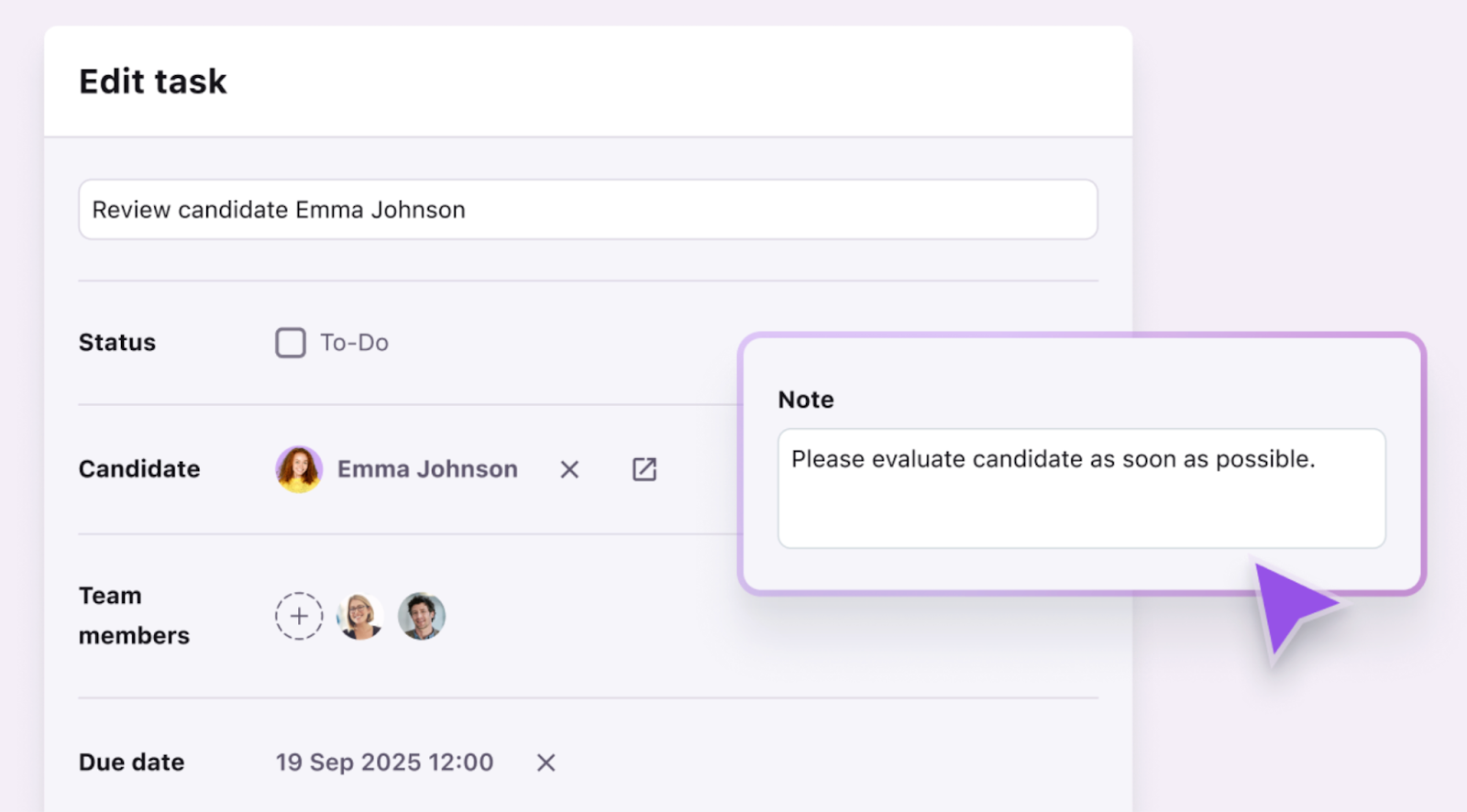
Mention your team members on candidate profiles to ask for their feedback
You can also automate interview feedback reminders — eliminating the need for manual chasing.
This works by automating actions in your hiring pipeline that trigger reminders automatically.
For example, when a candidate moves to a new stage, the system sends relevant interviewers an evaluation request. You can also set feedback deadlines here — say, feedback due in two days.
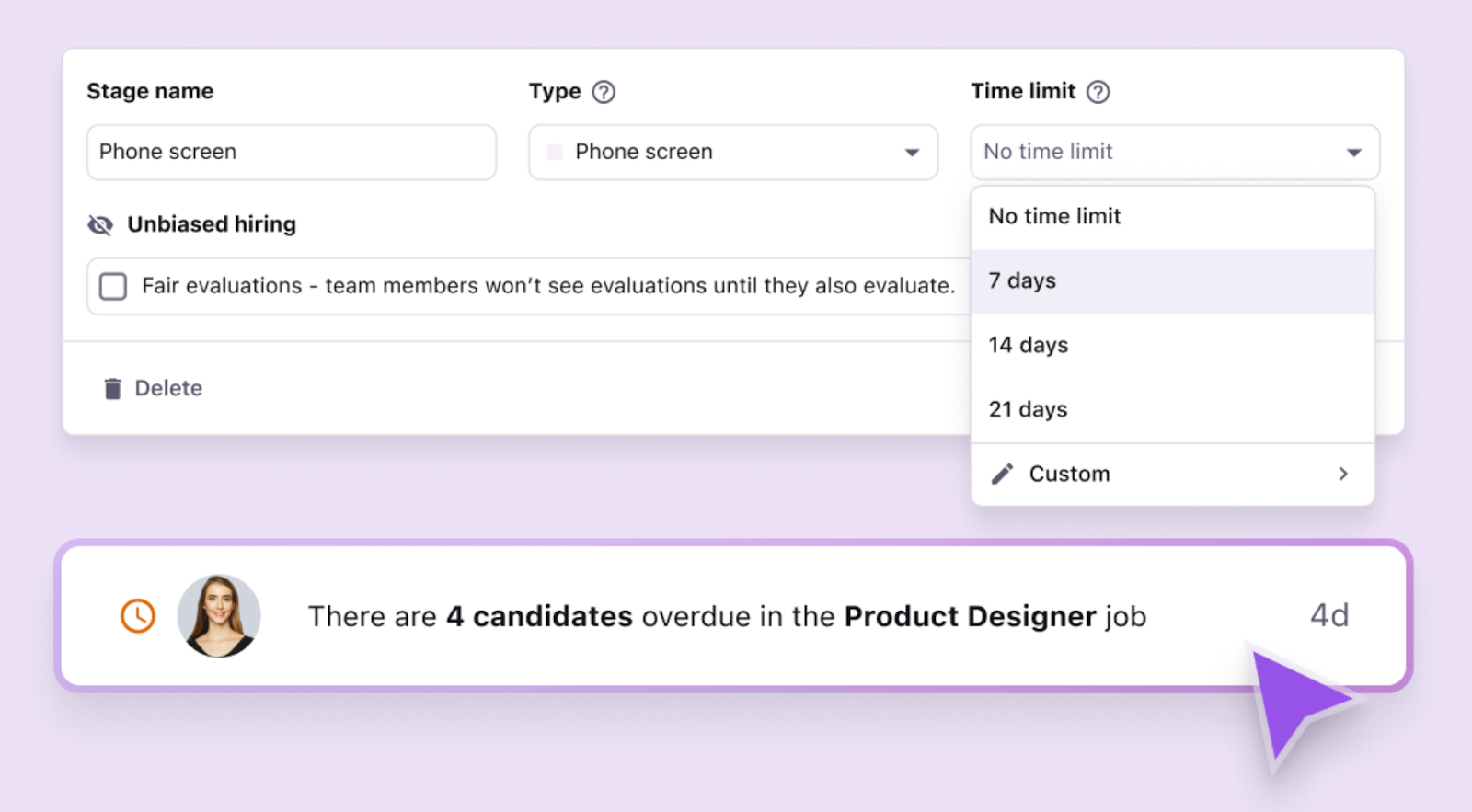
Set automated evaluation requests with deadlines in Tellent Recruitee
The interviewing team can also simply go to their dashboard to see what evaluations are pending.
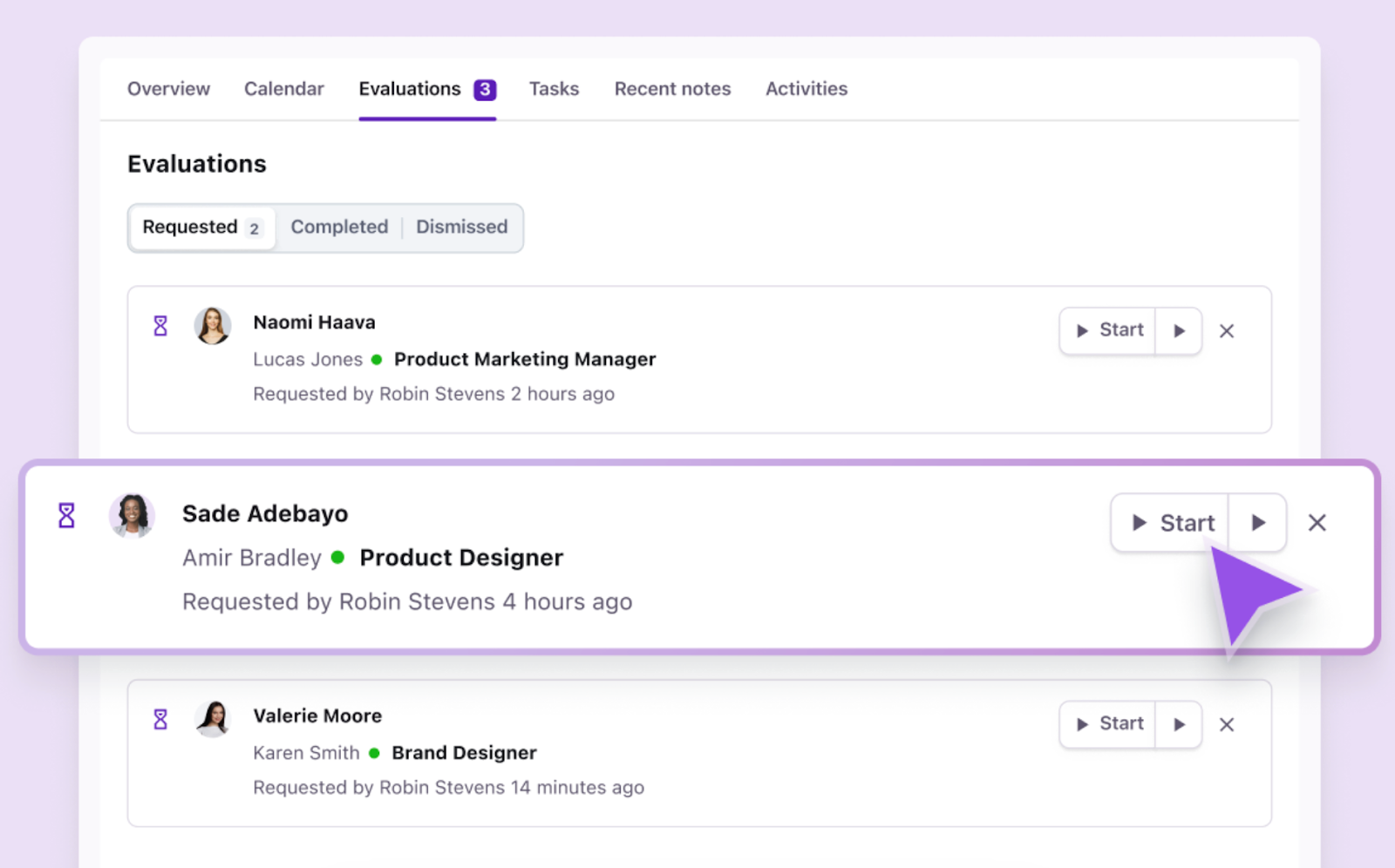 Hiring team members can see evaluations due and completed in their Tellent Recruitee dashboard
Tie feedback sharing to workflow progression
On top of automating reminders, you can also make interview feedback a condition for moving forward.
Here are some workflow examples:
- Schedule next-stage interviews only after prior feedback is submitted
- Require completed evaluations before holding debrief meetings
- Pause stage progression until all interviewers submit feedback
Tying feedback to stage progression helps ensure feedback stops being treated as an afterthought and hiring timelines become predictable.
4. Use structured debriefs only when needed
Running debrief meetings after every interview stage slows hiring and creates unnecessary scheduling delays. Instead, hiring teams should collaborate primarily through structured evaluation forms (see above) and use debrief meetings only when:
- Interviewer feedback conflicts
- The hiring decision is unclear
- You’re hiring for senior or strategic roles
And when you do run debriefs, keep them structured:
- Require all evaluations to be submitted in advance
- Focus only on areas of disagreement or concern
- Assign a clear decision owner before the meeting begins
5. Host mini workshops to train your team on giving effective interview feedback
Short, focused workshops help you align your team on what “complete” and decision-ready feedback actually looks like.
Take the time to train interviewers and hiring managers on:
- What complete feedback includes: explain what makes a clear rating and defensible recommendation, using specific examples.
- How to explain their reasoning: educate on adding concise evaluation notes that explain why they reached their conclusion based on defined competencies or criteria.
- How to use your ATS correctly: educate on where to add interview notes on candidate profiles, how to complete evaluation forms, and how to collaborate with the rest of the hiring team.
These sessions don’t have to be dedicated workshops. In meetings, Kamila has with hiring managers to discuss candidate evaluation criteria, she demonstrates how to use Tellent Recruitee.

Not to mention, these workshops don’t need to be long. A short, 30-minute walkthrough using real candidate examples is often enough to improve clarity, reduce vague comments, and speed up decision-making.
How to measure whether your hiring feedback process is improving
The easiest way to measure hiring feedback efficiency is to track what happens after interviews — how fast feedback is submitted, how quickly candidates move forward, and how much coordination it takes to reach a decision.
Track and review these metrics regularly to optimize your hiring team feedback process:
|
Interview feedback metric |
What it measure |
Why it matter |
Interview feedback turnaround time |
Time between interview completion and feedback submission |
It’s a direct indicator of how quickly interviewers respond |
Time between hiring stages |
Days candidates wait before moving forward |
|
Candidate drop-off rate |
Percentage of candidates who disengage mid-process |
It reveals whether slow decisions are costing you talent |
Interview-to-offer conversion rate |
Percentage of interviews that result in offers |
It indicates clarity and alignment in evaluation |
Recruitment coordination time |
Time spent chasing or reminding interviewers to share feedback |
It signals whether your workflow is structured or reactive |
You use your ATS to track most of these metrics. Other metrics, such as recruiter coordination time, may require simple internal tracking, but together, they give you a clear picture of whether your feedback process is becoming more efficient.
When you structure interview feedback sharing, these metrics typically improve together — signaling a faster, more scalable hiring process.
Common mistakes that slow interview feedback (and extend time-to-hire)
Even with clear timelines and structured workflows in place, certain habits can quietly slow your hiring process. Avoid these common mistakes to keep your interview feedback sharing structured, predictable, and easier to scale:
- Letting feedback sit until a team debrief
Feedback should ideally be recorded immediately after interviews while details are still fresh. Waiting for meetings to discuss feedback often delays decisions and increases the risk of forgotten details.
- Allowing unstructured or inconsistent feedback
If interviewers use different criteria or provide vague comments, comparing candidates becomes time-consuming and subjective. Consistent structure keeps decisions fast and defensible.
- Overloading interview panels
More interviewers don’t always improve hiring quality. Larger panels increase coordination time, which often extends turnaround time unnecessarily
- Relying on meetings instead of written evaluations
If decisions depend on live discussions rather than submitted feedback, hiring slows whenever calendars don’t align.
- Setting expectations too late
If you don’t define feedback timelines and evaluation standards before interviews begin, delays are almost inevitable.
Turn slow feedback in recruitment into faster hiring decisions
Faster interview feedback isn’t about pushing your team harder — it’s about designing a hiring process where feedback is expected, structured, and built into the workflow.
Set clear expectations from the get-go, keep feedback in one system, and automate reminders so feedback doesn’t rely on manual chasing. Do that, and time-to-hire shortens, without sacrificing hiring quality.