


.webp)
Manufacturing is facing a hiring crisis that isn't going away anytime soon. An estimated 2.4 million manufacturing positions could remain unfilled through 2028, and 66% of manufacturers report that time-to-hire keeps creeping up year over year. Finding skilled trades workers — welders, CNC operators, electricians — is harder than ever.
And if you've ever tried to fill 15 machine operator roles across two shifts while simultaneously sourcing a CNC programmer and onboarding a new plant manager, you’ve already faced the problem. Manufacturing HR teams hire at volume, under pressure, and across skill levels that span from entry-level assemblers to highly specialized engineers.
Choosing the right applicant tracking system (ATS) for manufacturing is about finding the one that solves the problems unique to your industry: deskless workers who apply from their phones during breaks, shift-based scheduling complexity, high-volume surge hiring when production ramps up, multi-location coordination, and compliance tracking for certifications and safety training.
This guide evaluates 12 ATS solutions specifically for manufacturing needs. Each one excels in different areas. The goal is to help you find the best fit based on your company size, specific challenges, and how complex your operations are.
Manufacturing companies need an ATS that solves their specific challenges
Manufacturing hiring is fundamentally different from office-based recruitment, and those differences break most generic ATS platforms.
Factory workers don’t sit at their desks browsing LinkedIn. They apply during lunch breaks on their phones. If your application process takes more than a few minutes, they'll abandon it. Tellent’s State of Hiring report shows that over 40% of applications get abandoned before submission when the process is too cumbersome.
Beyond the application itself, manufacturing hiring involves layers that corporate recruiting rarely touches: verifying EU-OSHA certifications and safety training, matching candidates to shift preferences, coordinating approvals across plant managers, production supervisors, and safety officers, and scaling from steady-state hiring to needing 50–500 workers quickly when production surges.
A generic ATS built for corporate recruiting creates friction at every one of these stages, resulting in application abandonment, compliance gaps, and the loss of your best candidates to competitors who move faster. Every week, a critical position that stays unfilled costs you in overtime, production delays, and employee burnout.
How we evaluated these ATS solutions
We assessed each platform against six criteria that matter in manufacturing hiring:
- Manufacturing-specific features: Mobile-first applications, multi-location hiring, compliance tracking, and certification management.
- Ease of use and implementation: Plant managers and hiring supervisors need intuitive interfaces that require minimal training.
- Integrations: Compatibility with manufacturing HRIS/ERP systems, background check providers, and skills assessment platforms.
- Pricing: Cost-effectiveness across different company sizes, from 50-employee job shops to 5,000-employee multi-plant operations.
- Support: Implementation assistance, training resources, and ongoing support quality.
- Scalability: Ability to handle both steady-state hiring and sudden surge demand periods.
Rankings reflect overall strength across these criteria. The #1 choice offers the most balanced capability for typical manufacturing scenarios. That said, "best" depends on your specific situation (company size, budget, operational complexity), and the "Best For" label on each entry helps you self-select.
We'll compare each platform honestly — including our own — so you can make the right call based on your actual hiring needs.
Let's get into it.
Top 12 applicant tracking systems for manufacturing
Each entry below follows the same structure: overview, key manufacturing features, pros, cons, pricing, and who it's best for. If you're scanning, jump to the comparison table further down for a quick side-by-side view.
1. Tellent Recruitee
Here's what we'll cover in this section:
- A brief overview of how Tellent Recruitee works
- Where other ATS platforms fall short for manufacturing
- Tellent Recruitee's 3 key differentiating features for manufacturing teams
- Other top features, pros, and cons
- Pricing
- Top use cases and who it's best suited for
- A note on table stakes features
- Best for
A brief overview of how Tellent Recruitee works
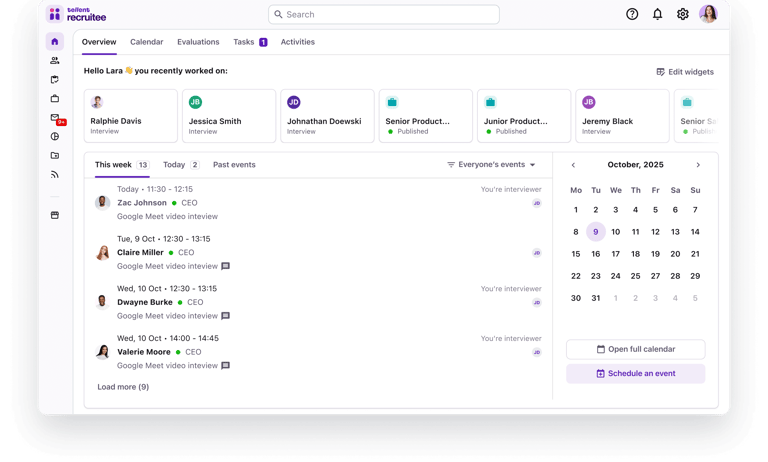
Tellent Recruitee is a collaborative ATS built for teams that need both flexibility and structure. From a single platform, hiring teams can post jobs across 2900+ job boards, manage multi-stage candidate pipelines, automate repetitive tasks, evaluate candidates with structured scorecards, and track hiring performance with real-time analytics.
The platform is part of the Tellent suite — which also includes Tellent HR for core HRIS and performance management — meaning it's designed to connect recruiting with the broader employee lifecycle, not sit in isolation.
Request a personalized demo of Tellent Recruitee →
Manufacturing teams specifically benefit from Tellent Recruitee's ability to run different hiring workflows simultaneously. You can have a fast, automated pipeline for high-volume production roles running in parallel with a structured, multi-stage process for technical or management positions — all in the same account, without switching tools.
Where other ATS products fall short for manufacturing
The deeper problem is that most ATS platforms were designed with a single hiring archetype in mind. Usually, a tech company filling knowledge-worker roles. Manufacturing doesn't work that way. You're hiring across multiple job families, often at multiple sites, with different urgency levels and different evaluation criteria for each.
Most platforms also assume candidates will apply via desktop, fill out detailed forms, and check their email regularly. A significant portion of manufacturing applicants are applying from their phones, may not have polished CVs, and expect a fast response. If your ATS creates friction in the application process, you lose candidates to competitors who respond faster.
And then there's the collaboration problem. In manufacturing, the hiring decision rarely sits with HR alone. Plant managers, shift supervisors, and department heads all need to weigh in. But most ATS tools either lock non-HR users out entirely or give them so much access that the process becomes chaotic.
Tellent Recruitee's 3 key differentiating features for manufacturing teams
Key differentiator #1: Pipeline automation that adapts to different role types
Manufacturing HR teams don't have one hiring process; they have several running at once. Tellent Recruitee's pipeline automation is built around this reality.
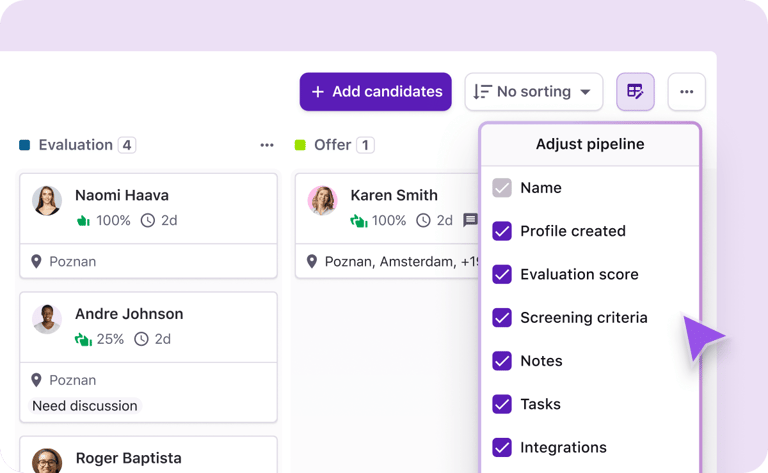
Here's how it works in practice:
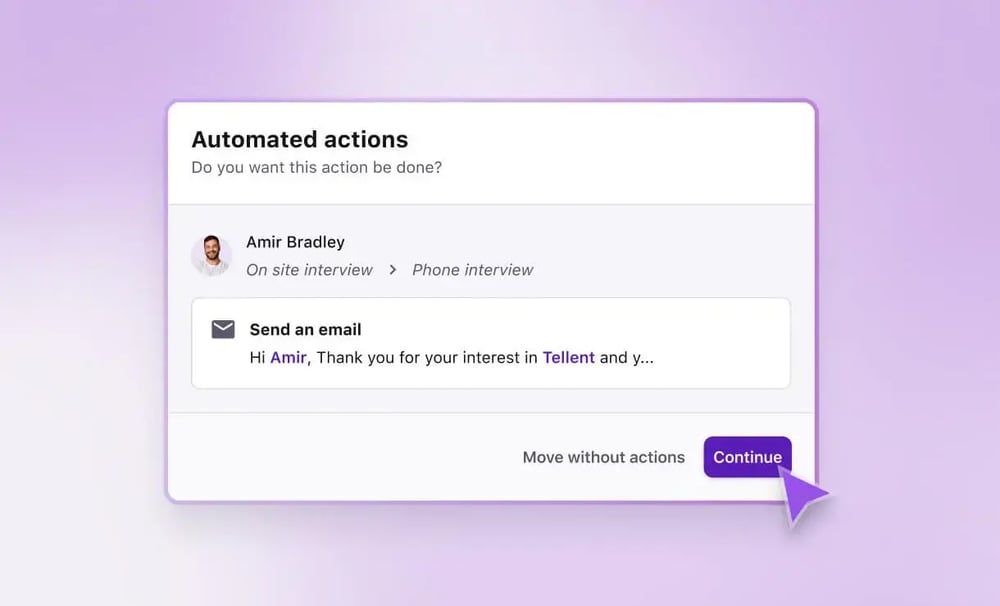
Automated triggers by pipeline stage. You can set up automation triggers that fire when a candidate moves between stages: sending a confirmation email when someone applies, sending booking links which candidates can use to book interviews on their own, when they're moved to shortlist, or sending a personalized rejection email when they're disqualified. For high-volume roles like machine operators or warehouse staff, this means your team isn't manually sending hundreds of status updates.
Custom pipeline stages per job. Each job posting can have its own pipeline configuration. A production worker role might have four stages: Application → Phone Screen → Offer → Hired. A quality engineer role might have seven: Application → CV Review → Technical Assessment → First Interview → Second Interview → Offer → Hired. You're not forced into a one-size-fits-all process.
Knock-out questions and pre-screening. You can add a custom set of questions that candidates have to answer, and mark them as knock-out criteria. For manufacturing roles where specific certifications, shift availability, or physical requirements are non-negotiable, this filters out unqualified applicants before they enter your pipeline, saving your team hours of manual screening.
Bulk candidate management. When you're hiring at volume, you need to be able to act on multiple candidates at once. Tellent Recruitee supports bulk actions, allowing you to move, tag, email, or disqualify groups of candidates simultaneously. You can also import candidates via CSV or CV file upload, which is useful when working with staffing agencies or processing applications from job fairs.

The result is a platform where your frontline hiring moves at the speed the market demands, while your technical and management roles get the structured process they require, without needing separate tools for each.
Mobile application and communication via WhatsApp. With WhatsApp Hiring, candidates apply via a chat interface they already use. They don’t have to download apps or fill in forms. Applications flow directly into the pipeline, and hiring teams can handle the entire communication thread from within Tellent Recruitee.
Key differentiator #2: Multi-page, multi-location hiring with centralized visibility
Manufacturing companies don't hire from a single location. You might have a main plant, a distribution center, and a regional office, each with different hiring managers, different role types, and different urgency levels. Coordinating that across email threads and spreadsheets is where things break down.
Most ATS platforms either give you a single flat account where everything gets mixed together, or they charge you for separate accounts per location and give you no consolidated view.
Tellent Recruitee's multi-location support lets you manage multiple sites and departments within a single account. Each location can have its own job listings, hiring team members, and pipeline configurations, while HR leadership gets a consolidated view across all of them.
Career site with multi-plant brand consistency. Tellent Recruitee's no-code, multi-page, multi-language CareersHub lets central HR control brand messaging while allowing individual plants to showcase their specific culture, benefits, and opportunities. You can publish roles by location, department, or job type, and candidates can filter to find what's relevant to them.
One-click job board distribution. Publishing a new role to 30+ job boards in one click means your production supervisor opening in Düsseldorf and your maintenance technician role in Lyon both go live simultaneously, without your team manually logging into each board.
Proactive candidate rediscovery with Talent Pools and Matching Assistant. Instead of waiting for applications to trickle in, your talent team can build warm pipelines of CNC programmers, welders, and quality engineers using Talent Pools. The Matching Assistant helps hiring teams rediscover relevant candidates from past applicants, talent pool members, and people who applied for different roles. It helps reduce manual search effort while keeping hiring decisions transparent and human-controlled.
Does this approach actually work for multi-site manufacturing teams?
Try Tellent Recruitee for free →
Key differentiator #3: Collaborative hiring that includes plant managers and shift supervisors
In manufacturing, it’s often the ones furthest from the ATS who know whether a candidate will work out. A plant manager who needs to approve a new hire shouldn't have to chase HR for updates via email. A shift supervisor who interviewed a candidate shouldn't have to fill out a paper form to submit their feedback.
Most ATS platforms:
- Give hiring managers full ATS access, which means training non-HR users on a complex system and risking data hygiene issues
- Give them no access at all, making HR the bottleneck for every decision
Tellent Recruitee takes a different approach. Team members can be assigned to specific jobs with role-based access. They see what they need to see, can submit structured evaluations, and can communicate with candidates and recruiters through the platform's built-in mailbox, without having full admin access to everything.
Structured evaluation forms. On the Advance & Optimize plans, you can buildstructured evaluation scorecards for each role. When a shift supervisor interviews a CNC operator candidate, they fill out a standardized form rather than sending a vague email. This gives HR a consistent, comparable record of every candidate evaluation, making the final hiring decision defensible.
Centralized candidate mailbox. All candidate communication runs through Tellent Recruitee's built-in mailbox, organized by candidate and job. No more digging through personal email inboxes to find out what was said to a candidate three weeks ago. Every message, from every team member, is in one place. You can sync your Tellent Recruitee inbox with Outlook and Gmail, to keep everything in one place.
AI-assisted communication. Tellent Recruitee's AI writing tools help hiring teams draft personalized candidate emails, translate job postings for multilingual workforces, and generate evaluation summaries. For manufacturing companies hiring across multiple countries or language regions, the translation feature alone saves meaningful time.
A mobile app hiring managers will actually use. Supervisors and production managers are on the floor. The Tellent Recruitee mobile app lets them review candidates, leave evaluation feedback, and advance people through pipeline stages (if they have the right permissions) from wherever they are and between shifts. All the collaboration described above works on mobile.
When your plant manager can see candidate status, submit feedback, and approve an offer without HR having to chase them down, your time-to-hire drops. In manufacturing, where a 2-week delay in filling a critical production role can directly affect output, that matters.
Key differentiator #4: AI that helps your team focus and get more work done
Most ATS platforms bolt on AI as a marketing claim. Tellent Recruitee applies it as a helping layer that improves relevance, timing, and prioritization while keeping every decision firmly in your team's hands.
You don't need AI to make the final call but it does help when it can surface a handful of candidates worth looking at more closely, so your recruiter isn't spending three hours on manual screening. AI is applied where repetitive volume is high and human attention is scarce.
Here's what that looks like in practice:
AI Candidate Screening. TheScreening Assistant reviews CVs against predefined job criteria and helps hiring teams triage inbound candidates. The Assistant provides clear, explainable insights while keeping all hiring decisions fully human-controlled. Recruiters can open the profiles to review the AI evaluation and see how candidates meet the defined criteria. For high-volume roles, this compresses the initial review from hours to minutes without removing human judgment from the process.
AI Candidate Matching. The Matching Assistant helps resurface relevant candidates already on file (past applicants, talent pool members, and people who applied for other roles). It cuts down the manual searching while still leaving the hiring decision in your team's hands.
AI Evaluation Insights. When multiple team members interview the same candidate the AI helps synthesize their individual notes into a clear summary. This way, everybody can see the feedback but no one dominates the conversation just because they spoke first.
AI Writer. Helps draft candidate emails and job descriptions, translates job postings into multiple languages, and generates evaluation summaries. Useful for teams hiring across language regions, or any recruiter who sends the same five email templates fifty times a week.
Other top manufacturing features
- ReferralsHub: Manufacturing leans harder on employee referrals than most industries. Your floor workers know who's reliable from their previous jobs and trade programs. Tellent Recruitee's dedicated referral module lets you structure, and track referral programs at scale.
- Fair Evaluations: Hides other people’s evaluation until you submit your own. In manufacturing, hiring decisions often involve multiple stakeholders where the loudest voice or the plant manager's first impression can dominate. This feature forces independent assessment, leading to more objective, merit-based hiring.
Tellent Recruitee pros
- Strong balance of automation efficiency and collaborative hiring quality. Doesn't sacrifice human judgment for speed.
- Intuitive interface that plant managers and supervisors can use without extensive training, driving high adoption rates.
- Multi-location and multi-language capability solves employer brand consistency for distributed operations.
- Candidates can apply straight from their phone, wherever they are. And your team can review applicants and share feedback, using Tellent Recruitee’s mobile app, without being tied to a computer.
- Fair Evaluations uniquely addresses bias and groupthink in technical hiring where gut feel often dominates.
- Proactive candidate rediscovery tools differentiate from reactive-only competitors — critical in shortage markets.
- Easy to connect with Tellent HR - Manage and Tellent HR - Grow, for companies that want a unified ATS, HRIS, and performance management experience.
- Free trial available.
Tellent Recruitee cons
- Smaller brand recognition compared to enterprise giants like iCIMS, though growing rapidly.
- Some advanced customization requires higher pricing tiers.
- Video interview capabilities rely on integrations rather than native functionality.
Tellent Recruitee pricing
Tellent Recruitee uses a pricing model with three tiers (Start, Advance, Optimize) based on company size. Pricing is competitive with mid-market solutions while delivering capabilities that rival enterprise platforms. Free trial available.
Top use cases for Tellent Recruitee in manufacturing
Scaling a manufacturing workforce from scratch: Origin Materials grew from 25 to 200 employees, opening two commercial manufacturing plants (Ontario, Canada and Louisiana, US). Used Tellent Recruitee to run different hiring processes for plant operators and specialized engineers simultaneously. The platform scaled with them without needing to be replaced as complexity increased.
Hiring deskless workers at scale across multiple locations: Van Cranenbroek had five branches plus two distribution centers hiring shop and warehouse staff. They reduced application dropout from 60% to nearly zero using WhatsApp Hiring. Generated 36 applications and 7 hires in the first month alone, with the recruiter's daily message volume dropping from 30–40 manual WhatsApp messages to just 1–2.
Multi-site manufacturer cutting costs and expanding internationally: Heras, a European perimeter protection manufacturer cut hiring costs in half by moving from RPO outsourcing to Tellent Recruitee. Collaborative features gave hiring managers and recruiters clear visibility into candidate status, accelerating decisions. Currently expanding from the Netherlands rollout to UK and broader European operations.
An important note about job board posting, GDPR compliance, and analytics
These three capabilities exist across most ATS platforms, so we won't make them the centerpiece of this comparison. That said, they're worth addressing because the quality varies significantly.
- Job board posting: Tellent Recruitee publishes to 2900+ job boards. This includes major generalist boards as well as European-specific platforms.
- GDPR Compliance: Tellent Recruitee hasGDPR compliance features built into the core platform. Candidate data handling, consent management, and data retention policies are all configurable. Tellent is built in Europe and GDPR-first by design, providing a trusted system-of-record foundation that protects sensitive candidate data while enabling structured governance and explainable AI.
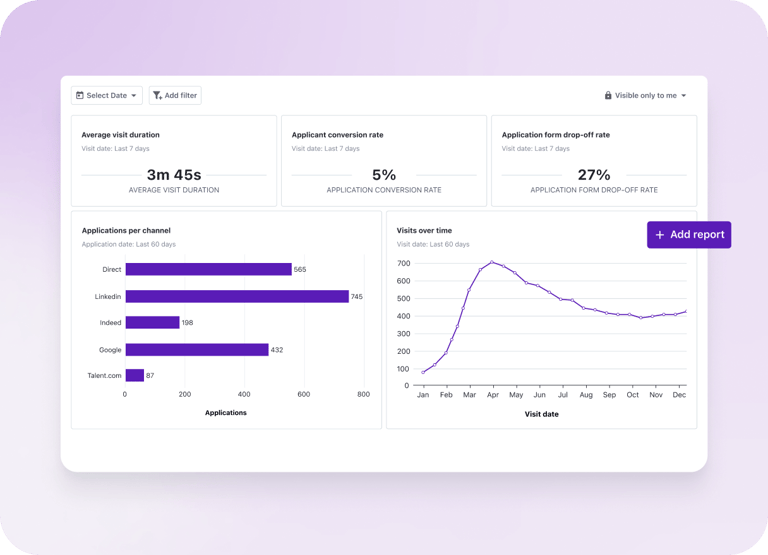
- Analytics: Tellent Recruitee tracks time-to-fill, fill rate, pipeline conversion, disqualification reasons, diversity metrics, careers site performance, and more across 100 pre-built report types. You can build custom dashboards, filter by date range, job, or department, and integrate with external BI tools on the Optimize plan.
Tellent Recruitee is best for
Mid-market to enterprise manufacturers (100–2,000+ employees) with multiple plant locations who prioritize hiring quality and cross-location standardization. Especially strong for companies with complex stakeholder groups, those committed to reducing bias in technical hiring, and growing manufacturers who need a platform that scales without requiring a system replacement down the road.
Competitor Comparison
2. Greenhouse
Greenhouse has built its reputation on one thing: enforcing structured, consistent hiring processes. If your manufacturing operation struggles with inconsistent interview quality across locations or subjective hiring decisions that lead to costly bad hires, Greenhouse's approach to standardized scorecards, defined competencies, and stage-by-stage evaluation can bring discipline to the process.
The platform is aimed at mid-market and enterprise organizations, particularly those where unbiased hiring is a priority.
For manufacturing, Greenhouse's strength in structured evaluation is genuinely useful for technical and management roles. However, its implementation complexity and pricing (starting around $6,500/year, scaling significantly for larger teams) make it difficult to justify for manufacturers who also need to run high-volume frontline hiring. The platform wasn't designed with production worker pipelines in mind, and the learning curve for non-HR users like plant managers is steeper than most manufacturing teams want to deal with.
Key features for manufacturing
- Structured hiring framework: Standardized scorecards and interview plans for every role, ensuring a CNC operator interview in Plant A follows the same evaluation criteria as Plant B.
- Configurable pipelines: Customizable stages with automation triggers for follow-ups, candidate movement, and team notifications.
- 500+ integrations: Connects with HRIS platforms, background check providers, scheduling tools, and assessment platforms.
- DE&I tools: Built-in features to mitigate bias, track demographic data, and support equitable hiring practices.
- Onboarding module: Extends beyond hiring into new-employee onboarding workflows.
Pros
- Industry-leading structured hiring methodology that reduces subjectivity.
- Extensive integration ecosystem with 500+ partners.
- Strong DE&I reporting and compliance features.
Cons
- Reporting features are a frequent user complaint. Customization and speed are limited.
- Steeper learning curve for non-technical hiring managers on the factory floor.
- Some newer features are locked to the most expensive tiers.
Pricing
- Quote-based.
- Three tiers (Core, Plus, Pro) with pricing scaled to headcount.
- User estimates suggest $6,500–$10,000+ annually depending on headcount.
- No free trial.
3. Teamtailor
Teamtailor has built its reputation on two things: a great candidate-facing experience and an intuitive interface. The career site builder is strong, and hiring managers adopt the platform quickly because it doesn't feel like enterprise software.
Teamtailor’s automation is limited. They are primarily triggered by stage movement (e.g. a candidate moves forward, an email fires). Combine/condition-based logic automation isn't available. Interview scheduling requires a third-party tool (Cronofy) rather than a native scheduler. Key features for manufacturing
- Career site builder: No-code, multi-page, multi-language career sites with strong branding controls.
- Multi-location hiring: Supports multiple sites and departments within a single account.
- AI tools: AI-assisted job descriptions, candidate screening & matching, and interview preparation.
- Mobile app: For reviewing candidates and leaving feedback on the go.
- Candidate experience focus: According to reviews, candidate experience with the application is positive.
Pros
- Career site builder and employer branding tools are among the best in the mid-market.
- Intuitive interface with a low learning curve for hiring managers and supervisors.
- Unlimited users and job postings removes scaling anxiety for growing teams.
- Strong international presence with local language support.
Cons
- Workflow automation is basic: no combine/condition logic for complex manufacturing hiring scenarios.
- Analytics and reporting are limited, pushing teams to build their own dashboards.
- Interview scheduling relies on a third-party integration (Cronofy) rather than a built-in native scheduler.
- Missing some features that mature ATS platforms include as standard: robust talent pool management, native WhatsApp integration, bulk operations.
Pricing
- Quote-based.
- Unlimited job postings and unlimited users.
→ Tellent Recruitee vs Teamtailor: a detailed comparison
4. Softgarden
Softgarden is a DACH-native ATS with a genuine focus on employer branding. Made in Germany, it emphasizes data residency and GDPR compliance, and has built an employer review integration that ties into Kununu and Google. For manufacturing companies in Germany, Austria, and Switzerland that compete hard for trade workers and want their jobs page to look credible, Softgarden's branding focus is a stand out feature.
Their core challenge is customization. Users consistently flag that modifying workflow steps, adjusting rejection reasons, or tweaking pipeline configurations requires contacting Softgarden's support team rather than doing it themselves. Ongoing changes to workflows and layouts aren't self-serve. This can create friction for teams that need to move fast and adapt processes as hiring requirements change.
Softgarden's entry-tier plandoesn't include a career site or job landing pages. The All-in-One plan is where the full feature set becomes available. And the platform only works in German and English, which closes the door for manufacturers expanding into Dutch, French, Swedish, or Finnish-speaking markets.
Key features for manufacturing
- Employer branding and review integration: Ties into Kununu and Google reviews.
- Multitenancy: Handles multiple brands, subsidiaries, and locations with structured permissions — useful for manufacturing groups with multiple plants under different brands.
- DACH compliance focus: Emphasizes GDPR data residency for organizations with strict data requirements.
- Multi-location support: Up to 8 locations covered with role-based permissions across branches.
- Job board distribution in Germany: Connects to major German-speaking job boards.
Pros
- Strong employer branding tools, particularly the Kununu/Google review integration for DACH talent markets.
- Made-in-Germany positioning resonates with compliance-sensitive manufacturing organizations in the region.
- Multitenancy is well-handled for complex org structures with multiple subsidiaries or branches.
- Competitive pricing, particularly for lower-volume hiring needs.
Cons
- Workflow customization requires contacting support for many configurations.
- No support for workflow automations, pushing teams to handle multiple manual actions to complete their processes.
- Career site and job landing pages only available on higher-tier plans (Elite, €799/month+).
- No support for Dutch, French, Swedish, Finnish, or other European languages other than German and English.
- Multi-location support caps out at 8 locations, which won't work for larger multi-site manufacturers.
Pricing
- Two tiers: Core (custom pricing), All-In-One (custom pricing). Pricing scales with features, not headcount.
- Career site builder is unavailable on the Start plan.
- 14-day free trial.
→ Tellent Recruitee vs Softgarden: a detailed comparison
5. Pinpoint
Pinpoint stands out for one thing many ATS platforms get wrong: handling multiple types of hiring within the same organization. If you're recruiting across desk-based engineering roles, deskless production floor workers, early-career apprentices, and experienced skilled trades — all with different processes — Pinpoint is designed to keep that complexity manageable rather than forcing everyone into the same workflow.
The platform pairs strong recruitment marketing tools with anonymized screening and workflow automation, and it's built for in-house recruiting teams (not agencies) at mid-size to enterprise organizations.
Key features for manufacturing
- Branded careers sites: Customizable, mobile-friendly career pages that help attract candidates to specific locations or roles.
- Anonymized screening: Blind recruitment tools to reduce bias during initial candidate review.
- Workflow automations: Auto-nudges to hiring managers for scorecard completion, automatic rejections for candidates missing core requirements, and stage-based triggers.
- CRM and talent pools: Stay in touch with silver-medalist candidates and build pipelines for future roles.
- Onboarding module: Personalized onboarding flows with task management and branded portals for new hires.
Pros
- Excellent at managing diverse hiring types (desk-based, deskless, early-career, experienced) within one system.
- Highly rated customer support with named Customer Success Managers and live chat.
- Clean, intuitive interface that hiring managers adopt quickly.
Cons
- Relatively cautious on AI adoption compared to some competitors.
- May be more platform than needed for very small manufacturers hiring only a few roles per year.
Pricing
- Quote-based.
- Pricing varies by organization size and hiring volume.
- No free trial.
6. iCIMS
iCIMS is the enterprise heavyweight. If you're a large manufacturer running hiring across dozens of locations and managing thousands of applications, iCIMS has the infrastructure to handle it. The platform bundles ATS, CRM, career sites, onboarding, text recruiting, and AI capabilities into one system.
iCIMS text engagement tools are particularly relevant for reaching deskless and third-shift candidates who aren't checking email.
Key features for manufacturing
- Text engagement: AI-powered SMS and conversational texting to engage deskless workers and third-shift candidates on their schedule.
- AI-powered matching: Candidate matching and ranking based on experience fit, reducing manual screening time for high-volume roles.
- Career sites with video: Branded career sites with employee videos to showcase your work environment. Valuable for attracting workers to specific plants.
- CRM and nurture campaigns: Build and maintain talent pools with automated, personalized outreach campaigns.
- Enterprise integrations: Connects with SAP, Workday, Oracle, ADP, UKG, and hundreds of other HR tools through its marketplace.
Pros
- Built for massive scale. Handles high-volume, multi-location hiring without breaking.
- Deep enterprise integrations, especially with SAP and Workday ecosystems common in manufacturing.
- Strong compliance and security features for regulated industries.
- Text engagement tools are a real differentiator for reaching deskless workers.
Cons
- Pricing can scale to $100,000+/year for the enterprise.
- Complex implementation requires dedicated admin resources and significant setup time.
- Interface can feel dated compared to newer competitors.
- Overkill for mid-market manufacturers with simpler hiring needs.
Pricing
- Quote-based.
- Estimates range from ~$11,500/year for growing companies to $100,000+/year for large enterprises.
- Implementation fees and add-on costs can be significant.
- No free trial.
7. Personio
Personio is one of the dominant HR platforms in the DACH market. They offer core HR, payroll, time tracking, performance management, and an ATS all under one roof. For manufacturing teams already running Personio for HR admin, the logic of using their recruiting module feels obvious.
The problem is that the recruiting module is an afterthought. It handles the basics (posting jobs, collecting applications, basic pipelines) but it was built to serve an HRIS, not a hiring team. For many teams, Personio's ATS is not enough once their hiring volume grows. Workflow customization is limited to standard scenarios. There are no reusable screening question templates, only manual yes/no questions. Career pages have limited flexibility. And if your team has a problem, only admins can contact support, but not the people doing the hiring.
For manufacturing teams that hire at volume across multiple role types and need automation, structured evaluation, and multi-location visibility, Personio's depth gap becomes a daily friction.
Key features for manufacturing
- Unified HR + Recruiting: ATS, Core HR, payroll, performance management, and time tracking in a single platform.
- Career page builder: No-code builder with custom branding, though flexibility is limited compared to dedicated tools.
- Mobile app: Available for HR and recruiting tasks.
Pros
- All-in-one HR coverage eliminates the need to manage multiple vendors.
- Strong brand and implementation support in DACH; well-understood by German tax advisors and HR teams.
- Bundled pricing can be accessible for teams that genuinely need both HRIS and ATS.
Cons
- Recruiting module lacks depth: no reusable screening question templates, limited workflow automation, and clunky document review experience.
- Only admins can contact support, creating bottlenecks for larger hiring teams.
- WhatsApp integration is unavailable.
- The all-in-one model forces you to buy the entire platform even if recruiting is your primary need.
- Edge cases for workflow customization require workarounds or support involvement.
Pricing
- Quote-based.
- Core and Core PRO plans available.
- The recruiting module is paid as an add-on.
- 14-day free trial.
- Offers 50% off for qualifying nonprofits.
→ Tellent Recruitee vs Personio: a detailed comparison
8. Workable
Workable hits a sweet spot for manufacturers that want modern AI-powered sourcing without enterprise pricing or complexity. The platform distributes job postings to over 200 job boards with a single click, offers AI candidate matching across a database of 400+ million profiles, and includes a built-in careers page builder.
Workable is also expanding beyond pure ATS into HRIS territory, adding time-off tracking, employee file management, and org charts. Useful if you want to consolidate tools.
Key features for manufacturing
- AI sourcing: AI-powered candidate matching and recommendations that scan 400M+ profiles to surface relevant talent for your open roles.
- 200+ job board distribution: Post to manufacturing-specific and general job boards simultaneously from one interface.
- Video interviews: One-way recorded and live video interview capability (available as add-on on lower tiers, included on Premier).
- Employee referral portal: Built-in referral management to tap your existing workforce's networks.
- Mobile app: Review candidates and manage hiring from anywhere.
Pros
- Strong AI sourcing tools at a price point accessible to mid-market manufacturers.
- 15-day free trial lets you test before committing.
- Clean interface with reasonable learning curve.
- Expanding HRIS features mean you can consolidate tools over time.
Cons
- Key features like texting ($89/mo), video interviews ($109/mo), and assessments ($59/mo) cost extra on lower tiers, making the real cost higher than advertised.
- Pricing scales by headcount, punishing larger companies with modest hiring needs.
- Reporting and analytics are still maturing compared to dedicated enterprise platforms.
- Less customizable workflows than Tellent Recruitee or Greenhouse.
Pricing
|
Standard starts at $3,588/year or $360/mo |
Premier starts at $7,188/year |
Enterprise starts at $8,628/year |
- Cost scales with employee count.
- Watch for add-on costs that can significantly increase the monthly bill.
- 15-day free trial.
9. BambooHR
BambooHR isn't an ATS that happens to have HR features — it's an HRIS that includes a solid (if basic) applicant tracking module. For smaller manufacturers that want one system to handle employee records, time-off tracking, onboarding, payroll, and hiring, BambooHR offers that all-in-one simplicity.
The trade-off is clear: you get convenience and ease of use, but the recruiting functionality is simpler than dedicated ATS platforms. If your primary hiring need is posting jobs, collecting applications, and running a basic evaluation process, BambooHR handles that well. If you need proactive sourcing, complex multi-stakeholder workflows, or high-volume hiring capabilities, you'll hit walls.
Key features for manufacturing
- Unified employee lifecycle: Hiring, onboarding, employee records, time tracking, performance management, and payroll in one platform. Mark a candidate as "hired" and their data flows straight into employee records.
- Job posting distribution: Post to major job boards including Indeed and ZipRecruiter from within the platform.
- Collaborative evaluations: Hiring managers can rate candidates and leave comments. Basic but functional for smaller teams.
- Automated onboarding: Electronic new-hire packets with e-signatures, so new factory workers can complete paperwork before day one.
- Mobile app: Responsive mobile app for time-off requests, directory access, and basic HR tasks.
Pros
- Easy to use. Minimal training needed, which matters when your HR team wears many hats.
- All-in-one approach eliminates the need to manage multiple vendors.
- Strong onboarding automation that bridges the gap from hire to first day.
- Highly rated customer support.
Cons
- ATS functionality is basic. Lacks advanced features like deep resume parsing, proactive sourcing, or talent pooling.
- Not built for high-volume recruiting or complex multi-stakeholder hiring workflows.
- Per-employee-per-month pricing can become expensive as headcount grows, even if hiring volume is low.
- Limited customization for recruiting workflows.
Pricing
|
Core $10 per employee per month |
Pro $17 per employee per month |
Elite $25 per employee per month |
- Starts at $10/mo per employee or $250 USD/mo for companies with 25 employees or fewer.
- Per-employee, per-month model.
- 7-day free trial.
10. Lever
Lever takes a relationship-first approach to recruiting. Its core product combines ATS and CRM functionality in one system, which means you manage active candidates and passive talent in the same platform rather than bolting on a separate sourcing tool.
Lever's CRM-first approach solves a problem most manufacturing ATS platforms ignore: what happens to the qualified candidates you don't hire today? If you interviewed three strong welders but only had budget for one, Lever keeps those relationships warm through automated nurture campaigns so you're not starting from scratch when the next opening comes up. In skilled trades markets where the same candidates get recruited by every manufacturer in a 50-kilometre radius, that ongoing relationship matters.
The downside: Lever doesn't offer manufacturing-specific features like shift-based scheduling or certification tracking, and the platform can feel overpowered for companies whose hiring is mostly straightforward production roles.
Key features for manufacturing
- Combined ATS + CRM: Manage active candidates and passive talent in one unified system with shared data and workflows.
- Automated nurture campaigns: Send personalized, stage-based email sequences to keep passive candidates engaged over time.
- Candidate surveys: Customizable feedback surveys at various stages of the hiring process to improve candidate experience.
- Advanced analytics: Visual dashboards, predictive analytics, and DEI tracking to inform talent strategy.
- Workflow automation: Trigger-based automations for common recruiting tasks including outreach and scheduling.
Pros
- Native CRM means no separate tool needed for talent pipeline management.
- Strong candidate nurturing capabilities for building long-term relationships with scarce skilled workers.
- Good analytics and DEI reporting.
Cons
- Can feel overpowered for companies with straightforward hiring needs.
- Less manufacturing-specific functionality compared to platforms like Tellent Recruitee or iCIMS.
Pricing
- Quote-based.
- Lever is generally positioned in the mid-to-upper market range.
- No free trial.
11. ApplicantStack
ApplicantStack is worth mentioning in a manufacturing context because it has built a niche serving industries with high-volume frontline hiring — healthcare, food and beverage, hospitality, and manufacturing. It's part of SwipeClock's WorkforceHUB ecosystem, which means it can connect to time tracking and scheduling tools that are common in shift-based operations.
Where ApplicantStack stands out is accessibility and price. Plans start at $29,99/month with no contract or long-term commitment required, making it the most affordable option on this list by a margin. Its Text-to-Hire feature lets recruiters communicate with candidates via SMS, which solves the core problem of reaching deskless workers who don't check email. Text-to-apply takes it further, allowing candidates to start an application on the spot from their phone.
The trade-off: ApplicantStack is primarily a volume-hiring tool for straightforward roles. Users consistently flag reporting as a weak spot. Extracting specific insights often requires manual work, and the interface feels dated compared to newer competitors.
Key features for manufacturing
- Text-to-Hire and Text-to-Apply: SMS-based communication and application lets candidates apply from their mobile device.
- Pre-screening questionnaires: Custom knockout questions with weighted scoring, including points for resume keywords, that automatically filter unqualified candidates.
- Multi-job pipeline management: Users can post multiple jobs using the same pipeline, handling various positions across different locations without recreating workflows from scratch.
- Background check and assessment integrations: Connects with background screening, skills assessments, and video interviewing providers.
Pros
- Most affordable ATS on this list.
- No contracts, no cancellation fees, and a 14-day free trial to test before committing.
- Text-to-Hire solves the deskless worker communication problem at a price point others charge extra for.
Cons
- Reporting and analytics are basic. A frequent complaint from users who need deeper insights.
- Interface feels dated and functionality is limited compared to more robust ATS platforms.
- No proactive sourcing tools, talent pooling, or CRM functionality. Purely reactive, inbound hiring.
- English-only — no multi-language support for international operations.
- Companies that grow beyond straightforward frontline hiring tend to outgrow the platform.
Pricing
|
Starter $29,99/mo |
Growth $49,99/mo |
Recruit $109,99/mo |
Bundle (Recruit + Onboard) $159,99/mo |
- Starter limited to 1 active job posting. Growth allows up to 3. Recruit offers unlimited jobs.
- No contract required — month-to-month billing.
- 14-day free trial.
12. SmartRecruiters
SmartRecruiters is a well-established enterprise ATS with 4,000+ customers, including Amazon, Visa, and McDonald's. The platform is designed around a social-network-style interface that drives high adoption, as teams report that collaborative hiring features work well out of the box. They've also been leaning hard into AI with their "Winston AI" intelligence layer, covering talent matching, candidate screening, and conversational AI.
SmartRecruiters was acquired by SAP in September 2025 and is now being integrated into the SAP suite. This is worth factoring in if you're not an SAP shop evaluating it as a standalone ATS, as it could critically impact their roadmap and pricing in the future.
SmartRecruiters’ reporting is widely cited as a weakness: teams can't build the custom KPI dashboards they need, dashboards don't surface the right metrics, and creating reports outside the pre-built templates requires workarounds or data exports. The integration ecosystem is large (300+ partners) but connecting tools often requires more technical effort than expected, and complex automation changes will have you talking to support more than you’d like.
Key features for manufacturing
- Enterprise-scale: strong collaboration UX, 37 languages, and deep HRIS integrations.
- Social-network-style interface: Intuitive design that drives adoption without extensive training.
- Collaborative hiring: Multi-stakeholder workflows with shared visibility, feedback loops, and structured evaluations.
- 300+ integrations: Connects with SAP, Workday, ADP, background check providers, and most enterprise HR tooling.
- Global multi-language support: 37 languages for multinational manufacturing operations.
- AI capabilities (Winston AI): Talent matching, candidate screening, and conversational AI tools.
Pros
- Enterprise brand recognition that gets through procurement and risk reviews at large organizations.
- Extensive integration ecosystem, particularly strong with SAP and Workday ecosystems, common in large manufacturing.
- Strong global compliance features and multi-language support for multinational operations.
- Active AI development roadmap with meaningful capabilities already deployed.
Cons
- Limited custom dashboards, hard to track specific KPIs without exporting data.
- Complex approval flows and non-standard processes require support involvement rather than self-service configuration.
- Pricing is enterprise-grade and it can scale significantly with headcount.
- Career site builder is an add-on cost rather than included.
- WhatsApp integration is only available through third-party tools, not native.
Pricing
- Not publicly listed beyond the Essential plan.
- Essential plan starts at $14,995/year.
- Other plans use a per-employee-per-month model
- Additional costs for implementation, training, support tiers, and add-ons.
- No free trial.
→ Tellent Recruitee vs SmartRecruiters: a detailed comparison
Quick comparison table
Use this table for a quick side-by-side comparison. Pricing reflects starting tiers, and actual costs vary by company size and features.
|
ATS Solution |
Starting Price |
Best For (Size) |
Key Differentiator |
Mobile-Optimized |
Multi-Location |
Free Trial |
|
Tellent Recruitee |
Custom quote |
100–2,000+ |
Collaborative hiring + Proactive talent rediscover + WhatsApp Hiring + Automations |
Yes |
Yes |
18 days |
|
Greenhouse |
~$6,500/yr (according to online user reviews) |
250–5,000+ |
Structured hiring methodology |
Yes |
Yes |
No |
|
Teamtailor |
Custom |
20–500 |
Employer branding + intuitive UX |
Yes |
Yes |
No |
|
Softgarden |
€199/mo or €2.148/yr |
50-500 |
DACH employer branding focus |
Yes |
Limited to 8 locations |
14 days |
|
Pinpoint |
Custom quote |
200–2,000+ |
Multi-type hiring flexibility |
Yes |
Yes |
No |
|
iCIMS |
Custom quote |
1,000–50,000+ |
Enterprise scale + text recruiting |
Yes |
Yes |
No |
|
Personio |
Custom |
10–250 |
All-in-one HR + basic ATS |
Yes |
Limited |
14 days |
|
Workable |
$360/mo |
50–500 |
AI sourcing + 200+ job boards |
Yes |
Limited |
15 days |
|
BambooHR |
$10/mo per employee |
25–250 |
All-in-one HR + basic ATS |
Yes |
Limited |
7 days |
|
Lever |
Custom quote |
200–1,500 |
Native ATS + CRM for pipelines |
Yes |
Yes |
No |
|
ApplicantStack |
$29/mo |
25–200 |
Text-to-Hire + budget-friendly |
Yes |
Limited |
14 days |
|
SmartRecruiters |
From $14,995/yr |
500–5,000 |
Enterprise scale + AI recruiting |
Yes |
Yes |
No |
Essential features to look for in a manufacturing ATS
When you're evaluating platforms beyond this list, or sitting in vendor demos, here's a practical checklist of what to look for, split into must-haves and differentiators.
Must-have features
- Mobile-first application experience (factory workers apply from phones during breaks)
- Knock-out questions screening and candidate matching
- Compliance tracking for EU-OSHA certifications, safety training, and background checks
- Automated job distribution to manufacturing-specific and general job boards
- Resume parsing and candidate database management
- Interview scheduling with calendar integration
- Basic workflow automation (email templates, status updates, task assignments)
Advanced differentiating features
- AI-powered candidate screening and matching
- Multi-location/multi-brand careers site management
- Proactive sourcing tools (CRM, talent pools, sourcing extensions)
- Structured evaluation scorecards and bias-reduction tools
- Employee referral program management
- High-volume hiring capabilities (bulk operations, batch processing)
- Robust integration marketplace (HRIS, background check, skills assessment)
- Advanced reporting and analytics (source tracking, time-to-hire, quality of hire)
Which advanced features matter most depends on your situation. Multi-location manufacturers need careers site management and standardized evaluations. High-growth manufacturers need scalability and high-volume tools. Companies facing severe talent shortages need proactive sourcing and candidate nurturing capabilities above all.
How to choose the right ATS for your manufacturing company
The comparison above gives you twelve strong options, but narrowing to the right one comes down to a few key decision factors.
By company size
Small manufacturers (50–250 employees, 1–2 locations): Prioritize ease of use, quick implementation, and transparent pricing. BambooHR works well for all-in-one simplicity. Tellent Recruitee is the stronger choice if you need real recruiting depth and plan to scale.
Mid-market manufacturers (250–1,000 employees, 2–5 locations): Balance functionality with usability. Tellent Recruitee for collaborative hiring and customization, Pinpoint for flexible multi-type hiring, or Lever for relationship-driven recruiting.
Enterprise manufacturers (1,000+ employees, 5+ locations): Require enterprise features like SSO, advanced permissions, and audit trails. Greenhouse for process rigor, iCIMS for configurability and scale.
By primary pain point
Speed and time-to-hire: Prioritize automation, AI screening, and scheduling efficiency. Workable and Tellent Recruitee both excel here.
Hiring quality and retention: Focus on structured evaluations, bias reduction, and skills assessment integration. Greenhouse and Tellent Recruitee lead in this area.
Multi-location consistency: Look for standardized workflows, centralized reporting, and multi-brand careers sites. Tellent Recruitee and Pinpoint handle this well, while Softgarden caps at 8 locations.
Compliance: Focus on automated certification tracking, audit trails, EEO reporting, and background check integration. Strong contenders are iCIMS and Greenhouse, with Personio for DACH-specific regulatory fit.
Talent shortage: Look for proactive features such as talent pools, sourcing tools, referral management, and candidate nurturing. Tellent Recruitee and Lever are best positioned.
Budget guidance
Realistic cost expectations:
- €2,000–€5,000/year for small manufacturers.
- €10,000–€30,000/year for mid-market.
- €50,000+/year for enterprise.
The ROI from faster hiring and reduced cost-per-hire make an ATS an investment, not just an expense. Don't choose solely on price. The wrong system wastes money through low adoption or missing critical features.
Conclusion
Manufacturing's talent challenges aren't going to resolve themselves. Manual recruiting processes can't compete when skilled workers are receiving multiple offers within days. The right ATS gives you the speed, consistency, and visibility to actually compete for the people you need.
The best choice depends on your specific circumstances — company size, primary pain point, budget, and operational complexity. Tellent Recruitee earns our top recommendation for manufacturers seeking balanced capability across sourcing, collaboration, and automation, particularly those with multi-location operations. But other solutions excel in specific niches: Greenhouse for process discipline, iCIMS for enterprise scale, and Workable for AI sourcing.
Start with a clear assessment of your primary challenges. Evaluate 2–3 solutions aligned to those needs. And prioritize implementation support and change management in your vendor selection.
Ready to see Tellent Recruitee in action?
If this comparison was useful, the next step is to see how Tellent Recruitee handles your actual hiring scenarios with your specific roles, pipeline stages, and team's workflow.
Tellent Recruitee is trusted by 7,000+ organizations across Europe and beyond. It was built to give manufacturing HR teams the flexibility to run different hiring processes simultaneously, the collaboration tools to bring plant managers and department heads into the process without chaos, and the analytics to show leadership what's working.
Start a free trial → or request a personalized demo → to see it with your own hiring context.