


.webp)
Retail HR teams have a hiring problem that most ATS vendors don't fully understand. According to Tellent's State of Hiring 2025 report, retail has one of the highest career site bounce rates of any industry — 67% — and an average time to hire of 29.6 days.
Two-thirds of candidates leave your career site before they apply, and filling a role takes nearly a month, long enough for strong candidates to accept other offers elsewhere. Add the challenge of coordinating recruitment across multiple store locations, each with its own managers, schedules, and local talent pools, and the problem compounds.
It's no surprise that 99% of Fortune 500 companies use some form of applicant tracking system. But most ATS platforms weren't designed with retail in mind. They're built for corporate hiring, where you post a role, review a handful of candidates, and make an offer within a few weeks.
Retail doesn't work that way.
You need a system that can handle high application volumes without drowning your team, empower store managers who aren't HR professionals to make hiring decisions quickly, and scale up operations when holiday season hits without everything falling apart.
This guide evaluates 16 ATS platforms through a retail-specific lens. For each one, we'll cover what it does well, where it falls short, and the type of retail operation it's best suited for. We'll compare each platform honestly — including our own — so you can make the right call for your team:
Let's get into it.
Top 16 applicant tracking systems for retail brands
1. Tellent Recruitee
Here's what we'll cover in this section:
- A quick overview of how Tellent Recruitee works
- Where other ATS platforms fall short for retail teams
- Tellent Recruitee's 3 key differentiators for retail hiring
- Other top features, pros and cons
- Pricing
- Top use cases + customer case studies
- A note on table stakes features
- Best for
How Tellent Recruitee works
Tellent Recruitee is a flexible, collaborative ATS built for teams that need to hire at scale without losing control of their process. It's used by over 7,000 organizations worldwide and is part of the Tellent platform, which also covers HRIS and performance management.
The fastest way to understand what it does is to request a demo or start a free trial. The platform is designed to be self-explanatory. You can explore it without needing a sales call.
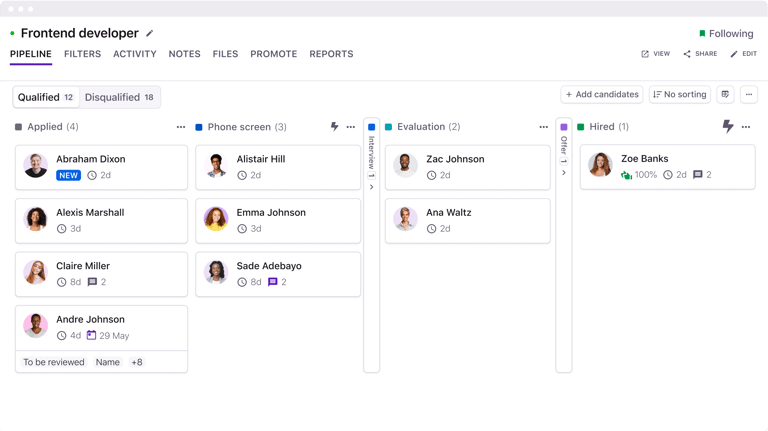
Tellent Recruitee covers the full hiring workflow: building a branded careers site, posting to 2900+ job boards, managing candidate pipelines with automation, collaborating with hiring managers, running structured interviews, and reporting on everything from time-to-fill to diversity metrics.
Where other ATS platforms fall short for retail
Retail hiring is genuinely high-volume and high-complexity at the same time. You might be filling 50 roles across 10 stores in a single month, each with different hiring managers, different pipelines, and different compliance requirements depending on the country or region.
Most platforms treat that as an enterprise problem. It's not. It's a mid-market problem that needs a smart solution that’s flexible enough to adapt to your hiring strategy.
Here are the specific problems retail HR teams run into with most ATS tools:
- Option 1: Enterprise platforms — These handle complexity well, but they're built for companies with dedicated HR tech teams. Implementation takes months. Store managers won't use them. And the per-seat pricing model punishes you for giving access to the people who actually need it.
- Option 2: tools focused on very small businesses — These are fast to set up and easy to use, but they hit a ceiling quickly for companies that hire across different locations and countries. Multi-location hiring, multi-language job postings, structured evaluation workflows, and advanced reporting are either missing or bolted on as expensive add-ons.
Tellent Recruitee's 3 key differentiators for retail
Key differentiator #1: Proactive sourcing that keeps pipelines full before you need them
Most ATS platforms are reactive. A role opens, you post it, and you wait for applications to come in. In retail, that approach guarantees you're always behind. By the time a seasonal surge hits or someone quits mid-week, you're scrambling: posting to job boards, paying staffing agencies a premium, and settling for whoever's available on short notice.
Tellent Recruitee flips this by giving your team the tools to build and maintain candidate pipelines continuously, so when a position opens, you already have warm candidates ready to go.
Here's how it works in practice:
Talent Pools as a candidate CRM. Every strong candidate who wasn't right for one role gets routed into a talent pool, organized by store location, role type, or region. Past seasonal workers, silver-medalist candidates from recent rounds, and employee referrals all live in a searchable database you can tap whenever a new position opens.
ReferralsHub for structured employee referral programs. Your current staff knows who'd be a good fit, but without a system, those referrals happen informally and get lost. ReferralsHub gives employees a branded portal to submit referrals, and gives recruiters visibility into which referrals convert to hires.
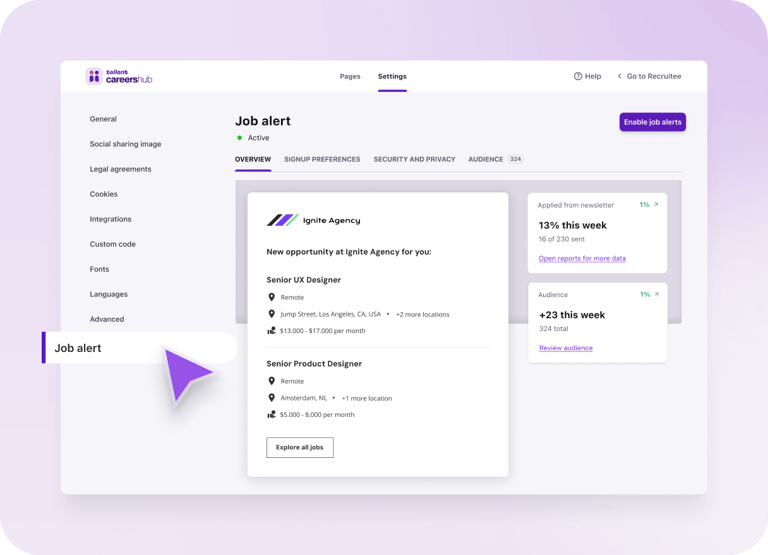
Job Alerts for repeat-applicant pools. Candidates who've expressed interest get notified automatically when a new role opens at a location they care about. For retail brands with high volumes of returning seasonal applicants, this keeps people engaged without your team lifting a finger.

Key differentiator #2: Collaboration that works for distributed retail teams
Most ATS platforms were designed for a centralized recruiting team. One recruiter owns a requisition, moves candidates through stages, and makes the hire. That's not how retail works.
In retail, the store manager needs to weigh in on who gets hired. The regional HR business partner needs visibility across multiple locations. The central talent acquisition team needs to maintain consistency and compliance. And none of these people are in the same building.
What most platforms do: they give everyone the same recruiter-level interface, which overwhelms store managers, or they create rigid role hierarchies that don't reflect how retail teams actually make decisions.
With Tellent Recruitee, collaboration is built into the core of the platform:
-
Team-based hiring on every job. Every job has a hiring team assigned to it. Hiring managers can leave structured feedback on candidates using evaluation forms, without needing to navigate the full ATS. Recruiters can @mention colleagues in notes. Tasks can be assigned to specific people. And the built-in Mailbox keeps all candidate communication in one place, visible to everyone on the team.
-
Fair Evaluations to prevent groupthink. When a store manager, a district leader, and central HR all weigh in on a candidate, the first person to share an opinion tends to anchor everyone else's. Fair Evaluations prevents this by hiding other people’s evaluation until you submit your own. Only then can you see the full picture.
-
Granular roles and permissions for decentralized control. Central HR maintains oversight and compliance while store managers get focused access to their specific locations and roles. This solves the common retail problem where corporate needs control for consistency but store managers need autonomy for speed. With Tellent Recruitee, both can operate effectively without stepping on each other.
-
AI-generated evaluation summaries. After multiple interviewers have left feedback on a candidate, the AI synthesizes it into a clear summary, surfacing where evaluators agree, where they disagree, and what the key themes are. For retail teams making fast decisions across distributed locations, this cuts the time spent aligning on a hire.
Does this actually speed up hiring? Marks & Spencer Greece, operating 27 stores with 550 employees, went from a fully manual screening process to collaborative hiring with automated candidate updates at every stage.
You can also use the collaboration features for things beyond just candidate evaluation:
- Assign pre-hire tasks to specific team members
- Set up approval workflows for job requisitions before they go live
- Sync calendars for interview scheduling without back-and-forth emails
- Use the mobile app so store managers can review candidates from the shop floor
Key differentiator #3: Mobile-first candidate experience that removes application friction
Retail candidates apply between shifts, on a bus, or during a lunch break. They're doing it on their phone. And if your application process asks them to create an account, upload a CV they don't have, or fill in 15 form fields on a tiny screen, they'll leave. According to Tellent's 2025 industry report, 40% of retail applications are abandoned before submission. For deskless roles like shop assistants and warehouse staff, the number can be even higher.
Most ATS platforms were built for desktop-first, professional hiring. Tellent Recruitee is built for the way retail candidates actually apply.
WhatsApp Hiring. Candidates tap a button on your careers site, start a short WhatsApp chat, answer a few screening questions, and their application lands directly in Tellent Recruitee, matched to the right store location by postcode. The entire process takes a couple of minutes on the phone they already have open. From there, hiring teams can handle the full communication process through WhatsApp, scheduling interviews, sending updates… everything.
Knockout questions and pre-screen questionnaires. Before a candidate even enters your pipeline, you can filter based on availability, location preference, or any other criteria that matter for the role. This cuts the volume of unqualified applications your team has to manually review, without adding friction for qualified candidates.
Candidate self-scheduling. Rather than your team spending time coordinating interview slots across multiple stores and managers, it syncs with Google and Outlook calendars and lets candidates self-book interviews based on real-time availability. For high-volume retail hiring, this is the difference between a two-day scheduling process and a two-hour one.
The combination means candidates get a fast, frictionless experience, and your team gets pre-qualified applicants without the manual overhead. Both sides win.
To learn more about Tellent Recruitee, explore the full feature set here.
Other top retail features
- CareersHub for retail employer branding: A no-code, multi-page, multi-language careers site builder that lets retail brands showcase culture, values, and benefits without needing a developer or agency. You can create location-specific landing pages for different store regions, highlight employee stories, and present each location's personality while keeping your brand consistent across the board.
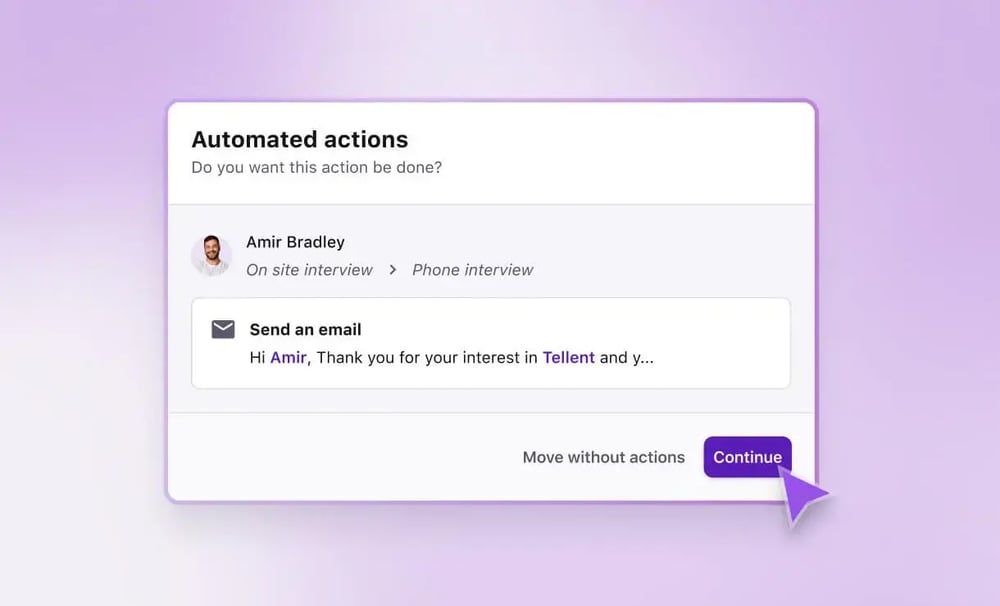
- Trigger-based automation engine: Beyond the knockout questions and self-scheduling covered above, Tellent Recruitee's automation handles the repetitive pipeline work that buries retail teams during hiring surges. When a candidate reaches a specific stage, the system can automatically send personalized emails (including delayed rejection sends to protect your employer brand), assign tasks to specific team members, request evaluation scorecards, or route candidates into Talent Pools for future roles.
- Mobile app for on-the-go hiring: Store managers and district leaders aren't sitting at a desk. The mobile app lets them review candidates, and submit evaluation scores between customers, during a break, or on the way to a store visit.
Tellent Recruitee pros
- Unlimited users on all pricing tiers. In retail, where hiring involves store managers, district leaders, and central HR, per-seat pricing punishes you for involving the right people.
- CareersHub gives you full control over employer branding with multi-language, multi-page careers sites.
- Trigger-based automations cover the full pipeline, from screening to rejection to talent pool routing, reducing manual work during seasonal surges.
- WhatsApp Hiring lets candidates apply in a couple of minutes through a chat they already have open. They don’t need to create an account or fill in a form. Hiring managers can then send them interview scheduler links, updates, and questions directly.
- Mobile-friendly applications let candidates apply from their phone, on the go, instead of needing to sit down at a desktop. The mobile app lets your team review candidates, leave feedback, and advance people through pipeline stages (when users have the right permissions) from wherever they are.
- GDPR compliance built in. As a European company, Tellent treats data protection as a default. A critical aspect for French and EU retail brands handling candidate data across multiple locations.
- 2900+ job board integrations. Apply with LinkedIn and Recruiter System Connect are included, so sourced candidates flow directly into your pipeline.
- Job Alerts notify interested candidates when new roles open at locations they care about.
- Proactive sourcing tools (Talent Pools, ReferralsHub, job board distribution) keep pipelines warm before seasonal surges hit.
- Free trial available. You can explore the platform without a sales call.
Tellent Recruitee cons
- Tellent Recruitee is a powerful ATS. If you’re looking for a full HR tool, Tellent offers a modular ATS, HRIS, and performance management solution. Tellent Recruitee is easy to connect with Tellent HR - Manage and Tellent HR - Grow, for companies that want a unified employee lifecycle solution.
- Smaller brand recognition compared to enterprise names like Cegid, though used by over 7,000 organizations.
- Video interview capabilities rely on integrations (Zoom, Google Meet, Teams) rather than native functionality.
Tellent Recruitee pricing
Tellent Recruitee uses a pricing model with three tiers (Start, Advance, Optimize) based on company size. Pricing is competitive with mid-market solutions while delivering capabilities that rival enterprise platforms. Free trial available.
Top use cases for Tellent Recruitee in retail
Multi-location retail chains hiring across stores: Marks & Spencer Greece operates 27 stores with 550 employees. Before Tellent Recruitee, their screening process was entirely manual. After switching, they built a branded careers site, integrated with local job boards, and used automated replies to keep candidates informed at every stage. Time-to-hire dropped from 30 days to 10–15 days. They now manage seasonal hiring spikes during the Greek tourist season through the same system that handles steady-state hiring the rest of the year.
Multi-location retail centralizing recruitment: Prêt à Manger struggled to see the source of their applications through a single interface before Tellent Recruitee. After switching, they centralized recruitment across locations, used AI-assisted tools to support efficiency, and got the whole department up and running on the software in about 2 weeks. The move also strengthened their GDPR compliance; a top priority for a brand handling candidate data at scale.
Hiring deskless workers at scale across multiple locations: Van Cranenbroek has five branches and two distribution centers in the Netherlands and Belgium. Candidates for these roles often don't have a CV, and their old process required one, leading to a 60% dropout rate. On top of that, their recruiter was fielding 30–40 manual WhatsApp messages daily. With Tellent Recruitee’s WhatsApp Hiring, candidates now apply via a short chat conversation and are automatically matched to the nearest branch by postcode. In the first month: 36 applicants, 7 new hires, dropout rate fell to nearly zero, and daily manual messages dropped to 1–2.
European retail with compliance requirements: Heras, a European perimeter protection company, chose Tellent Recruitee specifically for its GDPR compliance and automation features, to hire across the Netherlands, UK, Germany, France, and Sweden. Before Tellent Recruitee, they outsourced hiring through an RPO at twice the cost. After bringing recruitment in-house with Tellent Recruitee, they cut hiring costs in half, gave hiring managers clear visibility into candidate pipelines, and set up role-based permissions so recruiters stay in control of who sees what across countries.
A note on job boards, compliance, integrations, and analytics
These features exist in every serious ATS on the market. We won’t focus on them because they shouldn't be the deciding factor in your evaluation. That said, here's how Tellent Recruitee delivers on each:
- Job board distribution: Tellent Recruitee publishes to hundreds of job boards in one click. The auto-fill feature pushes your job details to board-specific formats automatically. Candidates who've opted in can be automatically notified when relevant roles open, keeping your employer brand visible between hiring cycles without manual outreach.
- Compliance: Tellent Recruitee includes GDPR compliance tools across all plans. The Optimize plan adds fairness tools for unbiased hiring, audit logs, and approval workflows for job requisitions. For European retailers, GDPR automation handles data retention and consent without manual intervention.
- Integrations: The Tellent Marketplace has 200+ integrations, including LinkedIn Recruiter System Connect (which saves recruiters up to 15 hours per month according to LinkedIn's own research), e-signature tools, video interview platforms (Zoom, Google Meet, Teams), background check providers, and HRIS systems. If you need to connect Tellent Recruitee to your existing HR ecosystem, the integration is almost certainly already built.
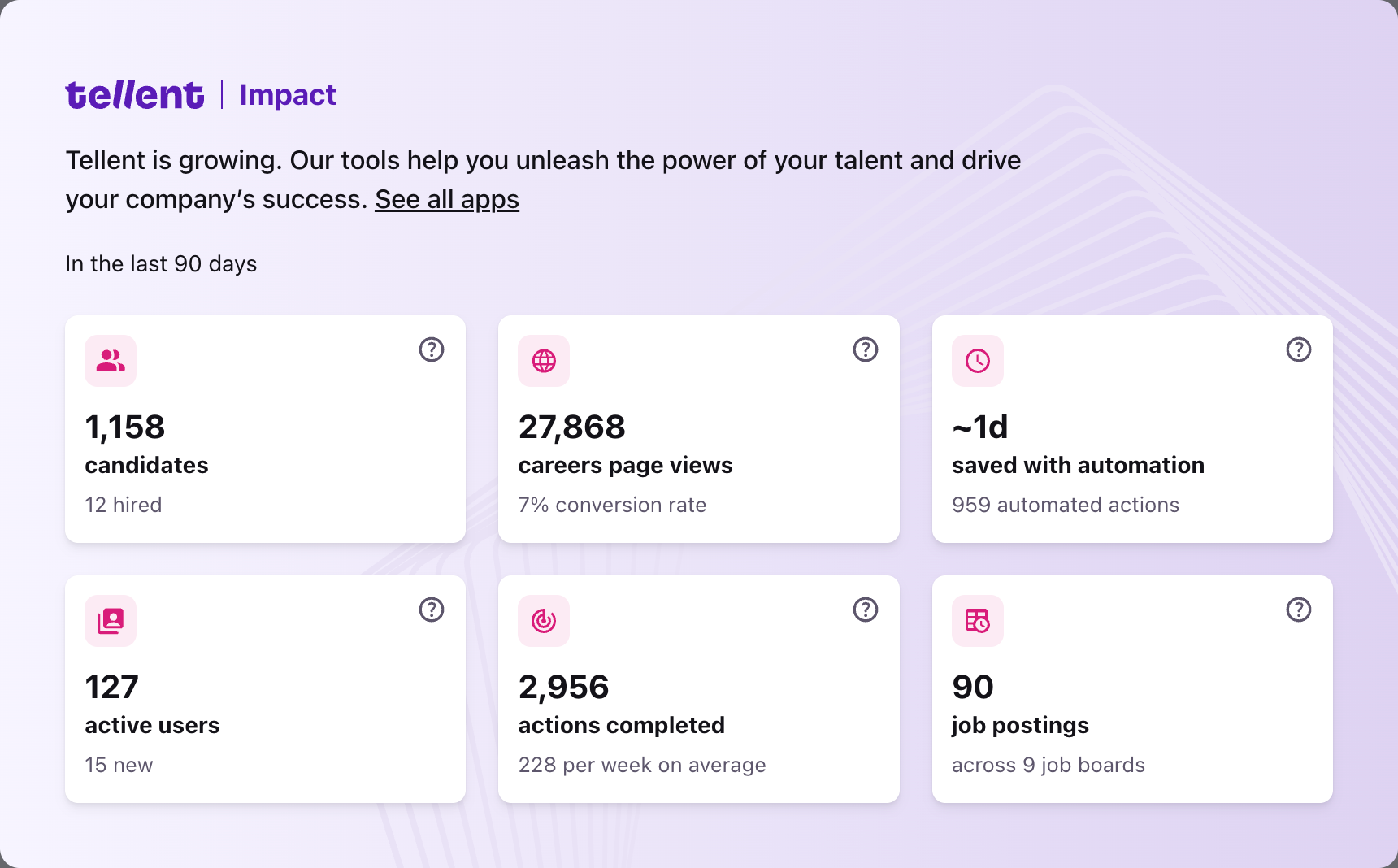
- Analytics: Tellent Recruitee's analytics module covers Jobs, Candidates, Pipelines, Disqualifications, Hires, Interviews, Evaluations, and Careers site performance. Pre-built dashboards give you time-to-fill, fill rate, and time-to-close at a glance. Custom reports and dashboards are available from the Advance plan. BI integrations (for Tableau, Power BI, etc.) are available on Optimize. The Impact Tracker lets you show the business value of your recruiting function, which comes handy when you're making the case for headcount or budget.
Tellent Recruitee is best for
Growing multi-location retailers (50–2,000+ employees) that need collaborative hiring across store managers and central HR, with proactive sourcing tools to stay ahead of seasonal surges and a mobile-first candidate experience for deskless workers. Especially strong for European retailers hiring across multiple countries.
See Tellent Recruitee in action. Request a demo →
Competitor comparison
2. Flatchr
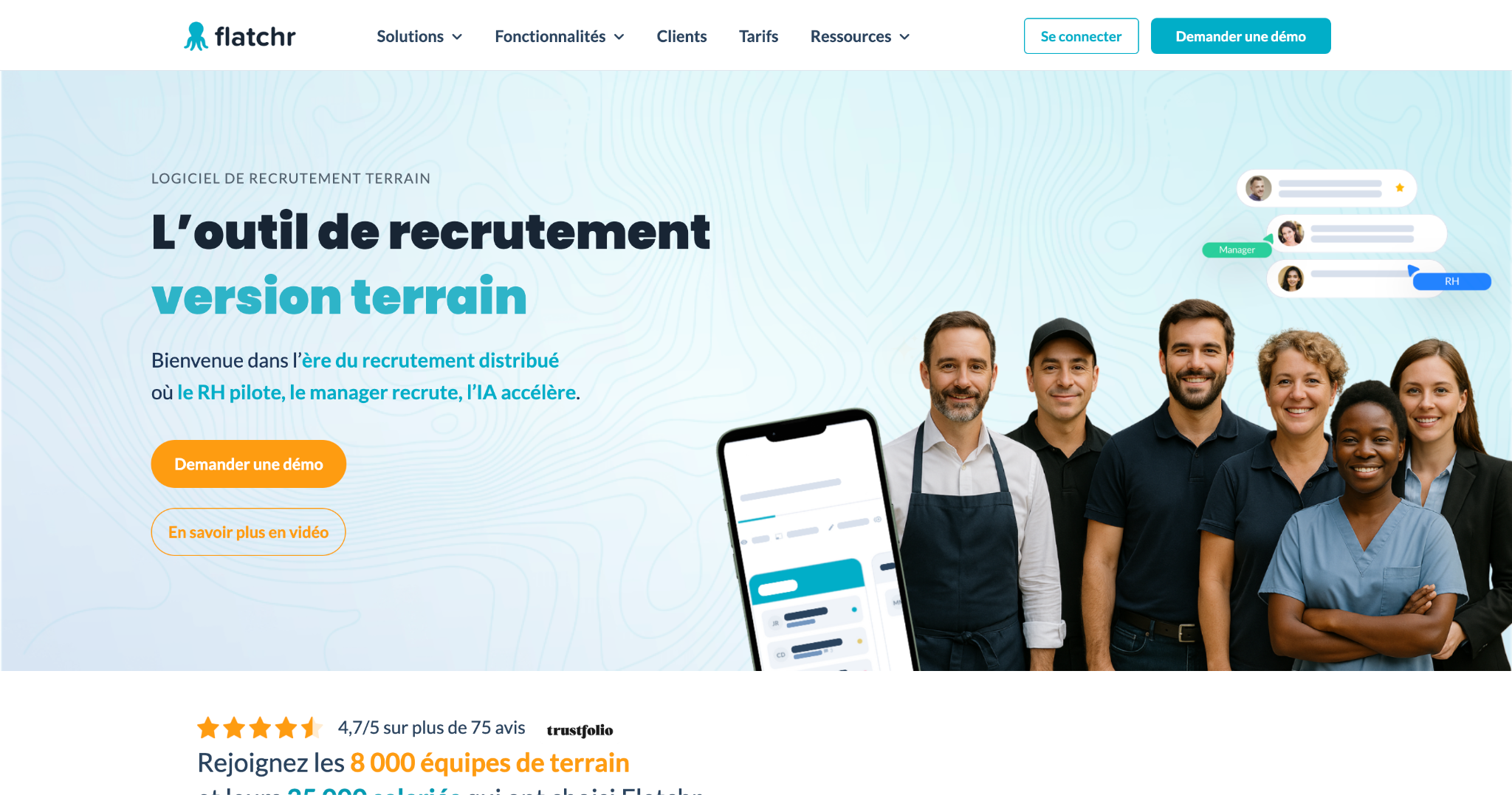
Flatchr is a French-built ATS designed to get small recruitment teams up and running quickly. Its strength is simplicity: a clean pipeline view, multiposting to French job boards, and an employer branding toolkit that doesn't require a design team. For retail brands still managing candidates in spreadsheets or email, it's a practical first step, but one with real limitations.
Job post limits kick in before your first seasonal spike, there's no automation to handle volume, and the product doesn't grow with you if you add locations or start hiring across borders. Flatchr doesn’t offer a mobile app, which seriously limits how candidates can apply to new roles and slows down hiring teams trying to evaluate candidates.
Key features for retail
- Multiposting to French and European job boards from a single interface
- Drag-and-drop kanban pipeline for candidate management
- Candidate database and CV library
- Collaborative hiring with recruiter notes and status updates
- GDPR compliance tools including consent management
Pros
- Fast to deploy. It’s simple enough to get it running in days.
- Straightforward pricing model with a per-active-job structure that suits low-volume hiring phases.
- The multiposting engine covers the key French boards (Indeed, APEC, Welcome to the Jungle, Monster) without manual re-entry.
Cons
- The Starter plan caps at one active offer, and even the Pro plan limits you to 10. For a brand managing seasonal hiring across multiple locations, you'll hit the ceiling quickly.
- Automation is limited to basic email acknowledgments. There's no trigger-based workflow builder, conditional logic, or approval chain support.
- No LinkedIn Recruiter integration, as Flatchr isn't an RSC-certified partner.
- Reporting is pretty basic.
Pricing
- Until recently, Flatchr offered plans at €49/month (Starter - 1 active job offer) and €149/month (Pro - 10 active job offers) but they no longer publish pricing on their site, so you’ll have to get a custom quote.
- No free trial available.
→ Tellent Recruitee vs Flatchr: a detailed comparison
3. Beetween
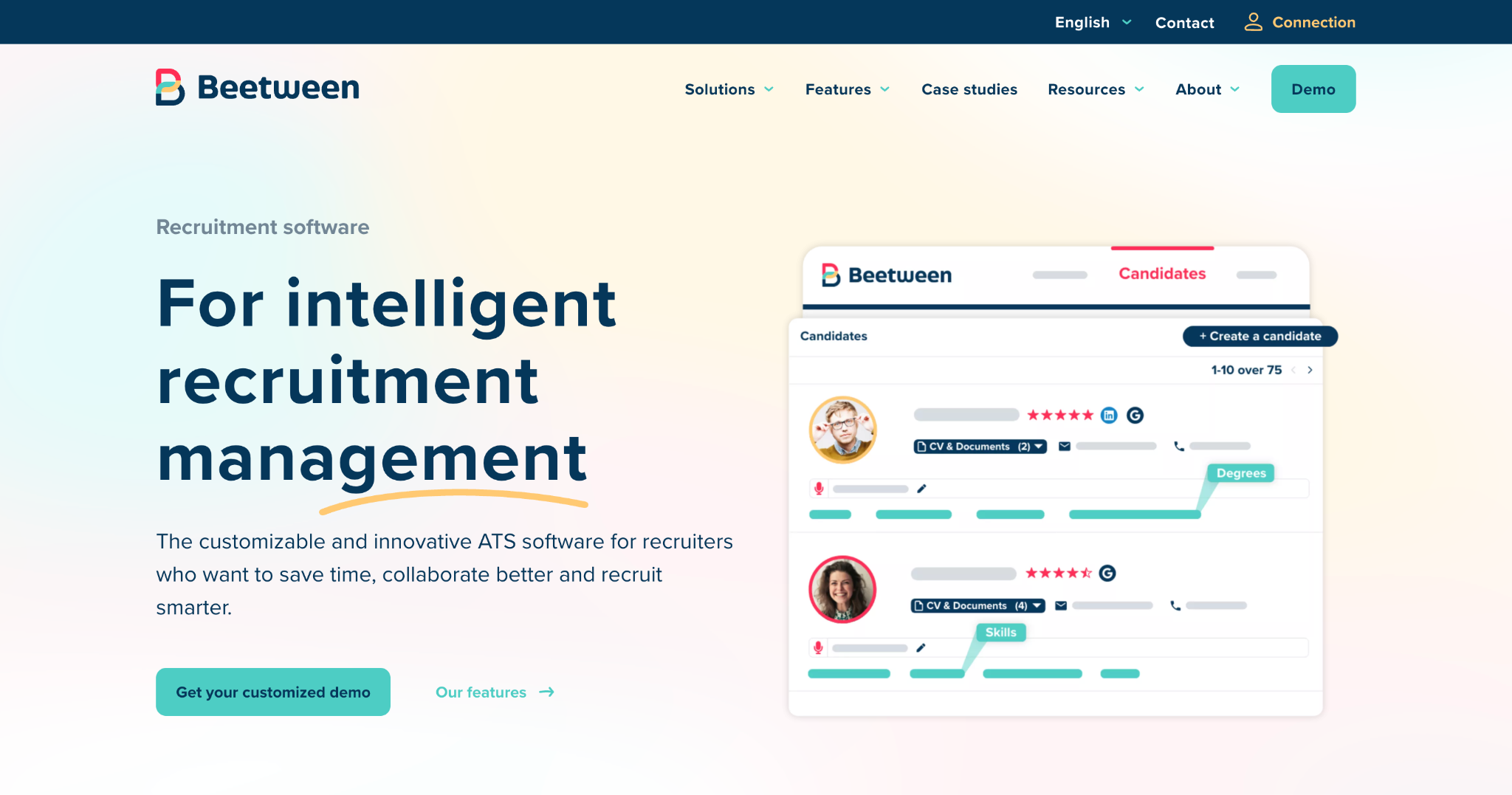
Beetween is a France-based ATS serving roughly 1,500 clients worldwide, with locations in France, Italy, and Spain. It's one of the few French-native recruitment platforms with real depth in sectors like healthcare, higher education, hospitality, and staffing. These are verticals where public-sector approval workflows and French regulatory compliance matter. Its multiposting engine covers 180+ job boards, and it has built a legitimate French HR brand.
The bigger trade-off is the lack of a mobile app. Teams can't review candidates, leave feedback, or move people through the pipeline from their phone, which is a real constraint for sectors where decisions happen away from a desk. Beetween’s integration ecosystem doesn't match competing platforms, with WhatsApp integration being a critical miss.
Key features for retail
- Multiposting to 180+ French and European job boards from a single interface.
- Native asynchronous video interviews.
- AI-assisted job description writing.
- AI-assisted matching that finds compatible profiles in your CV-library.
- GDPR compliance tools with French data hosting.
Pros
- The French-language interface, local CSM team, and French data hosting are real advantages for retail groups with compliance-sensitive hiring in France.
- Strong multiposting reach across French job boards, including platforms that global ATS tools don’t handle well.
Cons
- No mobile app and no candidate portal (both are listed as "coming soon" on site).
- No Whatsapp integration.
- No LinkedIn Recruiter System Connect (RSC) certification. Candidate data doesn't sync back into the ATS.
- Building complex, trigger-based workflows using conditional-logic is not supported.
- Very limited integrations marketplace, with the biggest HR-tech brands missing.
- No path to HR suite expansion beyond recruitment.
Pricing
- Quote-based.
- No free trial available.
4. Cegid Talent (ex-Talentsoft)
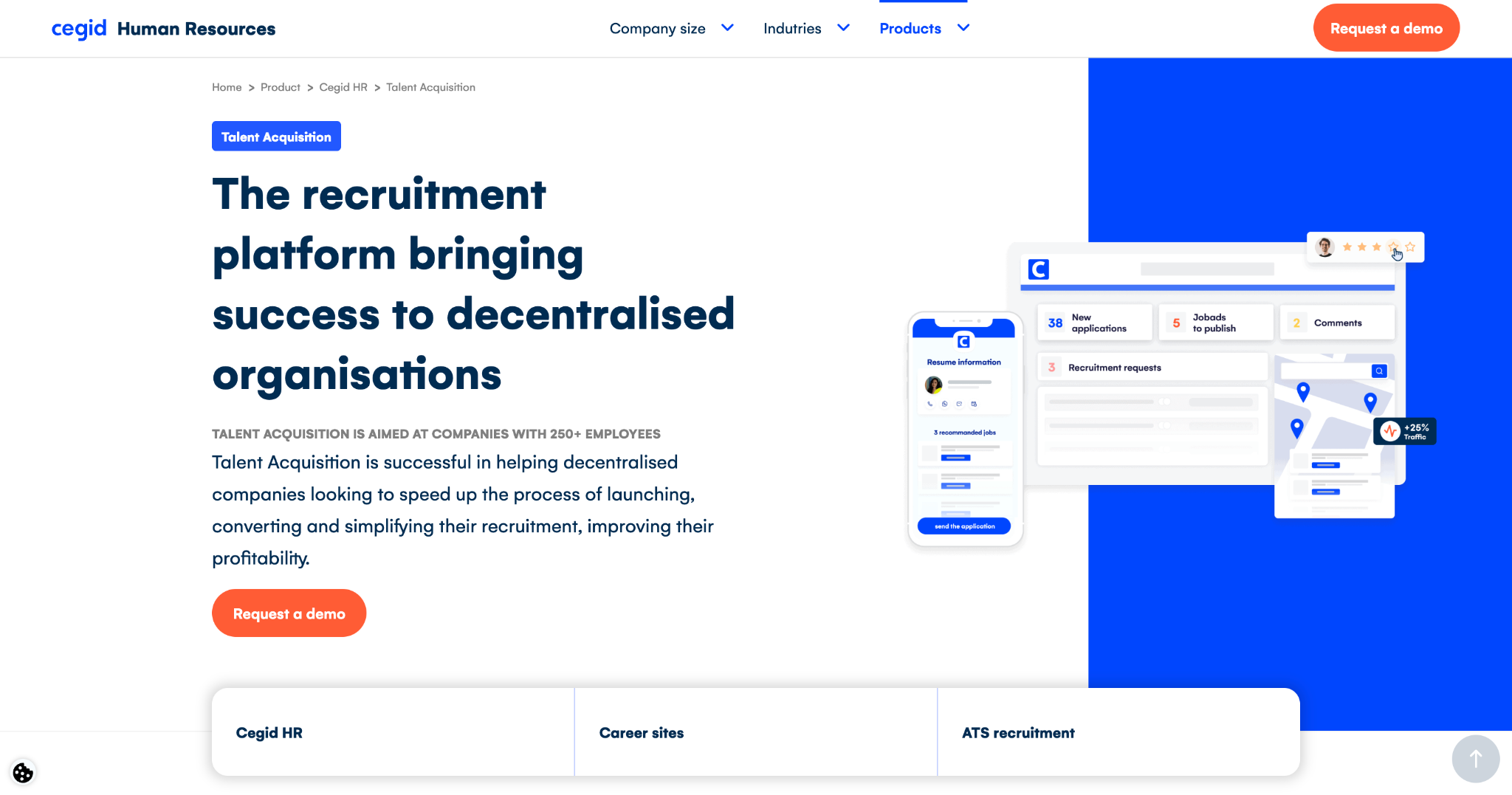
Cegid Talent Acquisition (formerly Talentsoft, acquired by Cegid in 2021) is the recruitment module within a full enterprise HCM suite covering payroll, core HR, learning, performance, and engagement. For large French retail groups already running Cegid's payroll or HR platform, adding the recruitment module is the path of least resistance. For anyone else, the implementation complexity, per-license pricing model, and enterprise positioning make it a difficult fit below 500 FTE.
Key features for retail
- Multiposting to 3,500+ job boards.
- Multi-brand, multi-entity career site builder.
- AI-assisted job description writing and CV analysis.
- CV parsing, questionnaires, scorecards, and assessments help you quickly sort and disqualify candidates.
- Mobile app available.
Pros
- The breadth of the Cegid HCM suite is the main draw. You’re looking at a talent acquisition module within a full HCM suite (payroll, core HR, learning, performance, engagement).
- Largest multiposting network in the French market, including niche French and regional boards.
- Strong enterprise compliance posture. Includes French data hosting with CNIL and GDPR compliance.
- Multi-language and multi-entity support at scale, which matters for large retailers operating across France and other European regions.
Cons
- Built for 1,000+ FTE. Implementation can take months, compared to 2–4 weeks for mid-market alternatives.
- Per-license pricing makes access to more stakeholders expensive.
- Advanced features come at a price, when the same features ship natively in competitors like Tellent Recruitee or Teamtailor.
- Contract terms are enterprise-grade, often with annual upfront payment terms.
- No WhatsApp integration. A meaningful gap for teams hiring blue-collar and frontline workers.
Pricing
- Quote-based.
- Yearly contracts are standard.
- No free trial available.
5. Workday Recruiting
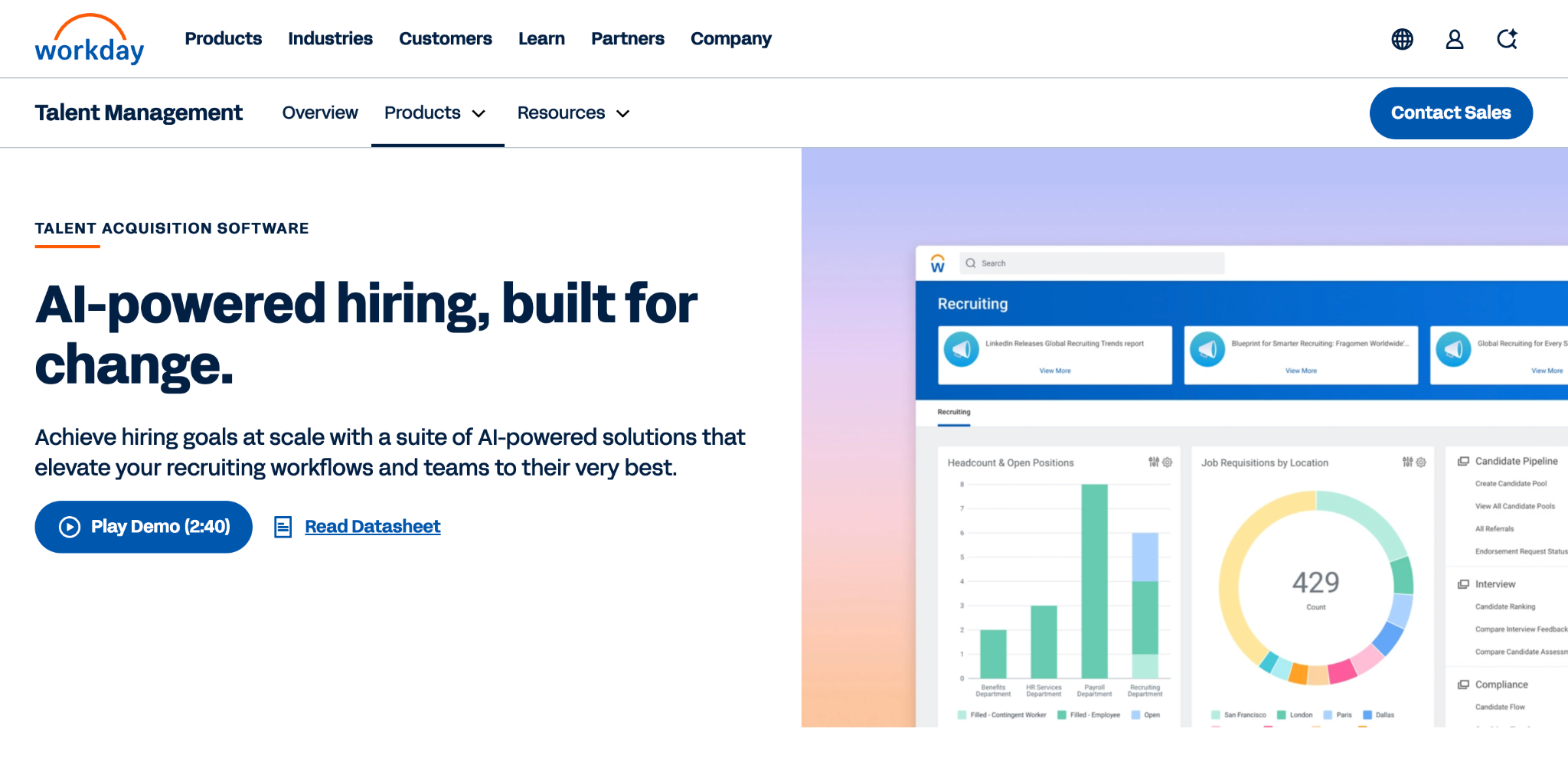
Workday Recruiting is the built-in ATS within Workday's Human Capital Management suite. If your retail organization already runs on Workday for HR, payroll, and workforce management, this is the natural choice. The tight integration means candidate data flows seamlessly into employee records, onboarding, and payroll without manual handoffs.
Workday's recent acquisition of Paradox adds a conversational AI layer specifically built for frontline hiring. The Paradox Conversational ATS replaces long application forms with text-based conversations. Candidates can apply, schedule interviews, and complete onboarding via text message.
Two things worth noting:
- Workday is a US-headquartered company. This adds a layer of complexity around data residency and US data-access laws like the CLOUD Act, for European companies. Workday does offer GDPR compliance, but it's something you configure and pay for at the enterprise level, rather than a default.
- Workday is facing a federal collective action alleging its AI screening tools disproportionately rejected applicants aged 40 and over. Courts have signalled that employers who enabled the AI features can be held liable for discriminatory outcomes, even unintentional ones.
Key features for retail
- Full lifecycle ATS integrated with Workday HCM, payroll, and workforce planning
- AI-powered candidate matching and skill recommendations
- Conversational ATS for text-based, mobile-first applications
- Branded career pages with mobile-optimized experiences
- Advanced analytics on time-to-hire, source effectiveness, and diversity
Pros
- The Paradox conversational AI is purpose-built for frontline retail hiring. Retail clients like 7-Eleven and Ace Hardware already use it to hire at scale.
- Enterprise-grade analytics and security.
Cons
- Only practical if you're already invested in the Workday ecosystem. Standalone, it's not a competitive option.
- Steep learning curve and complex implementation.
- As a US-based vendor, GDPR compliance and EU data residency require enterprise-level configuration rather than coming standard. That's extra setup and cost compared to tools that offer this out of the box.
- Active AI bias lawsuit. Workday faces a federal collective action over AI screening that allegedly rejected older applicants.
- Pricing is enterprise-level and significantly higher than mid-market ATS options.
Pricing
- Quote-based.
- Enterprise-level pricing, typically bundled with the broader Workday HCM suite.
- Standalone licensing isn't practical. Only cost-effective if you're already investing in the Workday ecosystem.
- No free trial available.
6. iCIMS
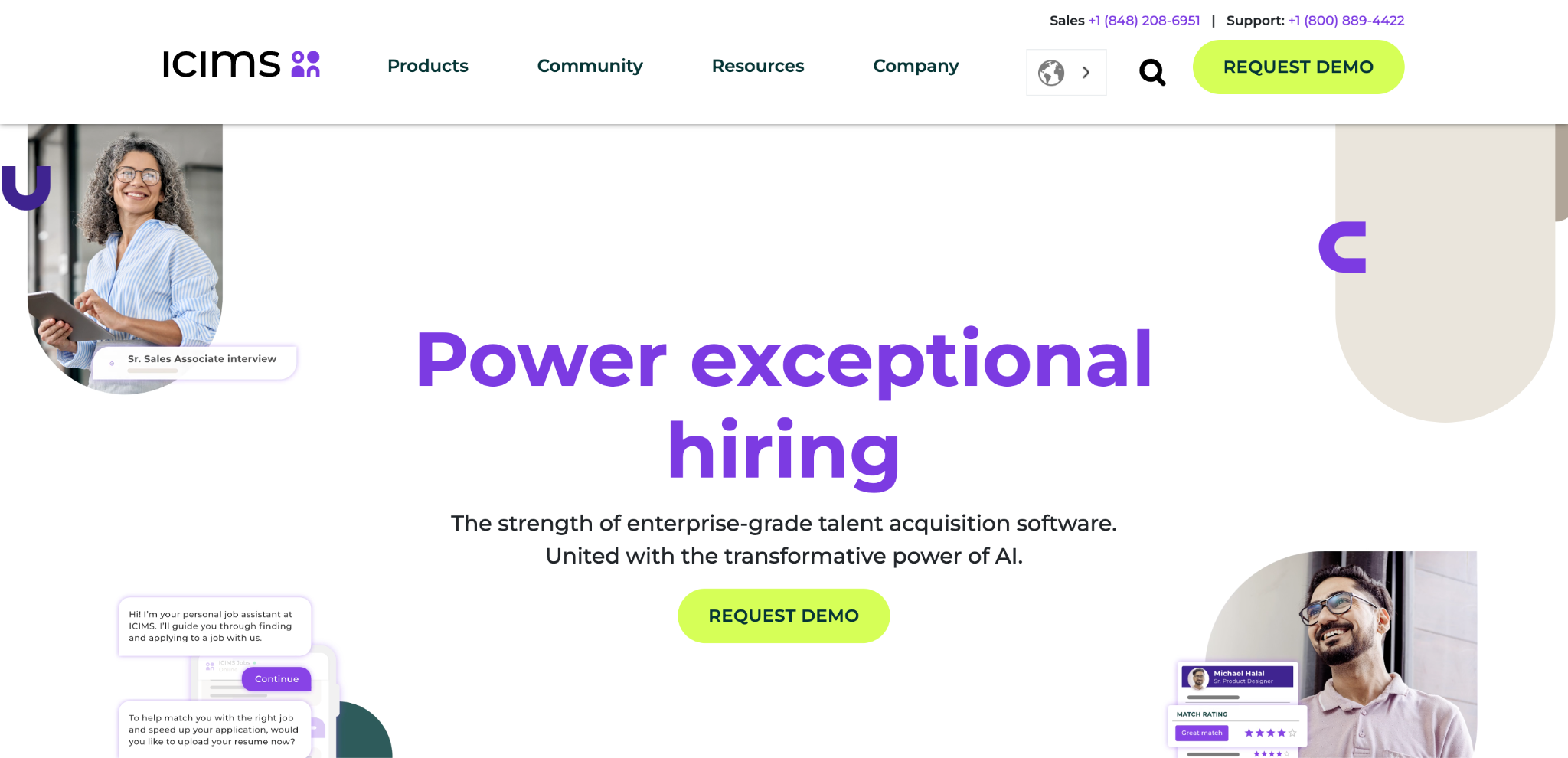
iCIMS is an enterprise talent acquisition platform used by some of the largest retail employers in the world. It combines ATS, CRM, talent marketing, and onboarding into a configurable suite. For retailers managing thousands of open roles across hundreds of locations, iCIMS offers the infrastructure to handle that volume.
Key features for retail
- High-volume candidate processing with AI-powered screening
- Talent CRM with automated nurture campaigns
- Text-based recruiting and conversational AI
- Career site builder with SEO optimization
- Advanced compliance management and equal opportunities reporting
Pros
- Purpose-built for high-volume hiring. The platform handles thousands of simultaneous applicants without performance issues.
- Strong text-recruiting capabilities for reaching frontline candidates where they are.
- Extensive compliance tools that scale across multiple jurisdictions.
Cons
- Complex implementation process. Expect weeks to months depending on scope.
- The interface can feel dated compared to newer ATS platforms.
- Pricing is enterprise-level and typically requires custom quotes.
- iCIMS compliance footprint is built around US frameworks like EEOC and OFCCP. EU-specific GDPR and data residency are configurable rather than native, so EU teams should expect extra setup.
- No free trial.
Pricing
- Quote-based.
- Estimates range from ~$11,500/year for growing companies to $140,000+/year for large enterprises.
- Implementation fees and add-on costs can be significant.
- No free trial available.
7. SmartRecruiters
SmartRecruiters is a US-headquartered enterprise ATS built for high-volume, global hiring operations. Its collaborative hiring model, broad job board network, and marketplace with pre-built integrations make it a genuine option for large retailers managing hundreds of requisitions simultaneously. The trade-off is price and complexity. It's designed for dedicated TA teams, not lean HR generalists.
SmartRecruiters was acquired by SAP in September 2025 and is now being integrated into the SAP suite. This is worth factoring in if you're not an SAP shop evaluating it as a standalone ATS, as it could critically impact their roadmap and pricing in the future.
Key features for retail
- Collaborative hiring with structured scorecards, interview guides, and team feedback workflows
- Native sourcing tools including a CRM for talent pooling
- AI-assisted matching and candidate screening
- Career site builder with multi-brand and multi-language support
- Integrations covering background checks, assessments, and HRIS
- Offer management with e-signature support
Pros
- One of the widest integration ecosystems in the market. If you already have a complex HR tech stack, SmartRecruiters plugs in without friction.
- The collaborative hiring model works well for large retail organisations where store managers, district leaders, and central HR all need a view into the same pipeline.
- Strong multiposting reach with direct connections to major job boards globally, including regional boards relevant to French retail.
Cons
- Pricing is enterprise-first. The Essential plan starts at $14,995/year, and meaningful customisation — including advanced reporting and AI features — sits behind higher tiers or add-ons.
- The interface can feel heavy for lean teams. Store managers without prior ATS experience report a steeper learning curve than expected.
- Faster support typically requires higher-tier plans. For teams used to picking up the phone, the ticketing model can be frustrating.
- Overkill for retail brands under ~500 FTE, where most of the enterprise functionality goes unused.
- SmartRecruiters built its compliance around US-headquartered operations, so GDPR and EU data residency are not their default. The SAP acquisition may improve that over time, but until the integration settles, EU teams might face uncertainty about where their data lives and how compliance is handled.
Pricing
- Not publicly listed beyond the Essential plan.
- Essential plan starts at $14,995/year.
- Other plans use a per-employee-per-month model
- Additional costs for implementation, training, support tiers, and add-ons.
- No free trial available.
→ Tellent Recruitee vs SmartRecruiters: a detailed comparison
8. Greenhouse
Greenhouse is known for its structured hiring methodology. It enforces consistent evaluation practices across your team through scorecards, interview kits, and configurable hiring stages. Retail brands that want to reduce bias and improve hire quality across locations can use Greenhouse’s framework.
Key features for retail
- Structured hiring framework with scorecards and interview kits
- 500+ integrations including Slack, LinkedIn, BambooHR, and Workday
- Diversity, equity, and inclusion tools including anonymized resume review
- Advanced analytics on time-to-hire, source quality, and pipeline health
- Configurable approval workflows
- Candidate sourcing tools and recruitment marketing
Pros
- Solid structured hiring process. Greenhouse is good for reducing bias and improving consistency across locations.
- Analytics and reporting help retail brands identify which sources, processes, and locations produce the best hires.
- Integration ecosystem that works with virtually any HR tool.
Cons
- Designed more for corporate and professional hiring than frontline retail. High-volume, hourly hiring isn't its primary strength.
- Pricing is on the higher end for mid-market.
- The emphasis on structured process can feel heavy for store managers who just need to hire quickly.
Pricing
- Quote-based.
- Three tiers (Core, Plus, Pro) with pricing scaled to headcount.
- User estimates suggest $6,500–$10,000+ annually depending on headcount.
- No free trial available.
→ Greenhouse alternatives: a detailed comparison
9. Fountain
Fountain is built specifically for high-volume, frontline hiring in retail, hospitality, and gig economy sectors. It's not a traditional ATS. It's a mobile-first hiring platform designed to move candidates from application to start date in days. If your retail operation needs to fill hundreds of roles per week, Fountain is purpose-built for that speed.
Key features for retail
- Mobile-first application experience designed for frontline workers
- Automated screening, scheduling, and candidate progression
- Text-based candidate communication
- Geolocation-based job matching
- Compliance and document verification automation
- Real-time analytics on application-to-hire conversion rates
Pros
- Purpose-built for the speed and volume retail frontline hiring demands.
- Mobile-first design matches how frontline retail candidates actually apply for jobs.
- Strong automation that keeps candidates moving through the pipeline without manual intervention.
Cons
- Purely focused on high-volume frontline roles. Not suitable for corporate or management hiring.
- Limited employer branding and career site capabilities.
- Compliance automation and document verification are built around US frontline hiring (think work authorization and I-9 checks), not EU data residency and GDPR.
- Less useful for retailers with moderate hiring volumes who need a more balanced platform.
Pricing
- Quote-based.
- Positioned as a premium solution for large-scale operations (national chains, QSR, logistics).
- No free trial available.
10. Teamtailor
Teamtailor is a Swedish ATS that built its reputation on career site design and candidate-facing experience. It's widely used across Northern Europe. The product is clean, fast to implement, and appreciated by hiring managers who find most ATS interfaces too rigid. Where it runs into problems is at scale: when workflows get complex or reporting needs get specific, the product's simpler architecture starts to show.
Key features for retail
- Drag-and-drop career site builder with templates, custom domains, and employer branding tools.
- Candidate pipeline with stage-based automations and triggered actions.
- Anonymous hiring for bias reduction.
- Built-in NPS-style candidate satisfaction surveys.
- Team collaboration with recruiter comments and @mentions.
Pros
- Retail brands with limited web resources can build a professional, branded careers page without IT support.
- Fast to deploy and easy for hiring managers to pick up, which matters when you're coordinating hiring across 20+ store locations.
- Good candidate-facing experience overall. The application flow is clean and mobile-friendly — ideal for retail candidates applying from their phones.
Cons
- Interview scheduling requires a third-party integration (Cronofy) rather than being native.
- Onboarding, requisition approvals and other modules sit outside their core pricing plan.
Pricing
- Quote-based.
- Unlimited job postings and unlimited users.
- Advanced features (job offer approvals, audit log) are available as paid add-ons
- No free trial available.
→ Tellent Recruitee vs Teamtailor: a detailed comparison
11. Pinpoint
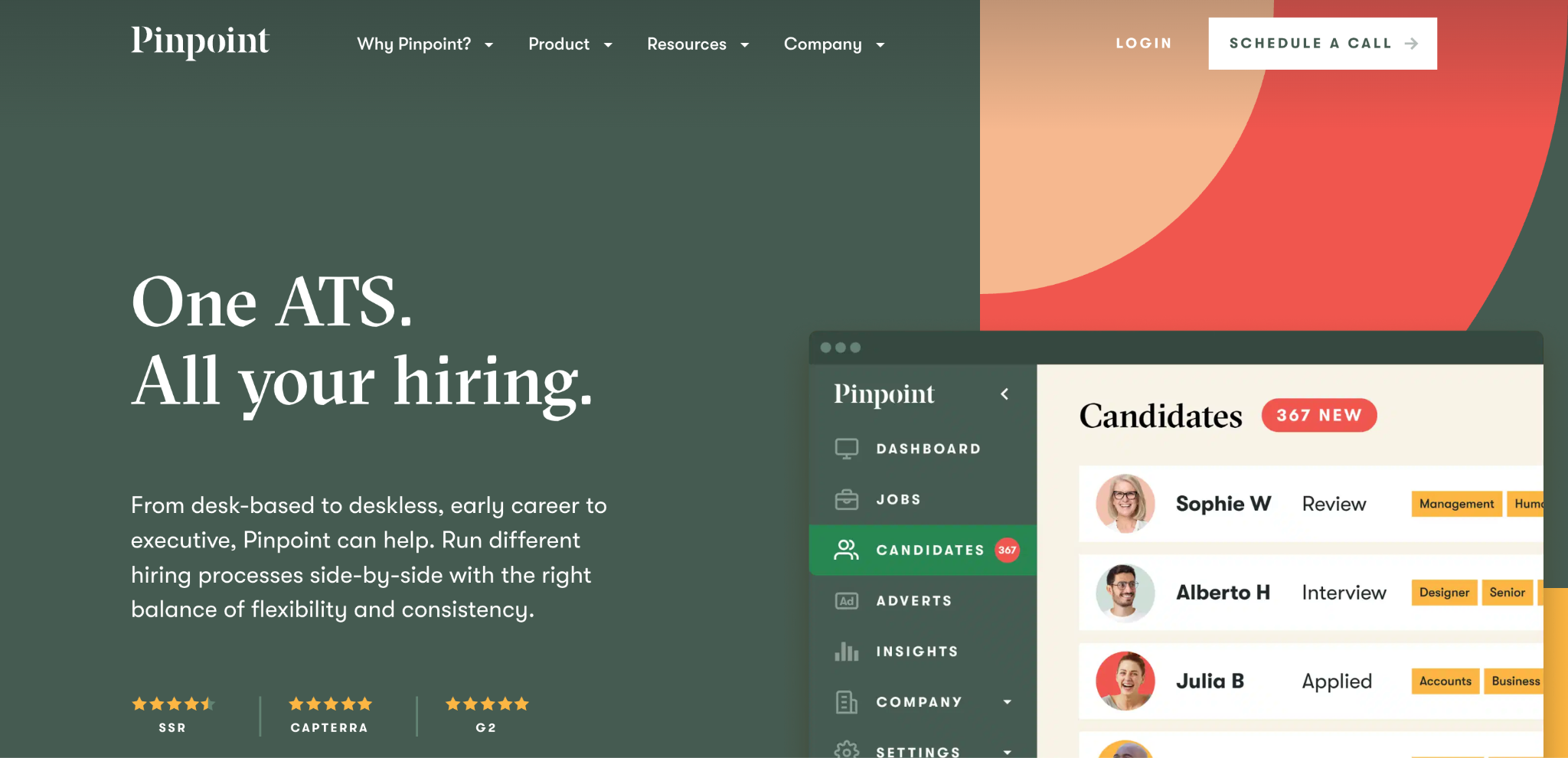
Pinpoint is built for organizations that manage different types of hiring under one roof. If you're running a corporate office, a retail division, and maybe an international subsidiary (all with distinct employer brands), this is where Pinpoint shines.
Pinpoint’s multi-brand career site builder lets each division present its own candidate experience while keeping everything centralized for your talent team.
Key features for retail
- Multi-brand career sites with separate branding for each business unit or region
- Workflow automation engine with if-this-then-that rules across the full candidate lifecycle
- Advanced CRM capabilities with talent pools and automated re-engagement campaigns
- Anonymized screening to reduce bias in early-stage candidate review
- Radius-based location filtering to find candidates near specific store locations
- Interview scheduling with multi-timezone support
- Onboarding module with task management and branded portals
Pros
- Reviews consistently praise how each division can run its own candidate experience without needing separate systems.
- Fast implementation. Most companies go live within 2–4 weeks, compared to 8+ weeks for many enterprise ATS platforms.
- Unlimited jobs and team members across all plans, which removes scaling anxiety for growing retail brands.
Cons
- Third-party estimates suggest roughly $600–$1,200/month depending on hiring volume.
- The reporting and custom dashboards can feel limited for teams that need deep analytics.
- Initial setup of complex automations and permissions has a learning curve.
Pricing
- Quote-based.
- Pricing varies by organization size and hiring volume.
- No free trial available.
12. BambooHR
BambooHR is an all-in-one HR platform with a built-in ATS module. It's not a dedicated recruiting tool. It's HR software that includes recruiting as part of a broader suite covering employee records, time tracking, benefits administration, and performance management.
BambooHR keeps things simple for small retail businesses that need one platform to handle everything.
Key features for retail
- Built-in ATS with customizable hiring pipelines
- Time tracking and PTO management
- Performance management and employee satisfaction surveys
- Onboarding with electronic signatures and task management
Pros
- Everything in one place. For small retailers, having HR, payroll, time tracking, and recruiting under one roof is a win.
- Clean, intuitive interface that non-HR people can use comfortably.
- Straightforward pricing relative to standalone enterprise ATS platforms.
Cons
- The ATS module is basic compared to dedicated recruiting platforms. Limited automation, basic talent pools, and minimal sourcing tools.
- Not built for high-volume hiring. If you're processing hundreds of applications per role, you'll hit limitations.
- Collaboration features for hiring teams are limited.
Pricing:
|
Core $10 per employee per month |
Pro $17 per employee per month |
Elite $25 per employee per month |
- Per-employee, per-month model.
- 7-day free trial available.
13. GoHire
GoHire is a lightweight, affordable ATS designed for startups and small businesses. It does the basics well: job posting across multiple boards, a branded careers page, candidate management, and interview scheduling. For small retail businesses still managing hiring through spreadsheets and email, GoHire is a clean step up without the complexity or cost of larger platforms.
Key features for retail
- Branded careers page included with all plans
- Candidate management with pipeline tracking
- Interview scheduling with calendar sync
- Team collaboration with shared notes and candidate evaluations
- Automated actions for bulk candidate management
Pros
- Plans start around €90/month, making it accessible for small retailers.
- Simple and intuitive. Minimal training needed.
- 14-day free trial lets you test before committing.
Cons
- Limited automation and workflow customization compared to mid-market platforms.
- You won't get deep analytics on source quality or hiring funnel metrics.
Pricing
|
Starter €99/mo or €990/year |
Growth €169/mo or €1.690/year |
Pro €289/mo or €2.890/year |
- Plans start at €99/month (with 2 months discounted if you pay yearly).
- Pricing scales with the number of active jobs and features.
- 14-day free trial available.
14. Jobvite
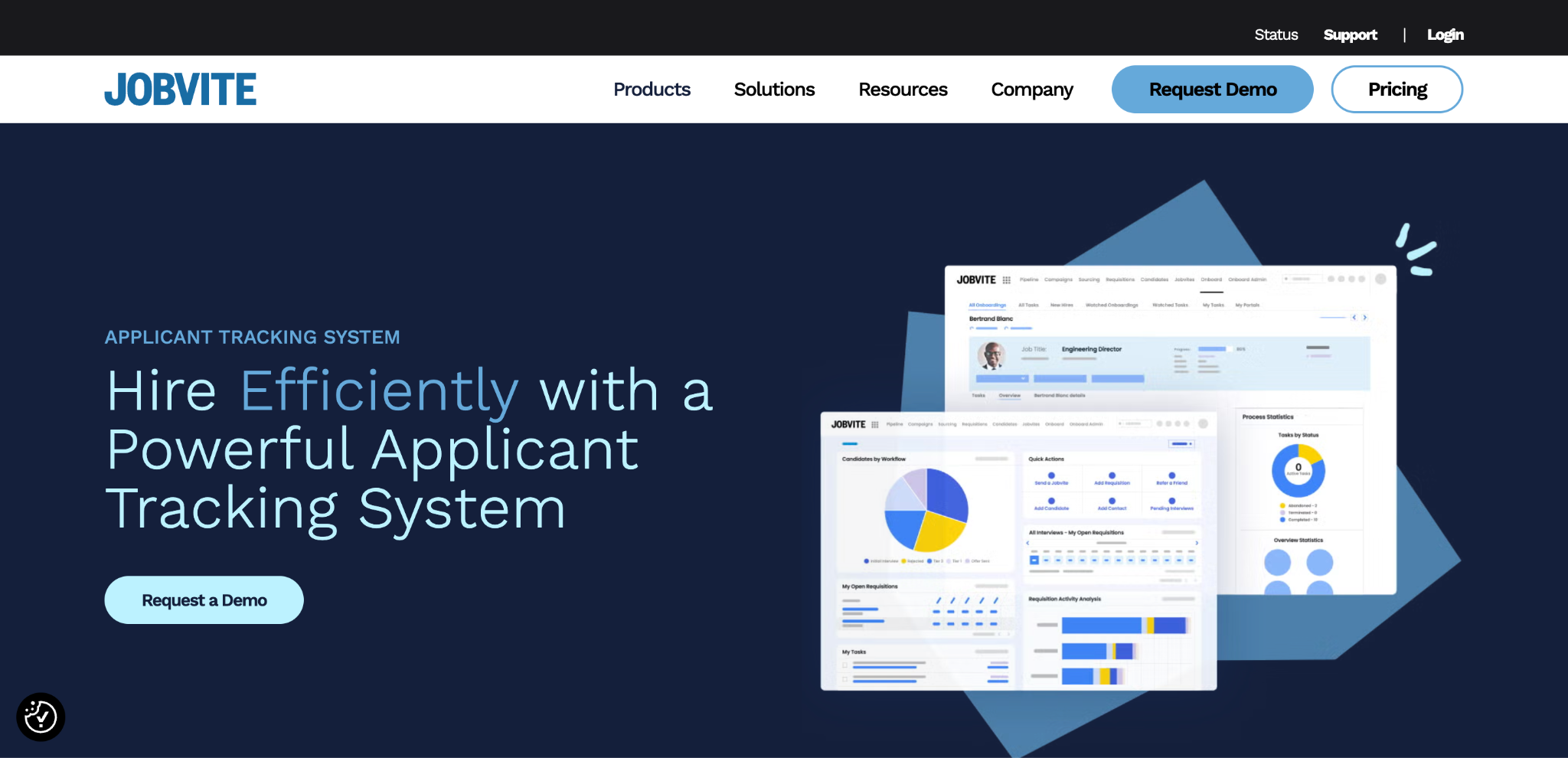
Jobvite combines ATS capabilities with recruitment marketing and employer branding tools. Its strength is in helping retail brands attract candidates proactively rather than just processing incoming applications. The platform includes career site management, social recruiting, employee referral programs, and CRM—all in one system.
Key features for retail
- Recruitment marketing with branded career sites and landing pages
- Employee referral management
- Social recruiting tools
- CRM with talent pipeline nurturing
- Video screening
- Onboarding and internal mobility tools
Pros
- Strong recruitment marketing suite that helps retail brands build employer awareness.
- Solid employee referral tools. Valuable in retail where word-of-mouth hiring is common.
- CRM capabilities for maintaining candidate relationships across hiring cycles.
Cons
- The platform can feel fragmented with different modules that sometimes don't integrate as expected.
- Some users report a steep learning curve for less technical team members.
- Jobvite is GDPR-compliant, but it leans on self-service: handling data subject requests is largely on you (Jobvite points customers to tools like OneTrust), and it doesn't publish a named EU data residency option the way some European-hosted vendors do.
- Pricing can be higher than expected for mid-market buyers.
Pricing
- Quote-based.
- Advanced features such as AI Interview Companion or Onboarding are priced separately.
- No free trial available.
15. Lever
Lever combines ATS and CRM in one platform, making it useful for retail brands that want to build long-term candidate relationships rather than just fill immediate openings. Its approach treats every interaction as a touchpoint in an ongoing relationship, which works well for retail's cyclical hiring patterns.
Key features for retail
- Combined ATS + CRM in a single platform
- Visual pipeline with drag-and-drop candidate management
- Automated email nurture sequences
- DEI analytics and reporting
- Interview scheduling with calendar integrations
- Customizable approval workflows
Pros
- The combined ATS/CRM lets retailers maintain relationships with seasonal candidates year-round.
- Clean, modern interface that's easy for non-recruiters to navigate.
- Strong analytics on pipeline health and recruiting performance.
Cons
- Best suited for professional and corporate hiring. High-volume frontline retail hiring isn't its primary design case.
- Some users report limited customization options for workflows.
Pricing
- Quote-based.
- Advanced add-ons (automation, onboarding) are priced separately.
- No free trial available.
16. Eploy
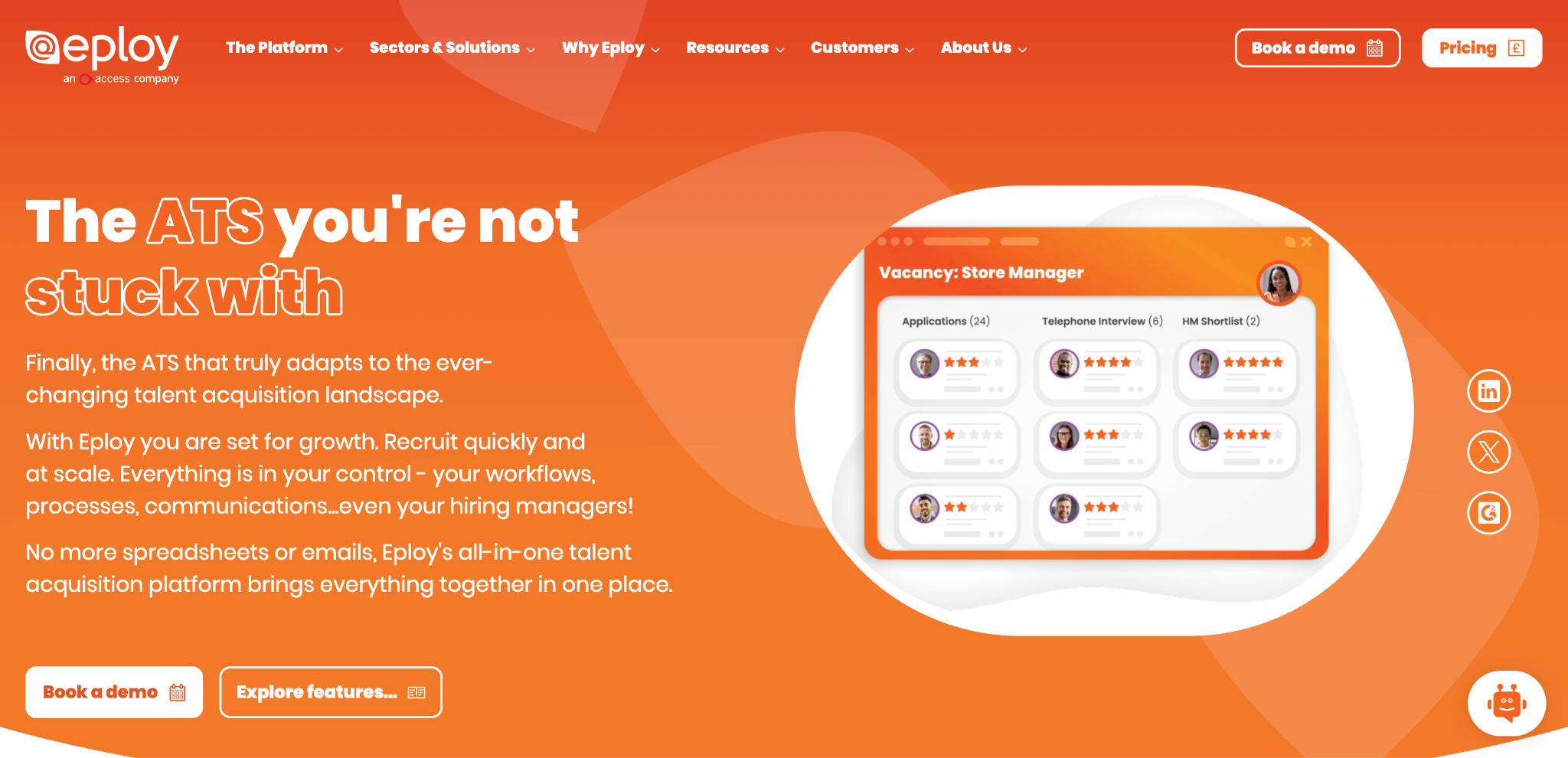
Eploy is a UK-headquartered ATS that has built strong traction with British retailers. It combines ATS, CRM, and onboarding in a single platform, with deep compliance features tailored for UK employment law. If you're a UK retail brand, Eploy offers sector-specific expertise that many US-centric platforms lack.
Key features for retail
- Combined ATS, CRM, and onboarding platform
- UK-specific compliance tools including right-to-work checks
- Branded career sites with sector-specific templates
- Reporting and analytics with retail-specific benchmarks
- Talent pool management
- Multi-location management
Pros
- Deep UK retail expertise (clients include Wren Kitchens, B&M, and Morrisons).
- Built-in UK compliance features.
- Strong onboarding capabilities included rather than sold as an add-on.
Cons
- Primarily UK-focused. Retailers operating outside the UK may find it less suited to their compliance and market needs.
- Smaller integration ecosystem compared to global platforms.
- The interface can feel less modern than newer ATS entrants.
Pricing
- Quote-based.
- No free trial available.
Quick comparison table
Use this table for a quick side-by-side comparison. Pricing reflects starting tiers, and actual costs vary by company size and features.
|
ATS Solution |
Starting Price |
Best For (Size) |
Key Differentiator |
Mobile-Optimized |
Multi-Location |
Free Trial |
|
Tellent Recruitee |
Custom quote |
50–2,000+ |
Collaborative hiring + proactive sourcing + WhatsApp Hiring |
Yes |
Yes |
18 days |
|
Flatchr |
Custom quote (used to start at €49/mo for 1 active job) |
Under 50 |
French-native, easy deployment |
Basic |
Limited |
No |
|
Beetween |
Custom quote |
50–500 |
DAR module |
No |
Yes |
No |
|
Cegid (Talentsoft) |
Custom quote |
500+ |
Full HCM suite, 3,500+ job boards |
Yes |
Yes |
No |
|
Workday Recruiting |
Custom quote |
1000+ |
Paradox conversational AI + HCM integration |
Yes |
Yes |
No |
|
iCIMS |
Custom quote |
1,000–50,000+ |
Enterprise scale high-volume + text recruiting |
Yes |
Yes |
No |
|
SmartRecruiters |
From $14,995/yr |
500–5,000 |
Enterprise scale + AI recruiting |
Yes |
Yes |
No |
|
Greenhouse |
~$6,500/yr (according to online user reviews) |
250–5,000+ |
Structured hiring methodology +DEI tools |
Yes |
Yes |
No |
|
Fountain |
Custom quote |
1,000+ |
Ultra-high-volume frontline speed |
Yes |
Yes |
No |
|
Teamtailor |
Custom quote |
20–500 |
Career site builder and candidate UX |
Yes |
Yes |
No |
|
Pinpoint |
Custom quote |
200–2,000+ |
Multi-brand career sites + complex hiring streams |
Yes |
Yes |
No |
|
BambooHR |
$10/mo per employee |
25–250 |
All-in-one HR + basic ATS |
Yes |
Limited |
7 days |
|
GoHire |
€99/mo or €990/year |
Under 50 |
Budget-friendly simplicity |
Yes |
Limited |
14 days |
|
Jobvite |
Custom quote |
100–2,500+ |
Recruitment marketing + referral programs |
Yes |
Yes |
No |
|
Lever |
Custom quote |
200–1,500 |
Native ATS + CRM for talent pipelines |
Yes |
Yes |
No |
|
Eploy |
Custom quote |
200–2,000+ |
UK retail specialist + onboarding included |
Yes |
Yes |
No |
How to choose the right ATS for your retail business
Every retail operation is different. A 10-store regional chain with 200 employees faces entirely different challenges than a national brand with 500 locations. Here's how to work through the decision.
Define your retail hiring profile
Before you start comparing features, map out three things about your operation:
-
Operational scale: How many locations do you have? How many hires do you make per month? Are you concentrated in one region or spread across multiple markets? A 15-store chain in Paris has very different requirements than a 200-location European brand.
-
Hiring patterns: Is your hiring volume relatively steady year-round, or do you see 1–3x spikes during seasonal peaks? What percentage of your roles are hourly versus salaried? Retailers with extreme seasonal swings need platforms that scale up fast and scale back down without waste.
-
Organizational structure: Who makes hiring decisions in your organization? If store managers own hiring with light oversight from HR, you need a platform that's intuitive enough for non-HR users. If everything runs through a central talent team, you'll prioritize different features, such as workflow routing and approval chains.
Platforms like Tellent Recruitee are designed for this middle ground. Flexible enough to handle multi-location complexity without requiring a dedicated HR tech team to manage the system.
Prioritize mobile-first candidate experience
Most retail candidates apply from their phones, often during a break or commute. If your application process requires a desktop, a login, or more than a few minutes to complete, you're losing people.
When evaluating platforms, test the mobile application flow yourself. Try applying for a role on your phone. Count how many steps it takes. Note whether you need to create an account. Check if progress saves when you switch apps. Features like one-tap apply, WhatsApp-based applications, and text-based communication are the difference between filling roles on time and falling behind.
Tellent Recruitee's WhatsApp Hiring and one-tap apply let candidates complete an application in under two minutes on their phone, with no account creation required.
Evaluate automation and integration capabilities
Retail hiring volume makes manual processes unsustainable. Your team can't individually screen 300 applications for a seasonal associate role. They can't manually coordinate interview schedules across 15 stores. And they definitely can't send personalized status updates to every candidate without automation.
Look for automation in the areas that eat the most time: resume parsing for high-volume screening, knockout questions that filter unqualified applicants immediately, scheduled interview reminders to reduce no-shows, and bulk communication tools for candidate updates.
Beyond automation, check how the platform integrates with your existing tech stack. Does it connect with your HRIS or payroll system? Your shift scheduling software? Your background check provider? Disconnected tools create manual data entry, and that's where errors and delays creep in.
Tellent Recruitee includes trigger-based automation across the full pipeline and 200+ integrations out of the box, without requiring enterprise pricing tiers to access them.
Assess collaboration features for distributed teams
The challenge unique to retail hiring is coordinating decisions across people who are rarely in the same room. A store manager in one city, a district manager in another, and central HR at headquarters all need to weigh in, often on different schedules.
The platform you choose should make this natural. Look for granular permission structures that let store managers see and act on what's relevant to them without accessing information they shouldn't. Evaluation tools that let multiple stakeholders submit independent feedback prevent the loudest voice from dominating. And centralized dashboards that give HR leadership visibility across all locations are essential for spotting bottlenecks and maintaining consistency.
This is what Tellent Recruitee's Fair Evaluations, granular permissions, and team-based hiring model were designed to solve, giving every stakeholder the right level of access without overwhelming anyone.
Test with real retail hiring scenarios
Vendor demos are curated performances. They show you what the platform looks like under ideal conditions, with clean data and a scripted workflow. Not really how hiring works, right?
Before committing, run a real pilot with 2–3 finalist platforms. Post an actual seasonal role and measure how long it takes from posting to first interview scheduled. Invite a store manager to use the system and rate how intuitive it is. Apply for a role on your own phone and note every point of friction. Check whether the reporting shows you actionable data or just vanity metrics. A two-week trial with real hiring scenarios will tell you more than any sales presentation.
Tellent Recruitee offers a free trial so you can run exactly this kind of test before committing.
Best practices for retail ATS implementation
Build talent pools before seasonal demands
The smartest retailers handle seasonal surges by re-engaging candidates they already know.
Start building segmented talent pools 90 days before your seasonal peak. Separate candidates by role type and location. Include past seasonal workers, silver-medalist candidates from recent hiring rounds, and employee referrals. Send them light engagement — store openings, culture content, early-access job alerts — to keep the relationship warm.
When you're ready to hire, these candidates are familiar with your brand and can move through the pipeline much faster. Retailers using this approach typically cut seasonal time-to-hire significantly and reduce staffing agency dependency.
Create location-specific workflows that scale
You need consistency across your hiring process without eliminating the flexibility individual locations require. The solution is standardizing your core pipeline.
Define 5–7 universal hiring stages (application, screen, interview, offer, onboard) that apply company-wide, then allow regional managers to add conditional steps for local requirements.
One location might need bilingual screening. Another might require a specific certification check. Build those as add-on steps within the standard framework, not as separate processes.
Empower store managers with simple scorecards
Store managers aren't HR professionals, and your evaluation tools shouldn't require them to be. Create simple, structured scorecards with 4–6 criteria that map to actual job performance indicators. Use rating scales, not open-ended questions. Make the scorecards available on mobile so managers can complete them immediately after an interview rather than trying to remember details hours later.
Structured evaluations reduce bias, speed up decisions, and create defensible hiring documentation. All of these things matter when you're managing hiring across many locations.
Measure metrics that matter for retail
Not all hiring metrics are equally useful for retail. Focus on the ones that drive improvement:
-
Time-to-hire by location and role type reveals process bottlenecks. If one store consistently takes twice as long to fill roles, that's a workflow or manager engagement problem you should fix.
-
Source of hire quality tells you where to invest your job board spend. If Indeed drives volume but employee referrals produce candidates who stay longer, shift your budget accordingly.
-
Offer acceptance rate by location flags compensation or culture issues. A low acceptance rate at specific stores signals problems beyond recruiting that need attention.
-
90-day retention rate is the ultimate hiring quality indicator. If new hires are leaving within three months, you're either attracting the wrong candidates or your onboarding needs work.
Common retail ATS implementation challenges
Getting store manager buy-in
This is where most retail ATS implementations succeed or fail. Store managers are busy. They're already juggling staffing, customer service, inventory, and operations. A new hiring system can easily feel like one more corporate initiative that adds work rather than removing it.
The fix is showing them the value on their terms, not HR's. Involve 1–3 manager champions in the platform selection process. Create training that's focused on their specific workflow: "How to review a candidate in 2 minutes" rather than "Overview of the ATS." Launch first with high-turnover roles where the pain of manual hiring is most acute, so they experience the time savings immediately. Celebrate early wins publicly.
Manager adoption determines whether your implementation succeeds more than any feature set ever will.
Data migration from legacy systems
If you're moving from spreadsheets, an older ATS, or — let's be honest — a chaotic mix of email threads and sticky notes, the migration can feel overwhelming. The key is not trying to move everything.
Prioritize active candidate pipelines and recent hires from the last 3-6 months. Establish standardized naming conventions and tags before you start importing. Run old and new systems in parallel for 2–4 weeks during transition so nothing falls through the cracks.
Accept that a perfect historical migration matters much less than having clean, consistent processes going forward.
Maintaining compliance across locations
When you're hiring across multiple regions, countries, or jurisdictions, compliance complexity multiplies fast. Look for ATS features that build compliance into the process rather than relying on individual managers to remember the rules.
Customizable application forms by location ensure you're collecting the right information everywhere. Automated compliance notifications handle local legal requirements without manual tracking. Audit trails for all hiring decisions create the documentation you'll need if a decision is ever questioned.
Compliance failures are expensive, both in direct fines and in reputation damage. A well-configured ATS provides insurance through consistent documentation.Choosing the right platform for your retail reality
Retail hiring will never be simple. The turnover rates, seasonal demand swings, and multi-location complexity are part of the industry. But the right ATS transforms how you handle that complexity, turning reactive firefighting into proactive talent management.
The platform you choose should match your real operation. If you're a growing multi-location brand that needs collaborative hiring without enterprise bloat, look at platforms like Tellent Recruitee that balance depth with usability. If you're a national chain already running Workday, lean into that ecosystem. If you're a 20-person boutique retailer, start with a simpler tool and grow from there.
Whatever you choose, prioritize mobile-first candidate experience, automation for the tasks that drown your team, and collaboration tools that work for managers who aren't HR professionals. Those three factors will have more impact on your retail hiring outcomes than any single feature on a comparison chart.
Start hiring smarter, your way
Hopefully this comparison gives you a clearer picture of what's actually available and where each platform fits.
Tellent Recruitee was built specifically to solve the problem that retail HR teams face most often: needing the flexibility and ease-of-use of a modern mid-market tool, with enough depth to handle real multi-location, high-volume hiring complexity. And it's trusted by over 7,000 organizations worldwide.
If you want to see it in action, you can request a personalized demo or start a free trial and explore it on your own terms—no sales call required.