


.webp)
Hiring in a small or scaling business has a special kind of chaos. One week you're polishing a job ad at 9pm because "we need someone yesterday," the next week you're juggling five interviewers across three calendars, and then a strong candidate vanishes because your follow-up fell into someone's inbox.
"Tracking applicants" is only a fraction of the challenge. The truly hard part is keeping momentum without turning hiring into everyone's second job.
Most applicant tracking systems for small to medium businesses force an annoying trade-off:
- Pick a simple tool and accept rigid workflows, weak reporting, and a lot of manual chasing.
- Or pick a powerful tool and accept setup overhead, admin work, and a price that only makes sense once you're already big.
You can get either speed-to-start or control, but many teams feel like they can't get both.
Tellent Recruitee was built to close that gap: a flexible ATS built for growing and mid-sized hiring teams
to collaborate in one place, adapt their workflow to how they actually hire, and still keep a clean audit trail when they need it.
Quick comparison: 13 ATS platforms for SMBs at a glance
Before diving into detail, here's a side-by-side snapshot. Pricing listed is what's publicly available — several tools require a sales conversation.
|
Tool |
Starting Price |
Best For |
Free Trial |
Standout Feature |
Company Size Fit |
|---|---|---|---|---|---|
|
Tellent Recruitee |
Custom |
Collaborative hiring at growing teams and mid-sized companies |
18 days |
WhatsApp Hiring, Mobile App, Workflow Automations, AI Matching and Screening |
50-3000 |
|
Personio |
Custom |
All-in-one European HR suite |
14 days |
HR + ATS in one platform |
10–250 |
|
Teamtailor |
Custom |
Employer branding & career sites |
No |
Career site builder |
20–500 |
|
SmartRecruiters |
From $14,995/yr |
Enterprise-grade talent acquisition |
No |
Winston AI, 300+ integrations |
200–5,000 |
|
Workable |
$360/mo or $3,588/year |
AI sourcing & broad feature set |
15 days |
400M+ candidate database |
20–500 |
|
Breezy HR |
Free tier |
Startups testing ATS waters |
Free plan and 14-day full feature trial |
Visual drag-and-drop pipeline |
1–50 |
|
JazzHR |
$110/mo or $1,000/year |
Budget-friendly basics |
14 days |
Unlimited users at low price |
5–100 |
|
Jobylon |
Custom |
Companies with Northern European candidates that need more customization |
No free trial |
Beautiful job ads, LinkedIn partner |
50–500 |
|
Jobtoolz |
€231/mo or €2,496/year |
Belgian/Dutch SMBs, employer branding |
14 days |
All features on all plans |
20–250 |
|
Ubeeo |
Custom |
Dutch public sector & enterprise |
No free trial |
Native Visma/AFAS integration |
250–5,000 |
|
Zoho Recruit |
Free tier |
Zoho ecosystem users |
Free plan and 15-day full feature trial |
ATS + CRM in one |
10–200 |
|
BambooHR |
$10/mo per employee or $250 USD/mo for companies with 25 employees or fewer |
HR + recruiting in one platform |
7 days |
ATS-to-employee handoff |
20–500 |
|
Manatal |
$19/user/mo or $15/user/mo if billed annually |
Affordable AI recruiting |
14 days |
AI candidate scoring |
5–100 |
Choosing the best applicant tracking system for SMBs
Whether you're a founder/ops lead trying to hire your first 10–50 employees or a lean HR/People team that needs to keep hiring managers aligned, this guide covers popular ATS options (including our own) so you can compare platforms based on what usually matters most in a small to medium business.
We've also included several platforms with strong roots in the Benelux and Northern European market, because most ATS comparison guides are US-centric and skip the tools that Dutch, Belgian, and European companies actually find during their search.
Let's dive in.
1. Tellent Recruitee
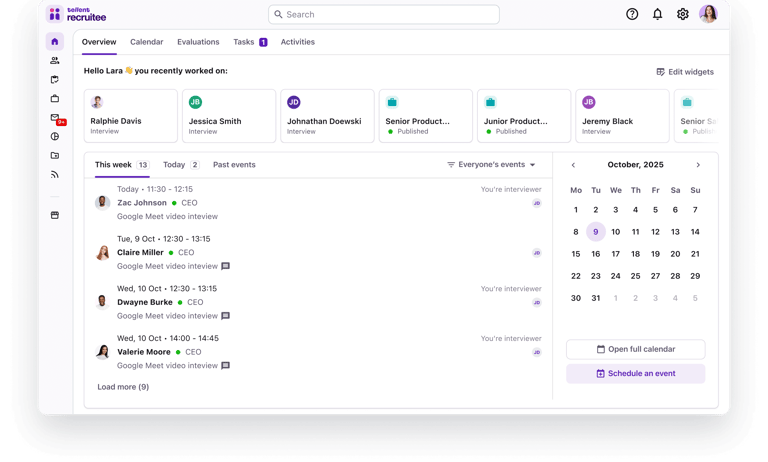
Here's what we'll cover in this section:
- Brief overview of how Tellent Recruitee works (2-min video)
- Where other applicant tracking systems for SMBs fall short
- Tellent Recruitee's 3 key differentiating features
- Top use cases + customer case studies
- A note about job posting, candidate importing, integrations, and reporting
Brief overview of how Tellent Recruitee works (2-minute video)
The quickest way to see what Tellent Recruitee looks like in practice is this short explainer:
If you want a detailed walkthrough, you can request a demo or start a free trial.
On demo calls, we always try to keep it real: instead of showing a polished "perfect" account, we focus on the flows you'll actually run in week one — creating a job, capturing applicants, routing feedback, and making sure nothing gets stuck.
Where other applicant tracking systems for SMBs fall short
After watching small teams evaluate ATS options, the same scenarios show up again and again:
- Option 1: "Keep it simple" (email + spreadsheets + a calendar) — You move fast at first, but you lose track of who owns next steps, feedback gets scattered across threads, and there's no consistent process when hiring managers get busy.
- Option 2: "Buy the enterprise-grade platform" — You get depth, but you pay for complexity: setup time, rigid processes, and a heavier admin load than most small teams can realistically own.
- Option 3: "Stick with the tool you started with" — You adopted something lightweight when the company was small. It still technically works, but now you're managing multiple teams, hiring managers want visibility, leadership is asking for data, and the tool can't keep up.
The result is predictable: hiring becomes inconsistent. One role gets handled carefully, another gets rushed, and candidates experience the difference. There's also a quieter risk: CVs sitting in personal inboxes and candidate details spread across spreadsheets are both messy and a GDPR liability.
And here's the part that always feels a bit ridiculous once you say it out loud: why should "being small" mean you have to accept either messy collaboration, slow process or using a tool that doesn’t add real value anymore?
Tellent Recruitee's 4 key differentiating features
Here are 4 Tellent Recruitee capabilities that address the trade-offs above.
Key differentiator #1: Flexible workflows that you can always adapt and reuse
Growing companies change hiring processes constantly. One quarter you're hiring two roles. The next quarter you're hiring 12 across multiple teams. A usable ATS needs to handle both without turning into a configuration project.
In Tellent Recruitee, your core building blocks are straightforward: jobs, candidates, stages, and automation. You can start from a clean slate (as in the Jobs view above) and build a workflow that matches how you already hire.
Here's how it plays out in practice:
Pipeline stages that match the role (not the vendor's default). You can keep a short, practical pipeline for most roles, and extend it when you need structure (e.g., adding a work sample stage or an extra interview round).

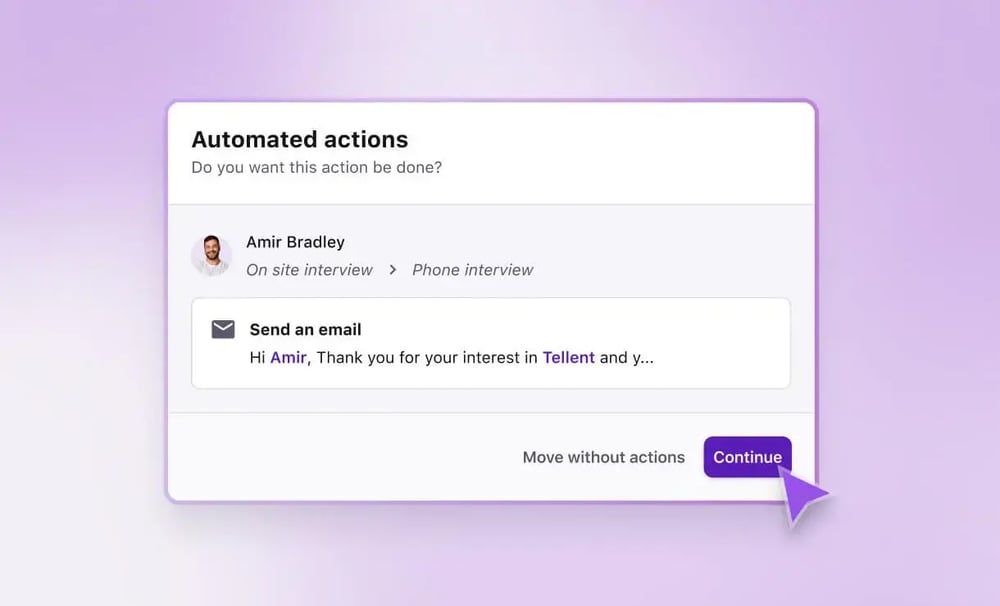
Automation so steps don't get "forgotten". Tellent Recruitee supports pipeline automation in its paid plans (see pricing details). The goal isn't to "automate hiring." It's to stop the constant manual nudging that kills speed.
Granular user roles and permissions. In most SMBs, the same person wears multiple hats. Tellent Recruitee lets you customize permissions per user rather than slotting everyone into fixed role templates. You control exactly who sees what (candidate data, pipeline stages, reports, and settings) and what they can do.
Talent pools to keep candidates warm. Talent pools let you save and segment past applicants by skill, role type, or location, and re-engage them automatically when a relevant role opens. Tools like Teamtailor don’t support dedicated talent pool features and force users to work around this with tags, which means more manual upkeep.
Custom fields to track what actually matters to you. As your hiring matures, you'll want to track details like department, location, contract type, or internal cost center. Tellent Recruitee supports custom job fields (limits depend on plan).
A single system of record When the decision happens, the context is already there: who reviewed what, what was agreed, and what the next step is.
Key differentiator #2: Collaboration that doesn't live in email threads
In SMBs, the "ATS problem" is often a collaboration problem.
Most platforms give you a place to store candidates, but the real work — follow-ups, feedback, and alignment — still leaks into Slack and email. That's how decisions get delayed, and how you end up re-reading the same context five times.
Tellent Recruitee includes a dedicated Mailbox module, so your team can keep candidate communication attached to the hiring workflow. And the Fair Evaluations feature hides individual feedback until everyone has submitted their scorecard — preventing the first reviewer's opinion from anchoring the group's assessment.
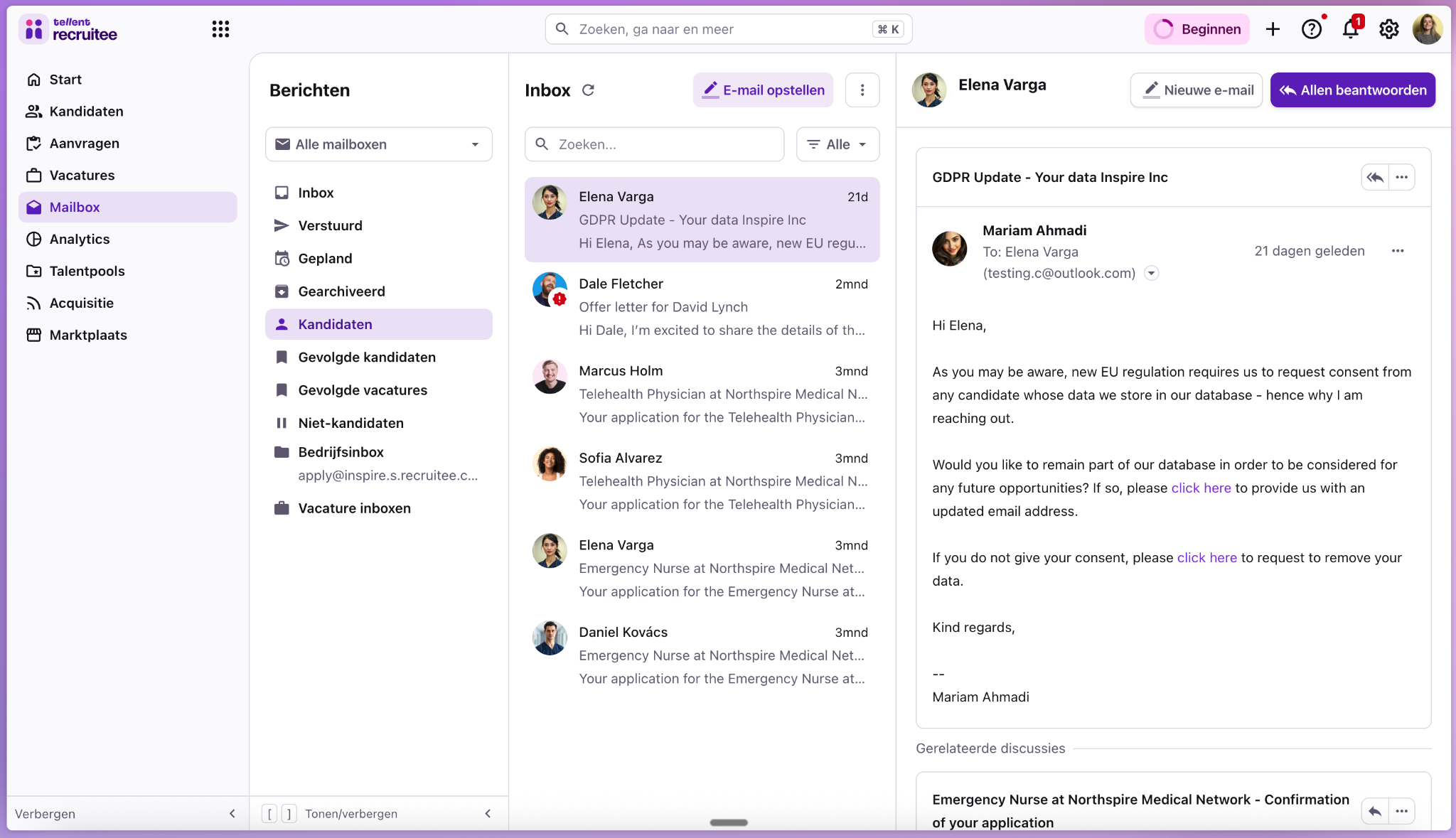
A few pieces that matter for small teams:
Keep candidate conversations in one place. Instead of asking "who replied last?" you have one source of truth for the message history.
Shared visibility without giving everyone recruiter-level access. You can bring hiring managers into the process without turning the tool into a free-for-all.
Fewer handoffs between tools. Tellent Recruitee plans include email and calendar sync (see pricing). For a small team, this is less about "features" and more about reducing daily friction.
Does this collaboration style actually reduce time-to-hire?
Teamleader, a work management company with 150+ employees across Ghent, Paris, Amsterdam, and Lisbon, reduced their time-to-hire from 40 days to 27 days after implementing collaborative hiring with Tellent Recruitee. As Femke De Vleeschouwer put it: "Having this set up in place has really helped improve internal communications across all stages of our hiring process."
Once collaboration is centralized, it becomes easier to:
- Ask hiring managers for feedback with a clear deadline
- See bottlenecks by stage (instead of guessing)
- Keep candidates warm with consistent follow-up
- Loop in interviewers without losing context
- Reduce “double work” between the recruiter and the hiring manager
- Keep approvals and offer steps moving
- Make handoff to onboarding less painful
If you want to see how this feels in your own hiring flow, request a demo.
Key differentiator #3: AI that supports complex work, not just repetitive tasks
Automation only handles steps you can define in advance. What really slows teams down is all the work surrounding hiring decisions: summarizing five different scorecards, writing a personalized rejection that doesn’t sound robotic, or translating a job ad into German when nobody on the team speaks German. That's where Tellent Recruitee's AI capabilities go further.
-
AI Evaluation Insights. After your team submits their scorecards, AI summarizes the collective feedback into a quick read. Hiring managers get a synthesized overview that helps them make faster, more consistent decisions by showing where the team agrees, where they don’t, and what the key takeaways are.
-
AI Writer. Draft candidate emails, translate job descriptions for multi-language career sites, and summarize long feedback threads. For Benelux companies hiring across Dutch, English, French, and German, AI translation removes a bottleneck that otherwise requires bilingual team members or outsourcing translation services.
-
AI Candidate Screening. When applications come in fast (during a growth sprint or a seasonal surge), AI helps hiring teams process inbound candidates more efficiently. The Screening Assistant analyzes CVs against job-specific criteria, providing clear summaries and insights while keeping all hiring decisions fully controlled by people.
-
AI Candidate Matching. The Matching Assistant helps hiring teams rediscover relevant candidates from past applicants, talent pool members, and people who applied for different roles. It helps reduce manual search effort while keeping recruiters informed and people fully in control of hiring decisions.
-
AI + automation working together. The automation engine handles rules-based work (when X happens, do Y). AI supports the context-dependent work (summarize this, draft that, translate this). Together, they reduce the manual load that compounds as hiring volume grows.
Key differentiator #4: A growth path from first hire to multi-team hiring
Growing companies change fast. The ATS you pick in year one shouldn't be something you outgrow the moment you add a second team or a second location.
That's why Tellent Recruitee is structured around a clear growth path:
- Start: build the basics — up to 5 active job posts, careers site (single-page), multi-job board posting, team collaboration, and standard reporting.
- Advance: expand to unlimited job posts, multi-page careers site, multi-location/multi-language support, referrals, candidate self-scheduling, structured evaluation forms, offer letter generation, AI-powered screening (100 credits/month), AI-powered matching (3 searches/month), and advanced reporting.
- Optimize: add SSO, API support, approval workflows for requisitions, unlimited custom fields, AI-powered screening (full functionality), AI-powered matching (65 searches/month), and BI integrations.
All plans include unlimited users. (Full plan details.)
Here's how those options map to real-world needs:
Option A: Keep it lean (first ATS, light admin). You set up the core pipeline, keep the careers page simple, and focus on collaboration and follow-ups.
Option B: Add structure without adding headcount. As hiring volume increases, self-scheduling, evaluation templates, and automation reduce the "coordination tax."
Option C: Add governance when you need it. When approvals, compliance, or reporting expectations increase, features like requisition approvals, SSO, and deeper analytics become relevant.
Option D: Expand into full HR management. When you're ready to go beyond hiring, Tellent Recruitee connects directly to Tellent HR to cover onboarding, employee records, time-off, and performance management on the same platform. No data migration needed. The candidates you hire today become employee records tomorrow.
If you want related product updates on offers and agency workflows, see Tellent’s product roundup posts (e.g. Q3 2025 Product Roundup).
4 use cases with real customer results
Scaling a fast-growing team: Origin Materials grew from 25 to 200 employees using Tellent Recruitee. Their Senior HR Manager conducts a quick Tellent Recruitee training for new hiring managers — most of whom are scientists and engineers — and reports minimal follow-up questions because the interface is self-explanatory.
Cutting time-to-hire through collaboration: Teamleader (150+ employees, four European offices) reduced time-to-hire from 40 to 27 days. They went from 10 active users on their previous ATS to over 50 active users in Tellent Recruitee, because the platform made it easy for non-recruiters to participate.
Fast setup with immediate results: Solutions 4 Delivery set up Tellent Recruitee in one week and made 10 hires in their first 2 months. Their Head of Growth built the careers site himself without needing developer support.
Boosting candidate pipeline: Incentro revamped their careers site using Tellent Recruitee's CareersHub and saw a 140% increase in applicants, largely by creating a career page that resonated with their IT-savvy candidate audience.
A note about job posting, candidate importing, integrations, and reporting
Most ATS platforms check the same basic boxes. These features matter, but they're not usually the deciding factor once you narrow down to a shortlist.
We’re not going to pretend Tellent Recruitee is the only tool with these capabilities — they're table stakes. You should compare them after you're confident the core workflow and collaboration model fits your team.
That said, here's what Tellent Recruitee covers:
- No-code career site builder (CareersHub): Multi-page, multi-language branded career sites built via drag-and-drop. Companies in the Netherlands and Belgium hiring local and international candidates can publish the same role in Dutch and English without maintaining two separate career pages.
- Multi-channel sourcing: Integrated job board distribution, Chrome extension for LinkedIn sourcing, ReferralsHub for employee referrals, and Talent Pools CRM to keep past candidates warm.
- Workflow Automations: Trigger-based automations for rejection emails, stage transitions, task assignments, and scorecard requests — powerful out-of-the-box, no configuration expert needed.
- Fair Evaluations & structured scorecards: Standardized criteria with hidden feedback until everyone submits, reducing groupthink across your hiring team.
- Compliance built in: ISO 27001 and SOC 2 Type II certified, GDPR settings and granular access controls included on all plans. Support is available in Dutch, German, French, and English, so your compliance questions get answered in your language.
- AI tools: AI-generated evaluation summaries, smart email drafting, job description translation, candidate communication assistance, candidate screening, and candidate matching. All features built into the workflow, not bolted on as an add-on.
- 200+ integrations through the Tellent Marketplace, plus API access on all plans.
Competitor comparison
2. Personio
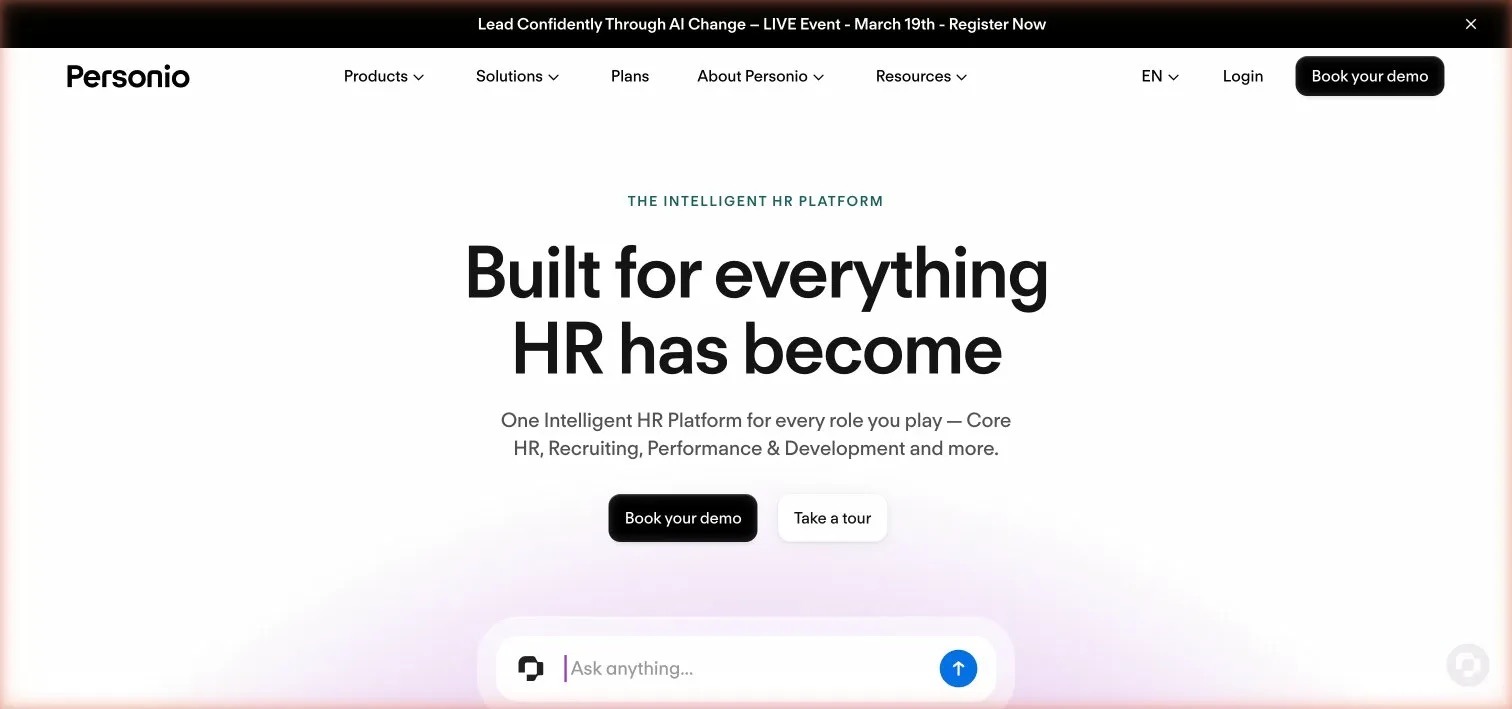
Personio is a European HR platform with recruiting as part of a broader suite covering Core HR, talent management, payroll, and more.
The main value prop: you get one system for everything from hiring to performance reviews to payroll. That's genuinely attractive if you want to avoid stitching together multiple tools. The ATS-to-employee handoff is seamless, as candidate data flows directly into the employee record.
However, the recruiting module isn't Personio's strongest area. User feedback consistently notes that the ATS functionality feels basic compared to dedicated recruiting platforms, with limited customization and some workflows requiring workarounds. If your primary need is an HRIS that also does some recruiting, Personio works well. If recruiting depth is your priority, a specialist ATS will likely outperform it.
Pricing:
- Not publicly listed.
- Core and Core PRO plans available.
- The recruiting module is paid as an add-on.
- 14-day free trial.
- Offers 50% off for qualifying nonprofits.
Standout strength: Comprehensive European HR suite with strong GDPR compliance.
Key limitations:
- Recruiting module is notably less flexible than dedicated ATS platforms.
- Career site is limited to one page.
- No WhatsApp integration.
- Only admins get access to support.
Best for: Companies with 10–250 employees that prioritize a unified HR platform over deep recruiting capability, especially in DACH and Benelux markets.
→ Tellent Recruitee vs Personio: a detailed comparison
3. Teamtailor
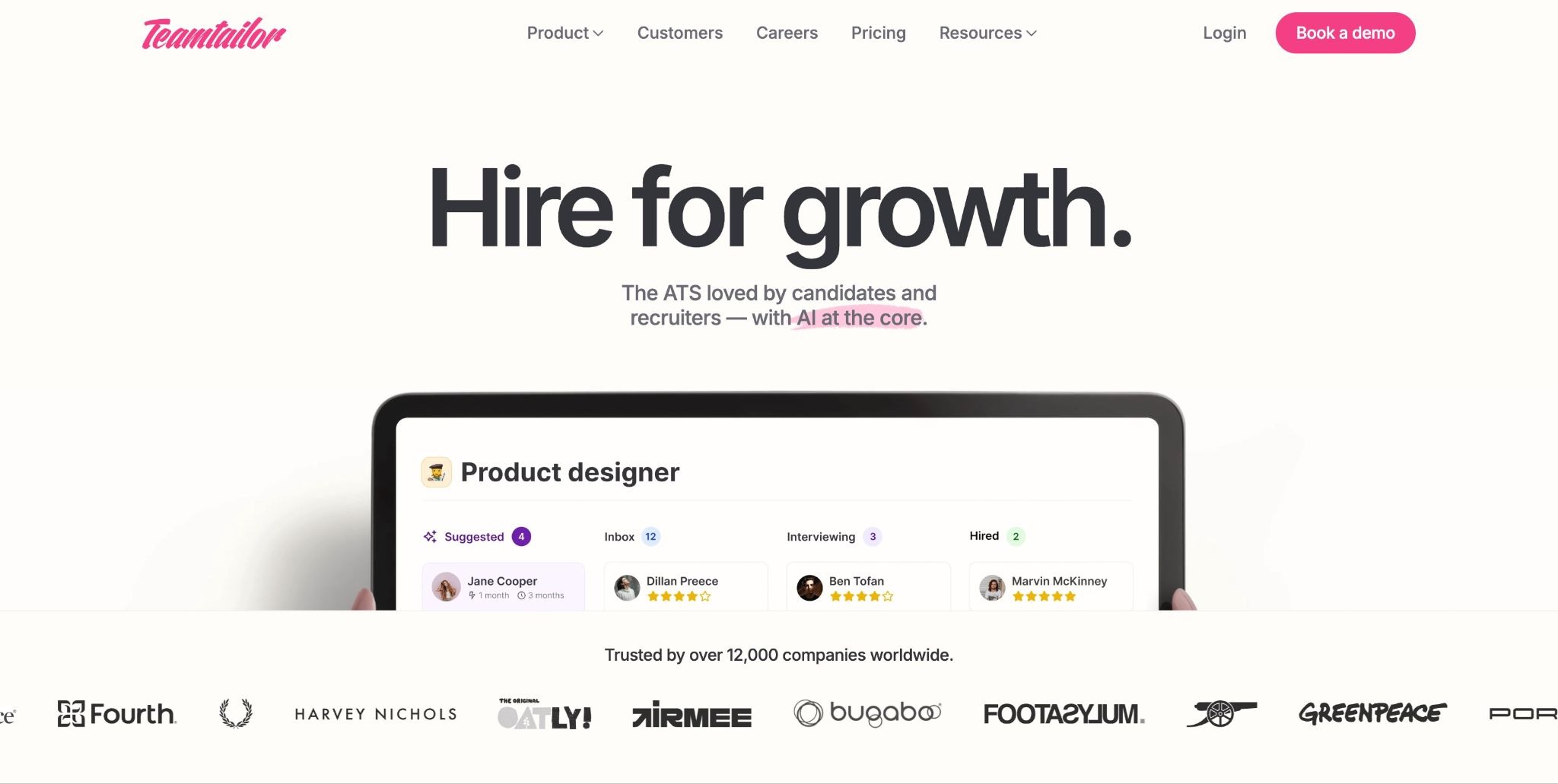
Teamtailor is an ATS with one of the strongest career site builders in the market. If your main challenge is attracting candidates, Teamtailor's design-forward approach to employer branding is compelling.
The platform is well-liked for its polished UX and competitive pricing with unlimited users and job posts, which removes scaling concerns. Where it falls short, according to user reviews, is their limited customization options. Some users also report that first-year pricing can be competitive but increases significantly at renewal, so it's worth asking explicitly about long-term pricing before signing.
Pricing:
- Not publicly listed.
- Unlimited job postings and unlimited users.
- No free trial.
Standout strength: Best-in-class UX and solid employer branding tools.
Key limitations:
- Publishing jobs to external boards often requires manual reformatting.
- Limited customization for complex workflows.
- No bulk CV download option.
- Limited talent pool functionality
Best for: Companies with 20–500 employees where employer branding is the top priority and customization is secondary.
→ Tellent Recruitee vs Teamtailor: a detailed comparison
4. SmartRecruiters
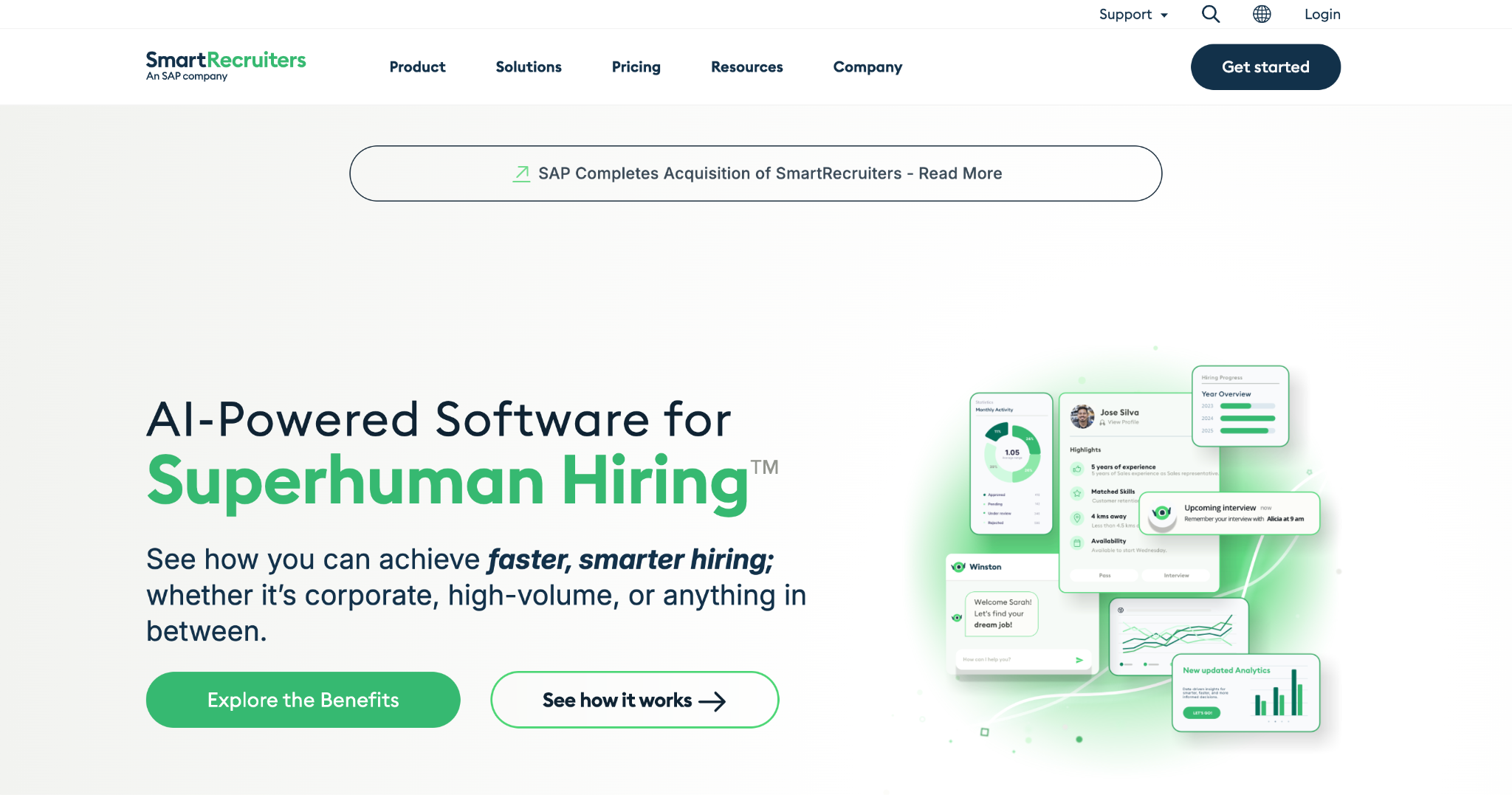
SmartRecruiters is an enterprise-grade talent acquisition suite used by 4,000+ companies including Amazon, Visa, and McDonald's. They've recently pivoted toward an AI-first positioning with their Winston AI layer, which adds conversational candidate experiences, AI screening, and talent matching.
SmartRecruiters was acquired by SAP in September 2025 and is now being integrated into the SAP suite. This is worth factoring in if you're not an SAP shop evaluating it as a standalone ATS, as it could critically impact their roadmap and pricing in the future.
The platform is strong on collaboration. Recruiters, hiring managers, and interviewers get shared visibility with an interface that users describe as intuitive and social-network-like. The integration marketplace includes 300+ partners with direct connections to enterprise HRIS platforms like SAP, Workday, Oracle, and ADP.
Where SmartRecruiters consistently frustrates users is reporting and customization. Teams frequently resort to exporting data to spreadsheets or BI tools to build the dashboards they actually need. Workflow customization hits walls once you move beyond standard configurations: complex approval flows or non-standard processes often require support tickets rather than self-service setup.
Pricing:
- Not publicly listed beyond the Essential plan.
- Essential plan starts at $14,995/year.
- Other plans use a per-employee-per-month model
- Additional costs for implementation, training, support tiers, and add-ons.
- No free trial.
Standout strength: Enterprise-scale hiring with strong collaboration UX, 37 languages, and deep HRIS integrations.
Key limitations:
- Reporting and analytics are consistently flagged as weak in user reviews.
- Customization requires support involvement for anything beyond standard workflows.
- Career site builder is a paid add-on.
- Winston AI is automation-first by design. Automated screening, ranking, and minimal human checkpoints. Under the EU AI Act, human oversight and explainability are legally required. Winston's approach sits uncomfortably with that framework.
Best for: Companies with 200+ employees and high-volume hiring needs that prioritize enterprise integrations (SAP, Workday) and global multi-language support.
→ Tellent Recruitee vs SmartRecruiters: a detailed comparison
5. Workable
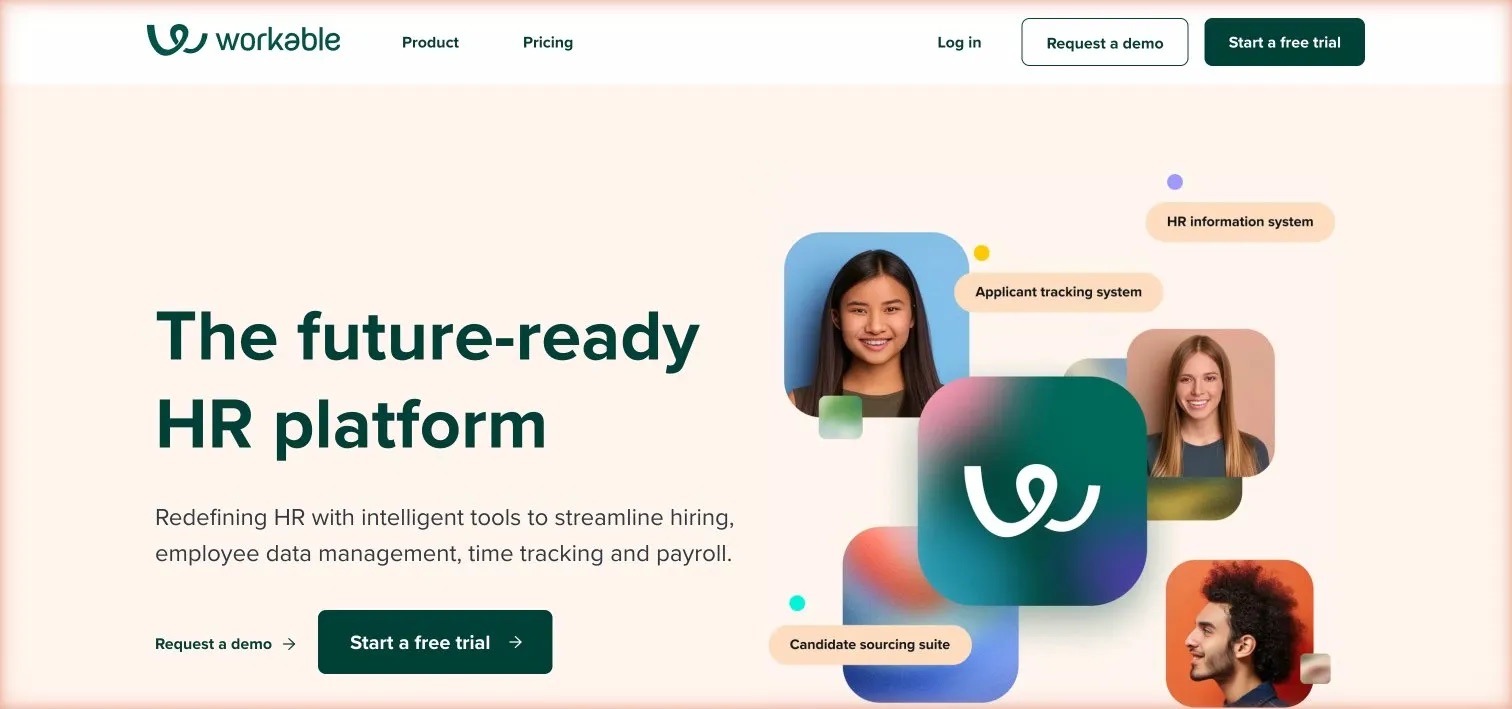
Workable positions itself as a recruiting + HR platform with transparent pricing and a strong AI sourcing engine, which searches a database of over 400 million profiles to surface passive candidates. This could be a real advantage for businesses without a dedicated sourcer.
The platform is well-rounded: one-click posting to 200+ job boards, built-in video interviews and assessments, and automated scheduling. The interface is clean and the learning curve is manageable.
Pricing:
|
Standard starts at $3,588/year or $360/mo |
Premier starts at $7,188/year |
Enterprise starts at $8,628/year |
- 15-day free trial.
- Cost scales with employee count.
Standout strength: AI-powered sourcing across 400M+ profiles.
Key limitations:
- The platform combines recruiting and HR, which isn't always what pure-recruiting teams want.
- Only yearly plans for Premier and Enterprise tiers.
Best for: Companies with 20–500 employees that prioritize finding passive candidates and want AI doing the heavy lifting.
6. Breezy HR
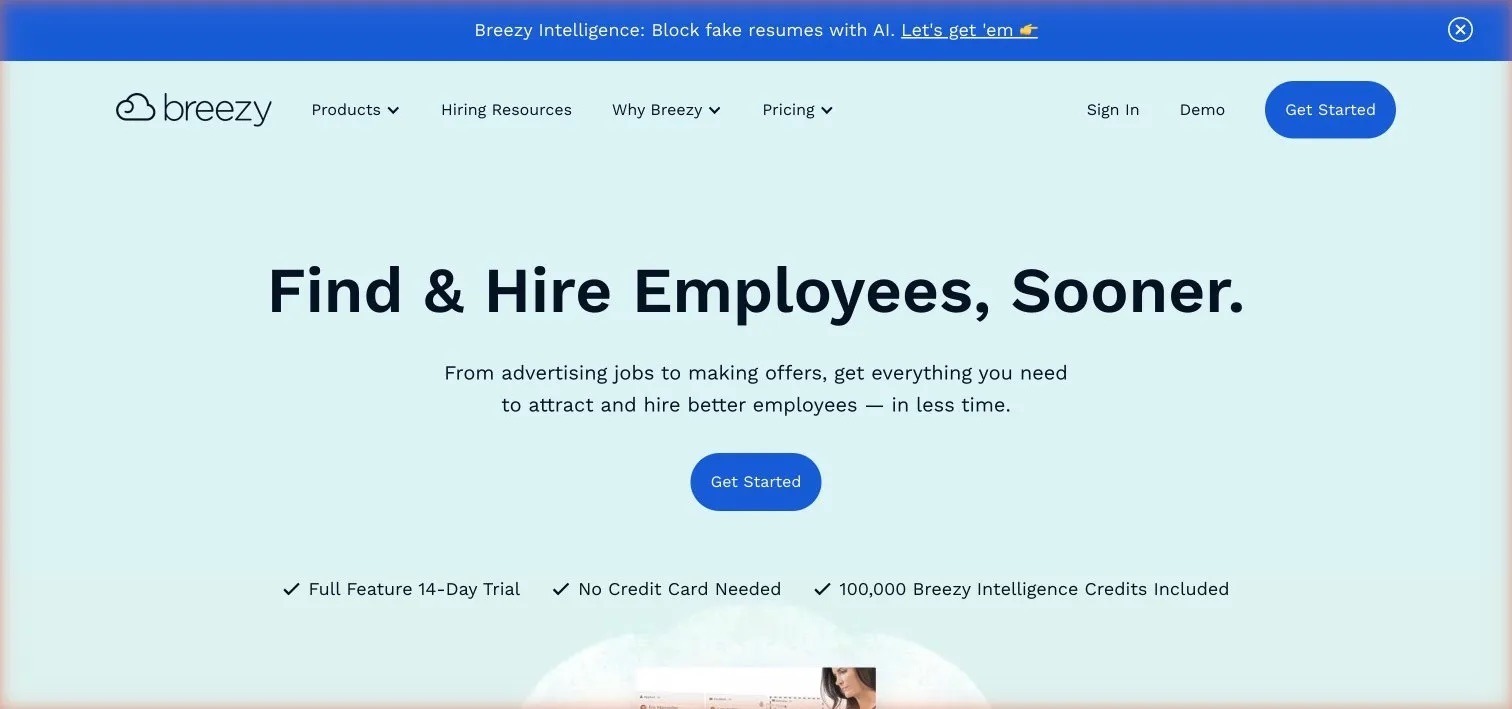
Breezy HR is a popular SMB-friendly ATS with a genuinely usable free plan, the Bootstrap plan. It lets you manage one active position with a visual Kanban-style pipeline, posting to 50+ job boards. For some companies, this is a real starting point.
The drag-and-drop interface makes it intuitive for first-time ATS users. Templates for job descriptions, interview questions, and other HR tasks help speed up setup. The paid tiers unlock more positions, automation, and deeper controls.
Pricing:
|
Bootstrap Free |
Startup $189/mo |
Growth $329/mo |
Business $529/mo |
- Unlimited users and candidates on paid plans.
- Annual pricing includes 2 months free.
- Free plan and 14-day full feature trial.
Standout strength: Functional free tier for testing whether an ATS adds value.
Key limitations:
- Free plan is limited to 1 position.
- Distribution to 50+ job boards is very small, with some products (like Tellent Recruitee) connecting to thousands.
- Advanced controls and reporting sit in higher-priced tiers.
Best for: Startups and very small teams (1–50 employees) testing the ATS concept before committing more budget.
7. JazzHR
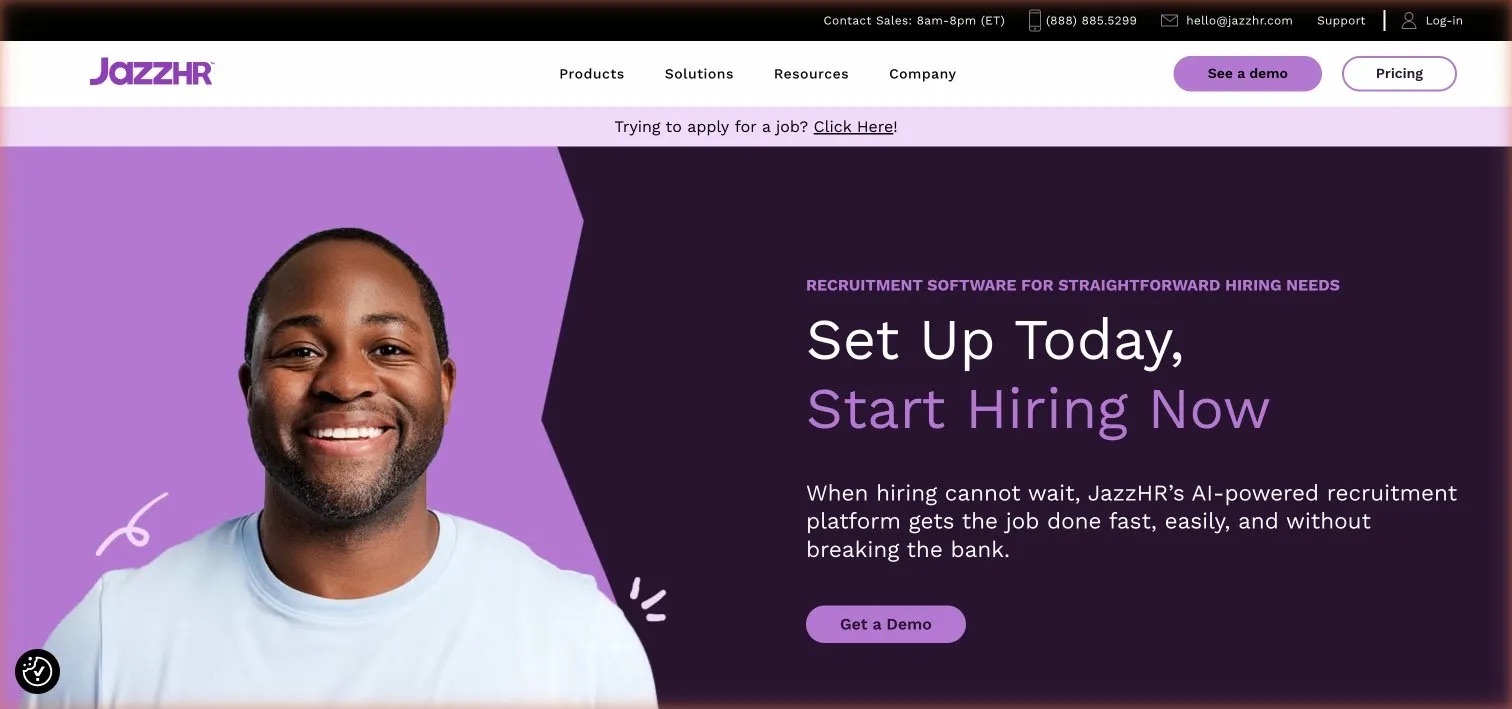
JazzHR was purpose-built for small businesses at a price point most can afford. The Hero plan at $110/mo covers up to 3 open jobs with unlimited users. A genuine step up from spreadsheets without a significant budget commitment.
The platform covers core ATS functionality well: job posting, candidate tracking, customizable workflows, and basic collaboration. It's clean, functional, and most teams can get value from it quickly.
Pricing:
|
Hero $1,000/yr |
Plus $350/mo or $3,480/yr |
Pro $549/mo or $5,508/yr |
- Basic features like calendar sync, knockout questions and bulk actions are not available on the Hero plan.
Standout strength: Lowest meaningful entry point with unlimited users.
Key limitations:
- Plus plan is limited to 200 active jobs.
- No WhatsApp integration.
- No dedicated mobile app.
- Automation and analytics are less sophisticated than other tools.
Best for: Companies with 5–100 employees that need a first ATS at a low price.
8. Jobylon
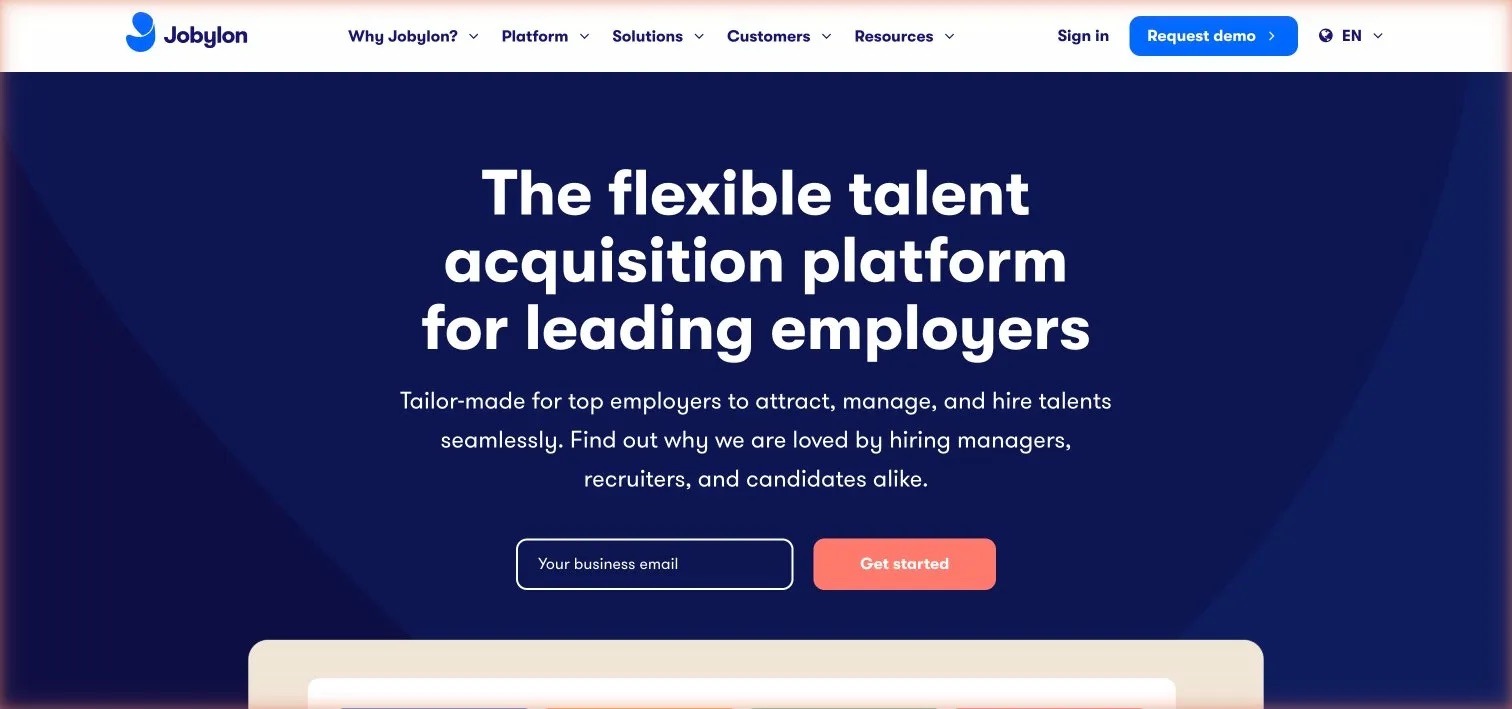
Jobylon is one of the fastest-growing ATS platforms in Northern Europe, with HR teams in 80+ countries using it. Their standout is creating visually appealing job advertisements, as they focus heavily on how your jobs look to candidates, not just how you track them internally.
Jobylon is one of few globally certified LinkedIn partners and offers features like confidential job postings, duplicate candidate prevention, and multi-entity account search. The candidate experience is polished and modern.
The gaps worth knowing about: analytics and reporting are a known weakness. Users report needing to export data to spreadsheets for meaningful analysis. There's no French or German language support, which limits appeal in key European markets outside the Nordics and Benelux.
Pricing:
- Not publicly listed.
- No free trial available.
Standout strength: Beautiful job ad creation and candidate experience.
Key limitations:
- No French/German language support.
- Missing critical integrations and job boards.
- No WhatsApp hiring.
- No mobile apps.
Best for: Companies with 50–500 employees in Nordic and Benelux markets that prioritize candidate experience and employer branding.
→ Tellent Recruitee vs Jobylon: a detailed comparison
9. Jobtoolz
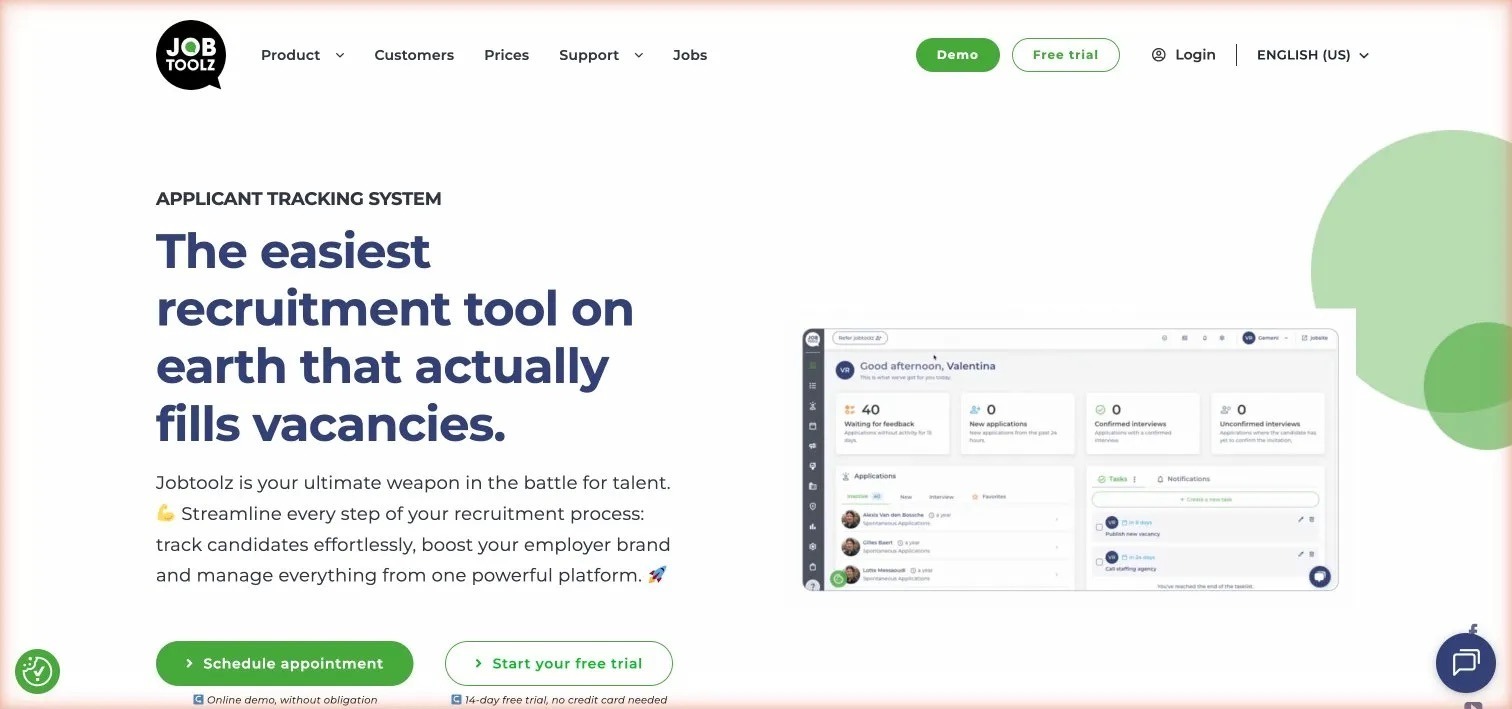
Jobtoolz is a Belgian-born ATS built specifically for SMBs, with a strong focus on employer branding. The platform includes a live editor for building career sites, vacancy video capabilities, and a recruitment marketing marketplace. Notably, there are no pricing tiers: all features are available on all plans.
They recently partnered with VONQ to offer embedded job distribution to 2,500+ job boards directly within the platform. Users on Capterra consistently praise the ease of use, quick setup, and customer service.
The pricing model is based on active vacancies, which keeps costs predictable but punishes fast-growing companies.
Pricing:
- Starting from €231/mo.
- Flat pricing — all features included.
- Scales by number of active vacancies.
- 14-day free trial.
Standout strength: Great value for money with all features unlocked.
Key limitations:
- Limited customization.
- Integrations lean on Zapier rather than direct connections.
- No mobile app.
Best for: Belgian and Dutch SMBs (20–250 employees) that want easy-to-use employer branding tools at a competitive price.
10. Ubeeo
Ubeeo (formerly HireServe) is a Benelux-focused ATS with over 20 years in the Dutch market. They specialize in healthcare, education, government, and retail sectors, with rigid compliance requirements and multi-level approval processes.
Their biggest strength is deep customization. But it comes at a cost: a structured 13-week implementation process where their team builds the system to match your workflows. Once things are configured, Ubeeo is hard to customize on your own.
Their fixed-price-per-employee model includes unlimited users, vacancies, candidates, and support. And they have native integrations with Visma and AFAS — often a deal-maker for companies already using those platforms.
Ubeeo runs on a small team (~35 people) that may limit innovation pace, and integration challenges outside their core partnerships. The platform can be unintuitive, with changes often requiring support consultations.
Pricing:
- Not publicly listed.
- Fixed price per employee.
- Includes unlimited users, vacancies, and candidates.
- No free trial available.
Standout strength: Deep Dutch market expertise, Visma/AFAS integrations, and highly customizable workflows.
Key limitations:
- Long implementation (13 weeks).
- Doesn’t work out-of-the-box.
- Limited to Dutch market.
- Small team.
Best for: Larger organizations (250–5,000 employees) in the Netherlands, particularly in public sector, healthcare, and education.
→ Tellent Recruitee vs Ubeeo: a detailed comparison
11. Zoho Recruit
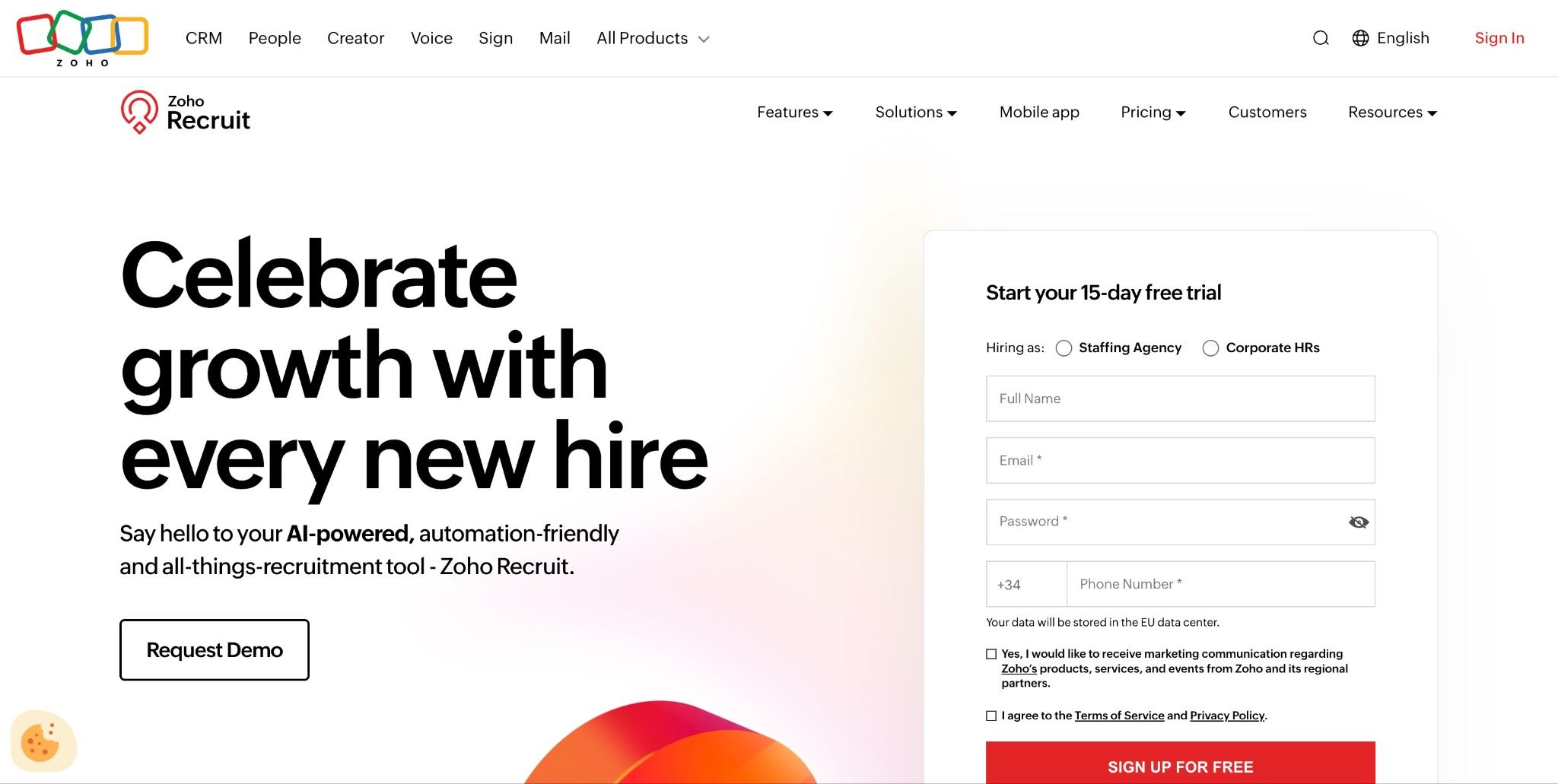
Zoho Recruit is an ATS built for both corporate HR teams and staffing agencies. If you're already running on the Zoho ecosystem (CRM, Projects, People), Recruit plugs right in. It combines ATS and CRM functionality, which is useful for teams that want to nurture candidates across multiple roles.
If you're not already in Zoho's ecosystem, the value proposition is less compelling. The interface can feel cluttered, and per-user pricing adds up for larger teams.
Pricing:
Corporate pricing:
|
Free €0 |
Standard €25/recruiter/mo |
Enterprise €50/recruiter/mo |
Agency pricing:
|
Free €0 |
Standard €25/user/mo |
Professional €50/user/mo |
Enterprise €75/user/mo |
- Free plan includes 1 active job.
- 15-day full feature trial.
- Save up to 16% on yearly plans.
Standout strength: Tight Zoho ecosystem integration. ATS + CRM in one.
Key limitations:
- Per-user pricing.
- Interface complexity for first-time users.
Best for: Small businesses (10–200 employees) already invested in Zoho's ecosystem.
12. BambooHR
BambooHR is a full HRIS with recruiting built in, that primarily targets the US market. If you need one platform for employee records, time-off tracking, onboarding, and hiring, BambooHR handles it all.
Their biggest advantage is the seamless handoff from "candidate" to "employee". Once someone accepts an offer, their data flows directly into the employee database.
Pricing:
|
Core $10 per employee per month |
Pro $17 per employee per month |
Elite $25 per employee per month |
- Starts at $10/mo per employee or $250 USD/mo for companies with 25 employees or fewer.
- Per-employee, per-month model.
- 7-day free trial.
Standout strength: One platform for HR and recruiting — no integration headaches.
Key limitations:
- The platform supports core applicant-tracking tasks, but its advanced recruitment capabilities may be more limited than those offered by dedicated recruiting platforms.
- Sourcing and analytics tools are basic compared to standalone ATS options.
Best for: Companies with 20–500 employees that want one system for HR and recruiting, are primarily US-based or US-aligned, and don't need the most advanced recruiting-specific features.
13. Manatal
Manatal delivers AI candidate scoring and social media profile enrichment at a price most small to medium businesses can afford. At $19/user/month, it's one of the most accessible entry points for AI-powered recruiting. The platform pulls data from LinkedIn, Facebook, and other profiles to enrich candidate records automatically.
Pricing:
|
Professional $19/user/mo |
Enterprise $39/user/mo |
Enterprise Plus $59/user/mo |
Custom Contact sales |
- Lowest plan allows for up to 15 jobs, which can be limiting.
- Save $4/user/mo on yearly plans.
- 14-day free trial.
Standout strength: Affordable AI features and social media enrichment.
Key limitations:
- Per-user pricing model.
- Smaller integration library.
- AI features need sufficient data volume to deliver real value.
Best for: Small businesses (5–100 employees) that want AI capabilities without the price tag of Workable.
How to choose the right ATS for your SMB
Evaluation criteria that actually matter
Forget generic "ease of use" scores. Here's what to specifically evaluate during trials and demos:
How long until you post your first job? This is the real measure of implementation speed. Ask vendors: "From signing to first job live — how many days?"
Tools like Tellent Recruitee, JazzHR, and Jobtoolz typically get you there in 1–5 days. Platforms like Ubeeo (13-week structured implementation) or heavily customized Personio setups take considerably longer.
What happens when you need help and have no IT team? Check whether support is live chat, email-only, or phone. Check response time claims against actual user reviews on G2 and Capterra.
For European teams: check whether support is available in your language. A Dutch company getting English-only support at 3 PM Pacific time isn't getting "great support."
What's the total cost when your whole team needs access? Tools that charge per-user (Zoho Recruit at $25–90/user, Manatal at $19–39/user) can get expensive when hiring managers, interviewers, and coordinators all need access. Tools with unlimited users — Tellent Recruitee, JazzHR, Teamtailor, Jobtoolz — eliminate this variable entirely. Do the math at 8–10 users, not just 2–3.
Does it integrate with what you actually use? European SMBs typically need Google Workspace or Microsoft 365, Indeed and LinkedIn, and often local HR/payroll systems. If you're Dutch and using Visma or AFAS, check whether the ATS connects natively or requires Zapier workarounds. Finally, check for local job board integrations (Nationale Vacaturebank, VDAB in Belgium) as this is where you’ll be doing most of your sourcing from.
A note for European buyers on AI and the EU AI Act. Recruitment AI is classified as high-risk under the EU AI Act, which means any AI tool involved in screening or ranking candidates must provide explainable results and keep humans meaningfully in control of decisions. Before signing with any vendor, ask specifically how their AI screening works, what explainability it provides, and where human oversight checkpoints sit in the workflow to avoid compliance exposure. Tellent Recruitee's AI Screening Assistant is built around explainable results and full human control.
Recommendations by company size and hiring volume
Under 50 employees, hiring fewer than 30 people per year: You may not need advanced collaboration or automation yet. A lighter tool such as Breezy HR or JazzHR will likely fit better and cost less. If you expect to grow quickly, prioritize a tool you won't outgrow.
50–250 employees, hiring 30–75 people per year: This is where a proper ATS starts paying for itself. Tellent Recruitee is a great fit if multiple people are already involved in hiring decisions and you want collaboration built in from the start. If you bought an early ATS to put out fires, this is also the point where you start to outgrow it.
250–1,000 employees, hiring 75+ people per year: You need automation, structured evaluations and reporting, plus multi-team workflows that don't require central HR to babysit every role. Tellent Recruitee is strongest here: collaborative depth across hiring managers and teams, flexible workflows, and the option to connect your ATS with a full HR suite through Tellent HR.
1,000–2,999 employees, hiring 100+ people per year: Evaluate collaborative hiring depth, AI screening, and candidate experience across multiple entities. Tellent Recruitee fits teams that need flexibility across distributed teams, Workable offers AI sourcing at scale, SmartRecruiters is relevant if you need enterprise-grade talent acquisition features, and Ubeeo is for the Dutch public sector or healthcare with complex approval chains.
Red flags to watch for
Enterprise tools marketed to SMBs. If a vendor requires a consultant-led implementation, a 6-week setup project, or a dedicated admin to manage… it's not built for your team, regardless of what the sales deck says.
Per-user pricing at scale. The difference between a flat-rate tool and a €50/user/month tool is nearly €5,000/year at 10 users. That adds up.
"Integrations via Zapier" for everything. A few Zapier connections are fine. But if the ATS has no native integrations with your core tools and relies on Zapier for all of them, expect maintenance overhead and occasional sync failures.
What is an applicant tracking system (and why SMBs need one)
An applicant tracking system is software that manages your hiring process in one place: candidate data, team feedback, communications, interview scheduling, and reporting. Think of it as a CRM, but for job applicants instead of sales prospects.
There's a common assumption that your current setup — whether it's spreadsheets, email, or a basic tool you adopted years ago — is "good enough" as long as hires get made. But what worked when you were 20 people starts breaking once you hit 50, 80, or 150. Feedback gets scattered, processes vary by manager, and reporting takes hours of manual work. Modern ATS platforms aren't just for companies building an HR function from scratch. They're equally built for growing teams that need to bring structure and speed to hiring processes that haven't kept pace with their growth.
When does a business actually need an ATS?
There's no universal threshold, but here are concrete signals:
- You're filling more than 15 positions per year, and the manual overhead of tracking candidates across email and spreadsheets is costing real time.
- You're spending more than 5 hours per week on hiring admin tasks that could be automated.
- You've lost a candidate because your process was too slow. That direct cost likely exceeds a year of ATS subscription fees.
- Multiple people are involved in hiring decisions, but you have no shared system for feedback and coordination.
- You're getting enough applicants that you can't reliably respond to everyone manually.
- You already have an ATS or HR tool, but it can't support multi-team hiring, structured evaluations, reporting across locations, or the workflows your process now requires. What worked for 20 employees doesn't work for 100.
If two or more of those apply, an ATS will pay for itself quickly.
Essential ATS features for SMBs success
Not every feature matters equally. Here's how to prioritize.
Must-have (non-negotiable)
- Multi-board job posting — distribute to Indeed, LinkedIn, and local boards in one click instead of logging into each platform separately.
- A centralized candidate pipeline with visual status tracking so everyone can see where each candidate stands.
- Basic automation for acknowledgment, rejection, and stage-transition emails.
- Candidate communication tools that live inside the platform rather than scattered across personal inboxes.
- Basic reporting on time-to-hire and source effectiveness.
High-value (delivers clear ROI)
- Structured evaluation scorecards standardize how your team assesses candidates. Without them, hiring decisions default to whoever argues most persuasively. This is where Tellent Recruitee's Fair Evaluations feature matters, because it prevents early feedback from anchoring the group's assessment.
- Interview scheduling automation eliminates the calendar back-and-forth that adds days to your process.
- A career site builder lets you present a professional employer brand without hiring a web developer.
- Integrations with your existing tools (calendar, email, Slack or Teams) means the ATS fits into your workflow rather than creating a new silo.
- Native WhatsApp integration allows candidates to apply via WhatsApp and then you can send them interview scheduler links, updates, and questions directly. Critical for companies hiring candidates that are not usually at their desk.
Nice-to-have (depends on your maturity)
- AI-powered candidate sourcing is valuable if you're hiring for competitive roles, but less impactful for inbound-heavy hiring.
- AI candidate screening helps when application volume is high enough to make manual triage a real bottleneck (typically during growth sprints or seasonal surges).
- AI candidate matching helps you automatically rediscover relevant past applicants and talent pool members for new roles.
- Talent pool / CRM functionality helps if you're building long-term candidate relationships.
- Advanced analytics matter once you have enough hiring data (50+ hires/year) to draw meaningful conclusions.
Features to be skeptical about
- Complex analytics dashboards look impressive in demos but only add value if someone on your team will regularly analyze the data.
- AI/ML features that "learn from your hiring patterns" need hundreds or thousands of data points to work well. At 20–30 hires per year, you won't generate enough data for meaningful AI insights for a long time.
- Extensive API capabilities matter only if you have a developer to build with them.
Benefits of using an ATS as a small to medium business
Time you get back
The most immediate, measurable impact. Posting a single job to 10 boards manually takes 30–60 minutes. With an ATS, it's done in a couple of clicks.
Sending personalized status updates to 50 candidates? Automated. Scheduling interviews? Candidates pick from your available slots instead of triggering multi-email chains.
Tellent Recruitee's own customer data illustrates this. Livestorm reported their time-to-hire dropped 2.5x (from 60 days to 25 days) after implementing the platform. Teamleader cut time-to-hire from 40 to 27 days.
Hiring decisions that improve over time
Disorganization wastes time and degrades decision quality. When interview feedback sits in separate email threads, hiring decisions rely on whoever's loudest in the debrief. When candidates wait two weeks for a response, the best ones have already moved on.
An ATS creates the structure for timely responses, shared evaluations, and decisions based on evidence rather than whoever happens to remember their interview notes.
A foundation that scales
The real strategic value is how you can set up a hiring process at 25 employees and it still works at 200. Origin Materials proved exactly this — they 8x'd their headcount without switching platforms.
ATS pricing for SMBs: what to expect and how to budget
Pricing models explained
Flat-rate or per-slot pricing (Tellent Recruitee, JazzHR, Jobtoolz): You pay a fixed amount based on plan tier or number of active jobs. Most predictable for budgeting. Tellent Recruitee starts at €301/mo; JazzHR starts at $110/mo; Jobtoolz starts around €207/mo.
Per-user pricing (Zoho Recruit, Manatal): Cost scales with how many people need access. Can get expensive when hiring managers, interviewers, and coordinators all need access. Zoho runs $25–75/user/mo; Manatal is $15–35/user/mo.
Custom/quote-based (Teamtailor, Jobylon, Personio, Ubeeo): You go through a sales process to get a number. Less transparent but sometimes negotiable.
Rough cost tiers
Free: Breezy HR's free plan works for testing but hits limits quickly (1 active position).
€50–€200/month: JazzHR and Jobtoolz cover core ATS functionality for smaller teams.
€200–€400/month: Tellent Recruitee, Workable, and Teamtailor deliver automation, collaboration depth, and sourcing capabilities.
€500+/month: Top-tier plans with dedicated support, API access, SSO, and BI integrations.
Hidden costs to ask about
Implementation fees can add €1,000–5,000+ on enterprise-oriented platforms. Some tools charge extra for features that feel basic, such as texting, video interviews, advanced reporting, or specific integrations. Check whether the integrations you need are included in your plan or require an upgrade.
And always ask about renewal pricing. If year-one pricing is unusually competitive, find out what year two looks like before you sign.
Try Tellent Recruitee this week
We hope this gives you a practical view of the ATS landscape for SMBs — especially the real trade-offs you'll run into once hiring managers, interviews, and follow-ups pile up.
Tellent Recruitee is built around a simple philosophy: keep hiring collaboration and workflow in one place, keep the process adaptable, and make it easier to stay consistent as you grow.
If you want to see whether it fits your team, the next step is simple:
- Start a free trial — post a real job and run it with your team for 18 days.
- Or request a demo — we'll walk through your actual use case, not a polished script.