


.webp)

Today, job seekers behave like consumers: researching and comparing companies and job openings, and opting out of poor candidate experiences. If your team is losing promising candidates, the issue may not be your sourcing strategy—it might be your candidate journey.
According to Tellent Recruitee’s 'State of Hiring in 2025’ report, the top reason candidates drop out of a recruitment process is poor communication. But the impact of a fragmented experience runs deeper.
Aleksandra Gurskaite, Lead Talent Acquisition Partner at The Social Hub, noted, “You have to be more understanding and compassionate to the candidates you work with or reject.” Strong candidate journeys aren’t just nice to have. They directly influence your ability to hire well.
This guide breaks down the full candidate journey, explaining why each touchpoint matters and how to improve them. Whether you’re building a structured process from scratch or refining your current flow, it’s time to see candidate experience as a business-critical function.
What is the candidate journey?
The candidate journey—also called the candidate experience—is the complete series of interactions a job seeker has with your company.
It begins long before a candidate hits “apply,” often starting with their first exposure to your employer brand, and can extend beyond the job offer into onboarding.
Think of it like a marketing funnel: each stage is a touchpoint where candidates decide whether to keep going or drop off. While every company’s process is unique, most candidate journeys follow the same core stages—from awareness to application, interview, offer, and onboarding.
Understanding your candidate experience helps you improve it. And in a market where top talent has options, every stage of the journey matters.
Why does the candidate journey matter?
A strong candidate journey isn’t just a nice-to-have. It directly impacts who you hire and how fast.
Here’s why optimizing it pays off:
- Better hiring outcomes: Long or clunky processes cost you talent. Tellent Recruitee’s ‘State of Hiring Report’ found that organizations with hiring timelines over 40 days see 12% more candidate drop-off.
- Improved candidate experience and employer reputation: Every email, call, and interview shapes how candidates see you. And it matters. 48% of candidates say poor scheduling or interview experiences make them less likely to recommend a company.
- Attracting top talent: Skilled candidates won’t wait around. A clear, respectful process helps your offer stand out and shows that you run an efficient ship.
- Lower costs and faster hires: Smoother journeys mean fewer reposted jobs, less wasted time, and shorter time-to-hire. Large firms with refined processes average 28 days to fill a role, according to our report, compared to 36 at smaller firms.
Think of it this way: every delay is a chance to lose someone great. Creating a great—and efficient—candidate journey is the most effective strategy for ensuring that great talent doesn’t systemically fall through the cracks.
The 7 stages of the candidate journey
Every candidate's experience is different, but most follow a similar path made up of distinct stages—or touchpoints—that influence their decision to apply, engage, and ultimately accept an offer. These seven stages make up what’s often referred to as the candidate journey or recruitment funnel.
At each step, how your company communicates, responds, and represents itself has a direct impact on candidate engagement.
In the following sections, we’ll walk through each of the seven stages, what happens at each candidate experience touchpoint, and how to make the most of them in 2026’s hiring landscape.
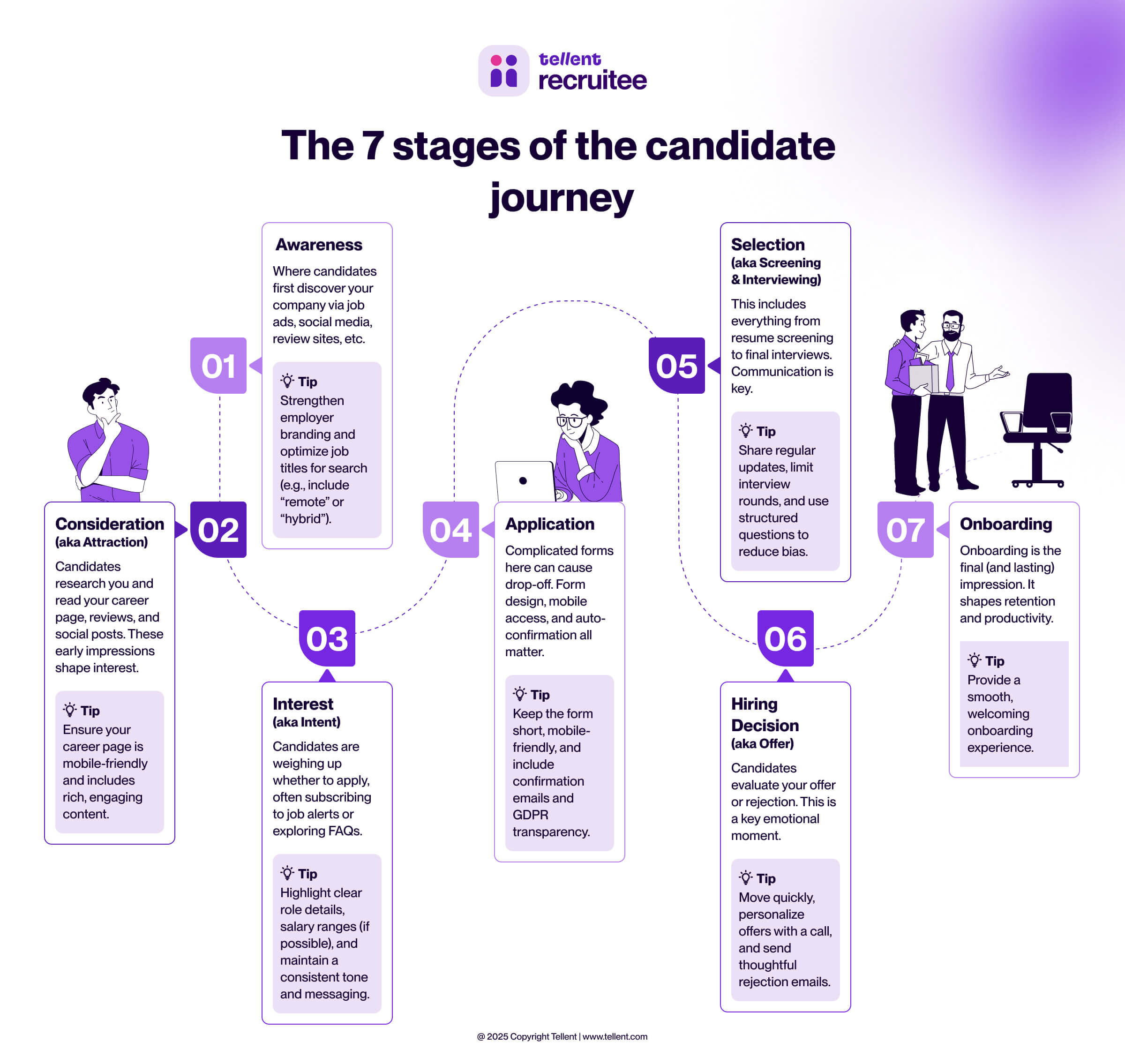
1. Awareness
The Awareness stage is when potential candidates first hear about your company or see a job opportunity. This can happen through job ads, social media posts, employer branding content, or word-of-mouth.
It’s the very first impression — and it matters. In 2026, candidates often encounter employers via social media or review sites before ever visiting a careers page. A compelling presence can spark their interest.
What candidates are thinking at this stage: "Is this company worth looking into?"
At awareness, candidates haven't committed to anything. They're forming a passive impression based on whatever signals reach them — a job title in their feed, something a colleague mentioned, a Glassdoor rating glimpsed in passing. Their decision to look further depends almost entirely on those incidental signals, not on anything you've intentionally shown them yet.
2. Consideration (aka Attraction)
In this stage, candidates are evaluating whether they’d actually want to work for you. They might visit your careers page, read reviews on sites like Glassdoor, or scroll through your LinkedIn feed.
These early candidate-journey touchpoints are critical to attracting candidates. They shape whether someone moves from passive interest to intent.
What candidates are thinking at this stage: "Would I actually want to work here?"
This is where active evaluation begins. Candidates are comparing your company against others — reading between the lines of your job descriptions, looking for signals about culture, and deciding whether to invest the time in an application. A careers page that looks like it hasn't been updated since 2019 answers that question for them.
3. Interest (aka Intent)
Here, the candidate is seriously considering applying. They may shortlist your company, subscribe to job alerts, or talk informally with a recruiter.
Touchpoints include talent communities, newsletters, or FAQ content on your site. This stage bridges consideration and action.
What candidates are thinking at this stage: "Is this specific role right for me?"
They've decided they like the company. Now they're interrogating the job itself — does the scope match what they're looking for, is the seniority right, does the salary range exist anywhere on the page? Candidates at this stage are close to applying, but gaps in information give them reasons to hesitate or move on.
4. Application
Once a candidate decides to apply, friction in the process can make or break the conversion.
Touchpoints include the online application form, your ATS portal, and any auto-emails confirming receipt.
Key tips to optimize this stage:
- Keep it short: 41.2% of all candidates drop off before completing an application form, with form length and time-to-completion as leading drivers of that drop off
- Stay mobile-friendly: Mobile users are more likely to drop out if forms aren’t optimized.
- Make it easy: Allow LinkedIn uploads or autofill features.
- Confirm receipt: A simple auto-response builds confidence.
- Ensure transparency: Include a brief GDPR statement to comply with EU requirements.
A smooth application process retains momentum and signals professionalism. Consider linking your applicant tracking system to simplify and streamline this step.
What candidates are thinking at this stage: "Is this process worth my effort?"
They've decided to apply — but any friction now can make them abandon. A long, clunky form signals that the rest of the process may be just as frustrating. A smooth, fast application process signals the opposite: that your company respects people's time.
5. Selection (aka Screening and Interviewing)
This phase includes everything from resume screening to final interviews and often takes the longest to complete. Maintaining strong communication during this process is critical.
To create a strong candidate journey at this stage, think in terms of touchpoints: screening emails, candidate assessments, video or in-person interviews, and interview feedback.
Silence erodes trust. Make sure you’re communicating clearly, authentically, and in a timely manner after each major screening and interviewing event, and if there are long delays between conversations.
Tip to improve at this stage:
- Be transparent: Regular updates keep candidates engaged.
- Structure matters: Use standardized questions to improve fairness and reduce bias.
- Limit interview rounds: Four to six is ideal—too many causes fatigue.
- Respect time: Coordinate efficiently with scheduling tools. Large companies that streamline here often hire eight days faster.
- Respect effort: Keep assessments relevant and under 15 minutes to reduce 45%+ drop-off rates.
Lastly, remember that interviews are a two-way street. Your team’s behavior influences how candidates perceive your brand.
What candidates are thinking at this stage: "Am I still being considered? Does this company value my time?"
This is where most candidate journeys quietly fall apart. Candidates are often running multiple processes in parallel. Whoever communicates best and moves fastest tends to win. Silence — even for a few days between stages — signals that the decision has already been made, and not in their favor.
6. Hiring decision (aka Offer)
The offer stage finalizes the formal part of the candidate journey. You've chosen your candidate. Now they must choose you.
Touchpoints at this stage include the offer letter, negotiation, and final reference checks. For those not selected, this is also where rejection communications happen. Don't neglect this part — a lack of communication to rejected candidates can cause significant damage to employer branding and future hiring efforts.
What candidates are thinking at this stage: "Is this the right move? Is this company decisive?"
Candidates are making a final comparison — against other offers, against their current employer, and against how the process itself made them feel. A slow offer, or one that arrives as a plain-text email, signals that enthusiasm may have faded. A fast, clear, well-presented offer signals the opposite.
7. Onboarding (Post-hire)
The journey doesn’t end at “you’re hired.” Onboarding bridges the gap between candidate and employee, and ensures the promises made during recruitment match reality.
Touchpoints at this stage include welcome emails, intro calls, training sessions, paperwork, and first-day support.
Treat onboarding as part of your employer brand. A great start confirms the candidate made the right choice, and is critical to boosting retention and early productivity.
Don't overlook compliance here either. Tools that help manage documentation and deadlines can streamline onboarding, especially for remote or cross-border hires.
What candidates are thinking at this stage: "Did I make the right choice?"
New hires are still evaluating, even after signing. The period between offer acceptance and day one is particularly fragile — silence during that window is an open invitation for doubt, or for a counteroffer from their current employer. A structured pre-start experience helps maintain confidence and reduces the risk of early attrition.
Common signs your candidate journey is broken
Mapping your journey is most useful when you know what to look for. These are the signals that tend to indicate a stage is losing candidates — and where to focus first.
Your application completion rate is low
Candidates are starting the form but not finishing it. The most common causes: the form is too long, it's not mobile-friendly, or it asks for information that duplicates what's already on a CV. If fewer than 60% of candidates who start your application complete it, this is worth investigating.
You're losing candidates between application and first interview
Candidates applied but have gone quiet. In most cases, this is a communication gap — no confirmation email, no status update, no indication of what happens next. Candidates who feel ignored assume they've been passed over and stop engaging.
Interview scheduling is taking more than two days
Every day of back-and-forth email scheduling is a day a competing offer can land. If your team is still coordinating interview times manually, scheduling delays are almost certainly costing you candidates at this stage.
Candidates are accepting offers and then withdrawing
This is typically a sign that the gap between offer acceptance and day one is unmanaged. No pre-onboarding communication, no sense of what's coming — candidates in this window are at their most vulnerable to doubt or a counteroffer from their current employer.
You're regularly getting negative feedback about the interview process
If candidates are mentioning unstructured interviews, too many rounds, or assessments that felt irrelevant, these aren't individual complaints — they're signals of a systemic problem in your selection stage.
Your time-to-hire keeps creeping up
A rising time-to-hire rarely means your sourcing is slow. More often, it means there's friction inside the process: delays in feedback, slow offer approvals, or a screening stage that takes longer than it needs to. The candidate journey is where that time gets spent.
If you're seeing any of these signals, the next step is to map where they're occurring — and then systematically address them.
How to map your candidate journey
Mapping the candidate journey means creating a visual or documented outline of every touchpoint a candidate has with your company, from start to finish. This exercise helps you see the experience through the candidate’s eyes and identify where improvements are needed.
It’s especially valuable for mid- to large-sized companies with complex recruitment processes and multiple stakeholders. A candidate journey map creates alignment, ensures consistency, and highlights friction points that cost you talent.
Here’s how to build one:
Step 1: Define your candidate personas
Start by identifying the kinds of candidates you want to hire—what skills, goals, and motivations they have. A developer may care about tech stack and flexibility, while a sales candidate might prioritize commission structure and culture. Mapping the journey around real personas makes it more actionable.
Step 2: Outline the stages of your journey
Use the seven stages we covered earlier: Awareness to Onboarding. At each stage, note what the candidate is likely thinking or feeling.
For example, at the Application stage, a key concern might be “How long will this take?” This helps you address unmet needs. Analytics can support this. Bounce rates or drop-offs can signal areas of improvement and focus.
Step 3: Map touchpoints and channels
For each stage, list every touchpoint (e,g. job ads, career pages, recruiter calls) and where they happen (e.g., website, ATS, email, in-person). This helps you see which channels work, and which need improvement. Use tools like Google Analytics or your ATS reports to find problem areas, and platforms having an outsize influence on your candidate pool.
Step 4: Gather feedback and refine
Ask recent candidates and new hires where they got stuck or confused. Include input from recruiters and hiring managers. Mapping is not a one-off project. Update it as you adapt tools, processes, or hiring goals.
It may seem detailed, but mapping your candidate journey will highlight both quick wins and bigger fixes in your hiring process.
Using your candidate journey map to improve your processes
Once you’ve mapped out your candidate journey, it’s time to put those insights into action.
Start by identifying bottlenecks. For example, if you notice a major drop-off between the Interview and Offer stages, it’s worth digging deeper. Are there too many interview rounds? Is scheduling slow? Streamlined interview processes lead to faster hires, giving you an edge in competitive markets.
Next, prioritize. Focus first on high-impact touchpoints. If your careers page has a 70% bounce rate—as many do in the DACH region, according to our ‘State of Hiring in 2025’ report— improving content and usability there could quickly increase application volume.
Bring your team into the process. Create an action plan to tackle one stage per quarter. Having the map helps to foster alignment and makes execution easier and more impactful. From HR to hiring managers, everyone sees their role.
Finally, measure your results. Track metrics like stage conversion rates, time-to-hire, and candidate feedback. Over time, improvements will become clear.
Lastly, consider whether your tools support your ideal journey. A flexible ATS like Tellent Recruitee, which automates follow-ups or interview scheduling, can resolve the common pain points you uncover.
With a clear map and focused action, you’re now equipped to elevate your entire candidate experience.

Ready to optimize your candidate journey?
Mapping your journey tells you where candidates are being lost. Optimizing it tells you exactly what to do about it — stage by stage, touchpoint by touchpoint.
Our candidate journey optimization guide covers:
- How to strengthen your employer brand and job distribution at the awareness stage
- How to remove friction from your application process
- How to automate candidate communication so no one falls through the cracks
- How to reduce scheduling delays and speed up screening
- How to send offers faster and secure acceptance more reliably
- How to keep new hires engaged between offer and day one
→ Read the candidate journey optimization guide
Make your candidate journey your biggest asset
A great candidate journey leads to better hires, stronger retention, and a standout employer brand.
By understanding and optimizing each step—and aligning with trends like mobile-first engagement and faster hiring—you’ll stay competitive in the hiring landscape.
Remember, hiring is about building relationships. Map your key moments, treat candidates like customers, and you’ll create an employer brand that attracts talent on autopilot.