


.webp)
A career page is the part of your company website dedicated to showcasing your employer brand, open roles, and what it's actually like to work there. It's where candidates go after they've seen your job ad — to decide whether you're worth their time.
The best career pages do five things well: they lead with a clear employer value proposition, show culture through real content rather than stock photos, make job discovery fast and frictionless, explain the hiring process step by step, and give passive candidates a way to stay connected. Get these right, and your career page becomes one of your most effective recruiting tools. Get them wrong, and even strong candidates quietly close the tab.
To give you concrete inspiration, we've pulled together 13 career page examples that get it right — covering companies of different sizes, industries, and locations. We've included both clients of Tellent Recruitee and well-known brands from outside our network, because great employer branding doesn't belong to any one type of company.
Key takeaways:
|
What makes a great career page?
Before diving into the examples, it helps to understand the criteria. Based on research into hiring outcomes across thousands of companies, the career pages that consistently perform best share five traits.
-
A clear EVP above the fold. Candidates should immediately understand who you are, what makes you different as an employer, and whether they might fit. Generic headlines like "Join our team!" waste this moment.
-
Show, don't tell. Photos, videos, and employee quotes beat corporate copy every time. Candidates trust people, not press releases.
-
Frictionless job discovery. Filtering by role, location, team, and work model is the baseline. The faster a candidate finds a relevant opening, the higher the application rate.
-
Process transparency. Explaining hiring steps — and approximate timelines — reduces drop-off. Uncertainty kills motivation.
-
Passive candidate capture. Job alert subscriptions and open application flows build a pipeline of future talent, not just today's applicants.
With those criteria in mind, here are 13 pages that get it right.
13 best career page examples
1. Funda
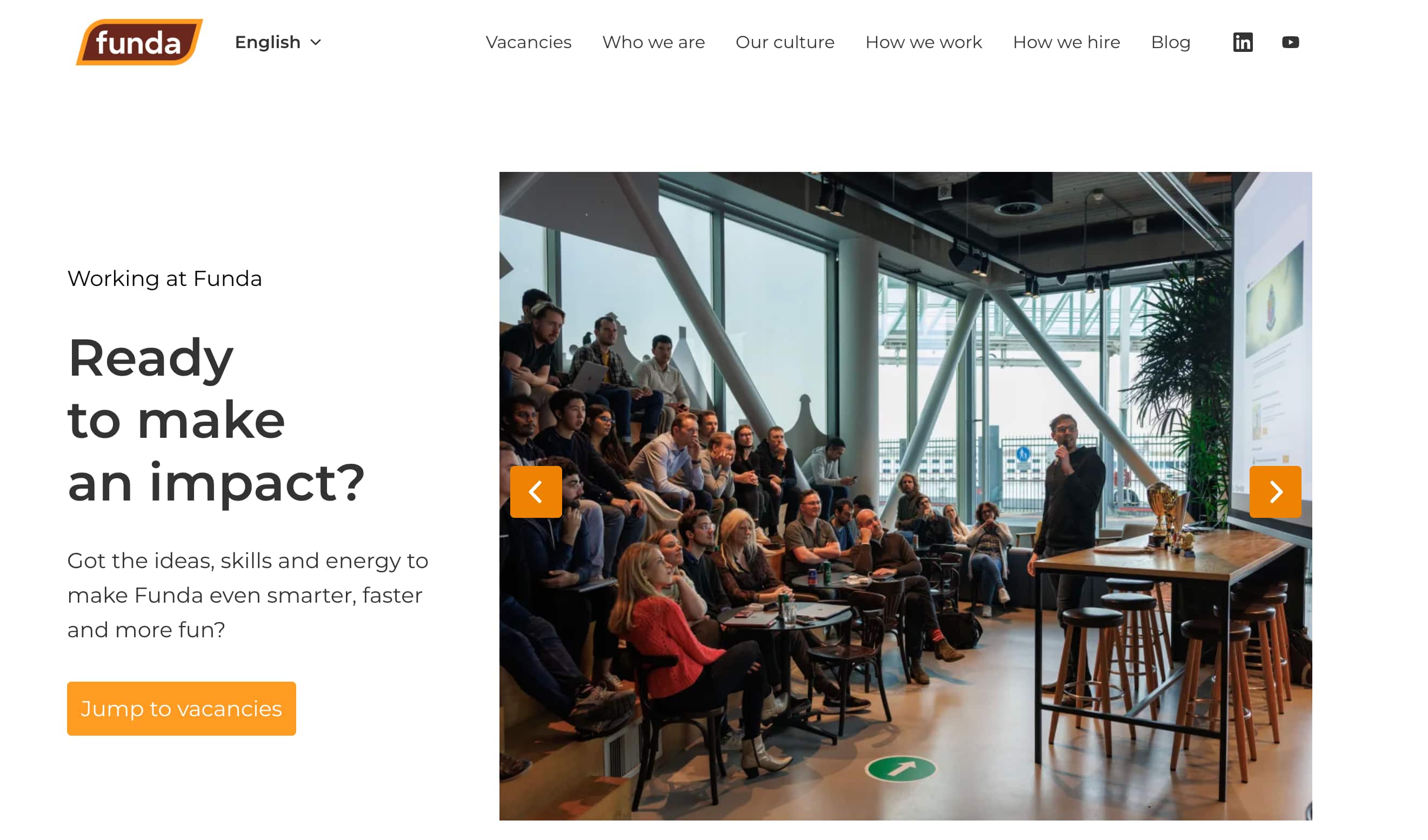
Funda's careers page earns its place at the top of this list for one reason: it's honest in a way that most career pages aren't. The EVP above the fold — "Ready to bring your A-game?" — sets a challenge rather than making a promise. It immediately tells candidates what kind of culture they're walking into.
What stands out most is the "How we hire" section in their job descriptions. Funda doesn't just say they have a structured hiring process — they spell it out step by step, including a technical assignment and an executive chat at the final stage. That level of openness builds trust before a candidate has even clicked "apply."
Funda also handles passive candidates well. Visitors who don't see the right role today are nudged toward open applications and job alerts — a smart way to keep building a warm talent pool. On the technical side, Funda has structured schema data baked into the site, which improves how their jobs appear in Google Search results.
2. My Jewellery
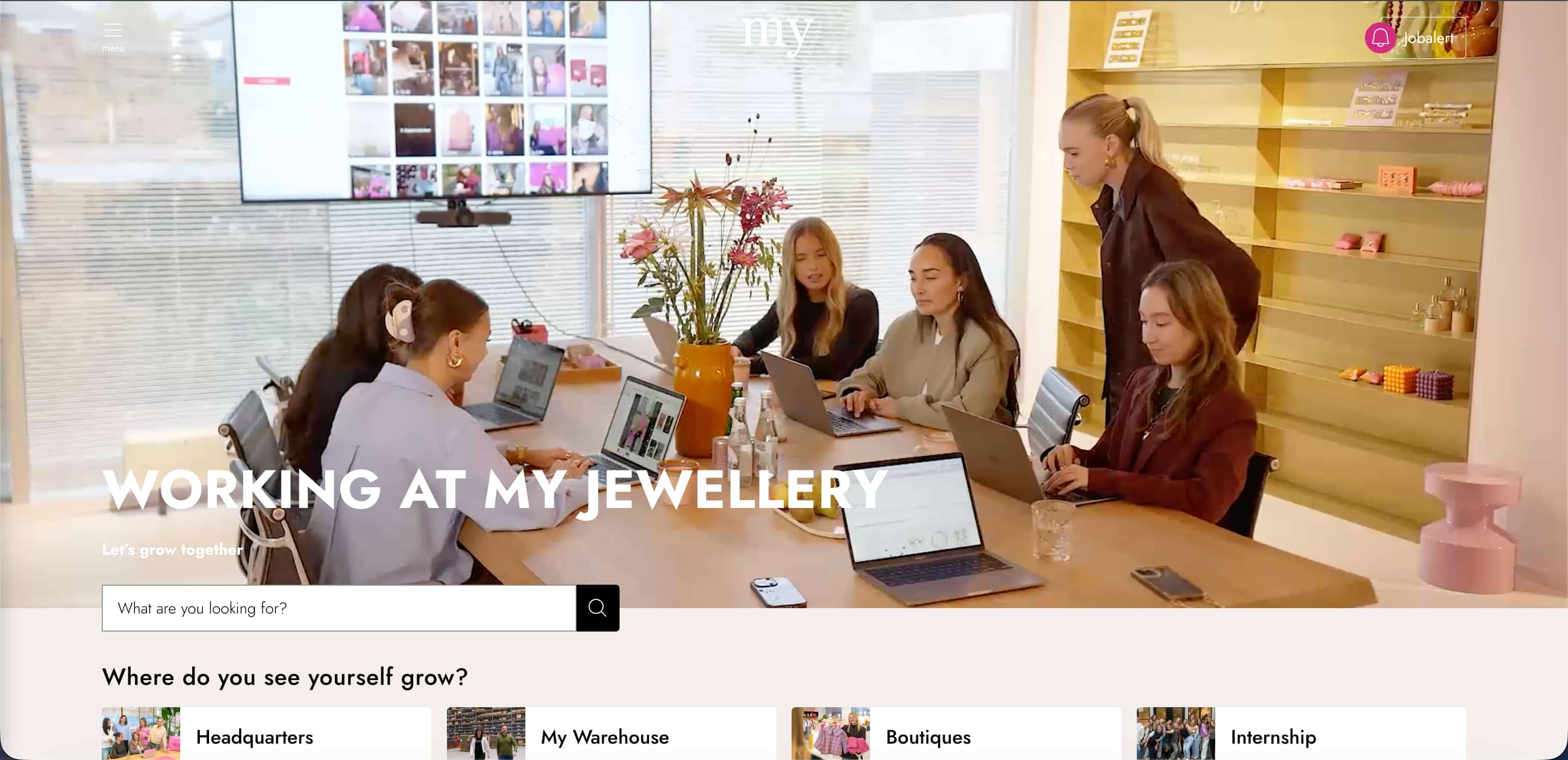
My Jewellery's careers page gives off a welcoming energy from the moment you land. Their EVP — "LET'S GROW TOGETHER!" — sets a vibrant, people-first tone straight away, and the playful internal question "What are we celebrating today?" makes the culture feel real rather than performed.
As you scroll, you meet team members, including the founder, see the company in action, and encounter 4.3/5 star ratings from Indeed — genuine social proof that shows this isn't just a company talking about itself.
One of the strongest features is department-level navigation. Instead of asking candidates to scroll through an undifferentiated list of roles, My Jewellery organizes positions by Warehouse, Headquarter, and Boutiques. Reducing that friction directly improves application conversion rates.
3. Transavia
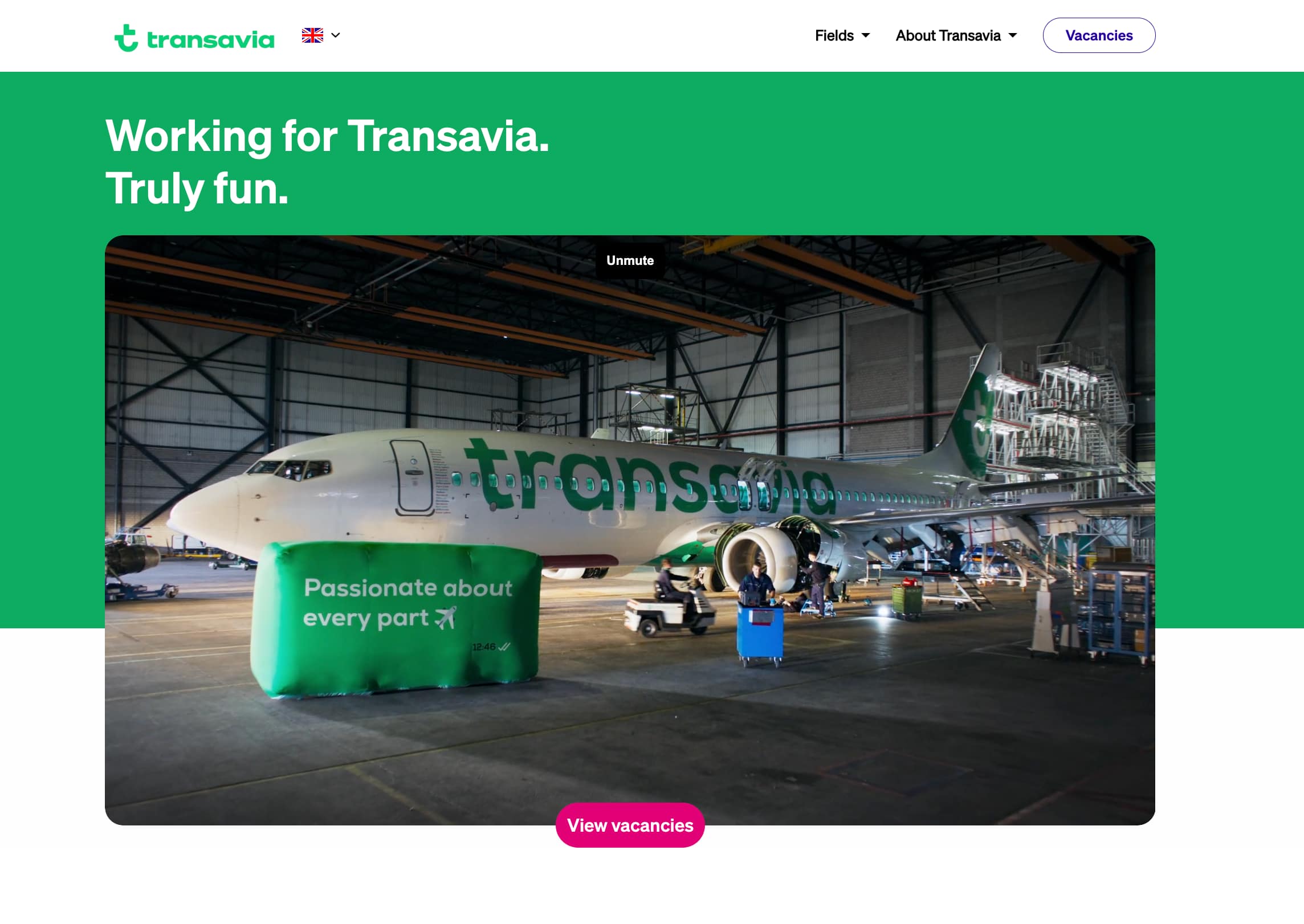
Transavia's careers page is a masterclass in letting employees do the talking. The EVP — "Working for Transavia. Truly fun." — is reinforced throughout the page not by the company's own voice, but by real employee stories from a Captain, a Certifying Technician, and others across the organization. That shift from brand claim to human voice is exactly what builds credibility.
From a usability standpoint, Transavia handles scale well. Their filtering system lets candidates narrow openings by department, city, country, and language. For a large, geographically distributed organization, this turns an overwhelming list into a manageable search. A bilingual toggle (English and Dutch) signals that inclusivity extends to the candidate experience, not just culture statements.
4. Teamleader
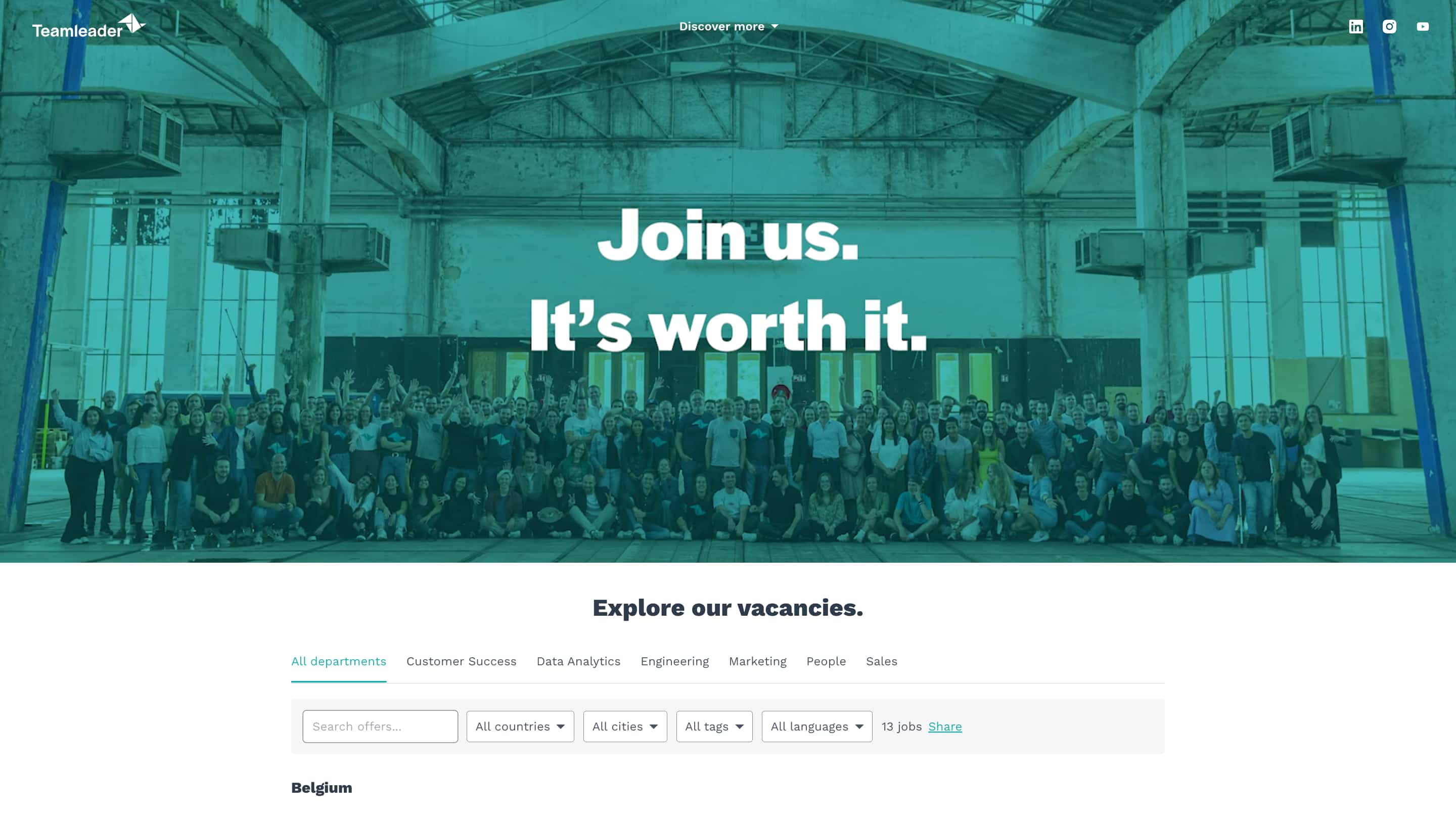
Teamleader's careers page leads with a hero video that shows company culture before any text attempts to explain it — a smart sequence. Immediately below, a robust job vacancies section with extensive filtering by department, country, city, and language gives candidates a clear jumping-off point.
Each job listing shows the job title, work model, locations, language, and departments before requiring a click. That's self-selection done well: candidates arrive at their shortlist informed, not surprised. The rest of the page builds out the culture story through company values, social proof, and a CEO message — context that makes the job listings feel like an invitation rather than a transaction.
5. Xylos
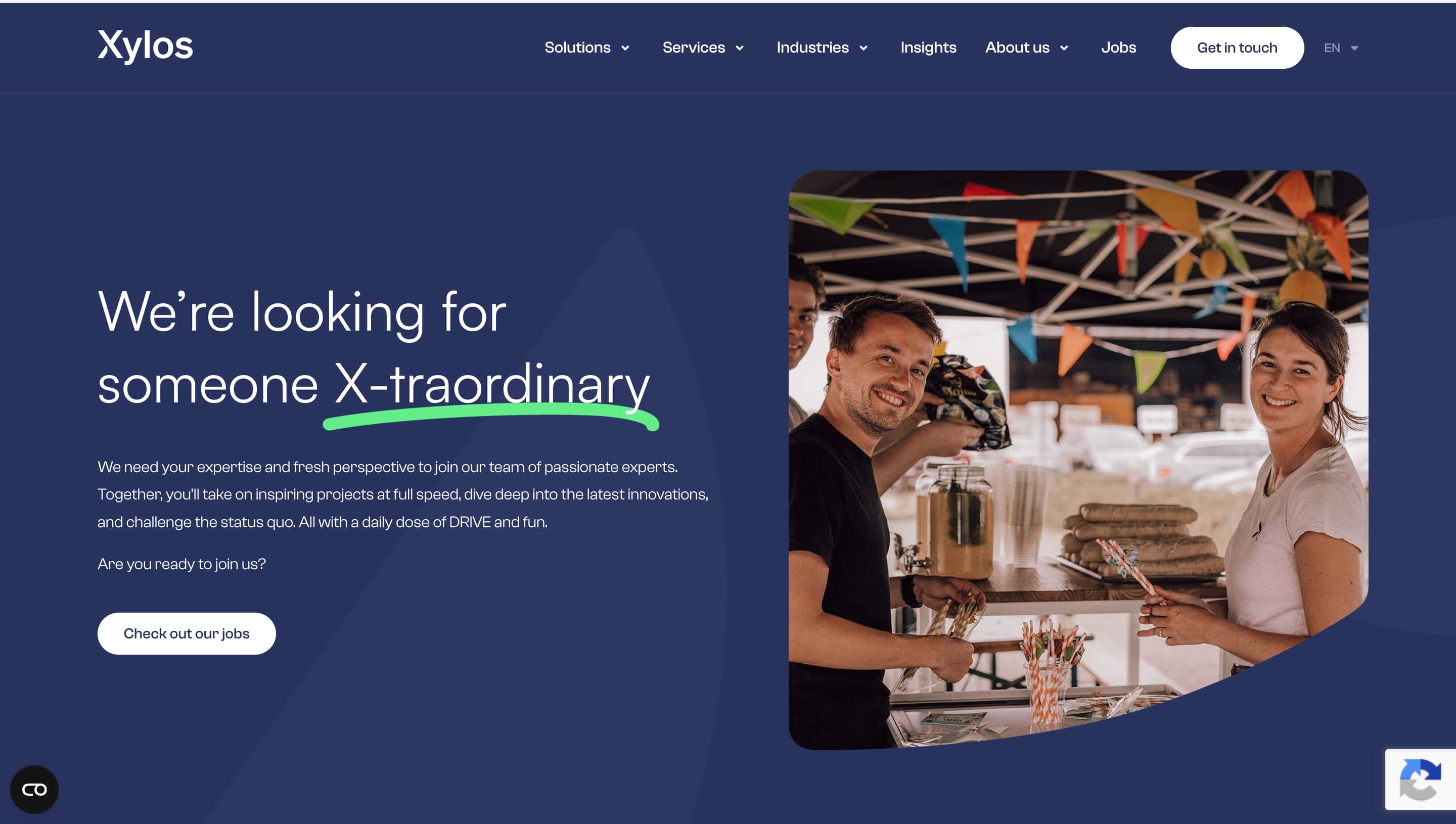
Xylos takes the mystery out of applying. After a sharp EVP — "We're looking for someone X-traordinary" — the page lays out the full hiring journey step by step, from first contact through a technical screening, with an average two-to-three-week timeline included.
That kind of specificity respects candidates' time and removes the anxiety that often causes drop-off during long, opaque processes. The rest of the site reflects the same clarity: a clean information architecture, easy job discovery, and a tone that treats candidates as partners rather than applicants.
6. Conscious Hotel
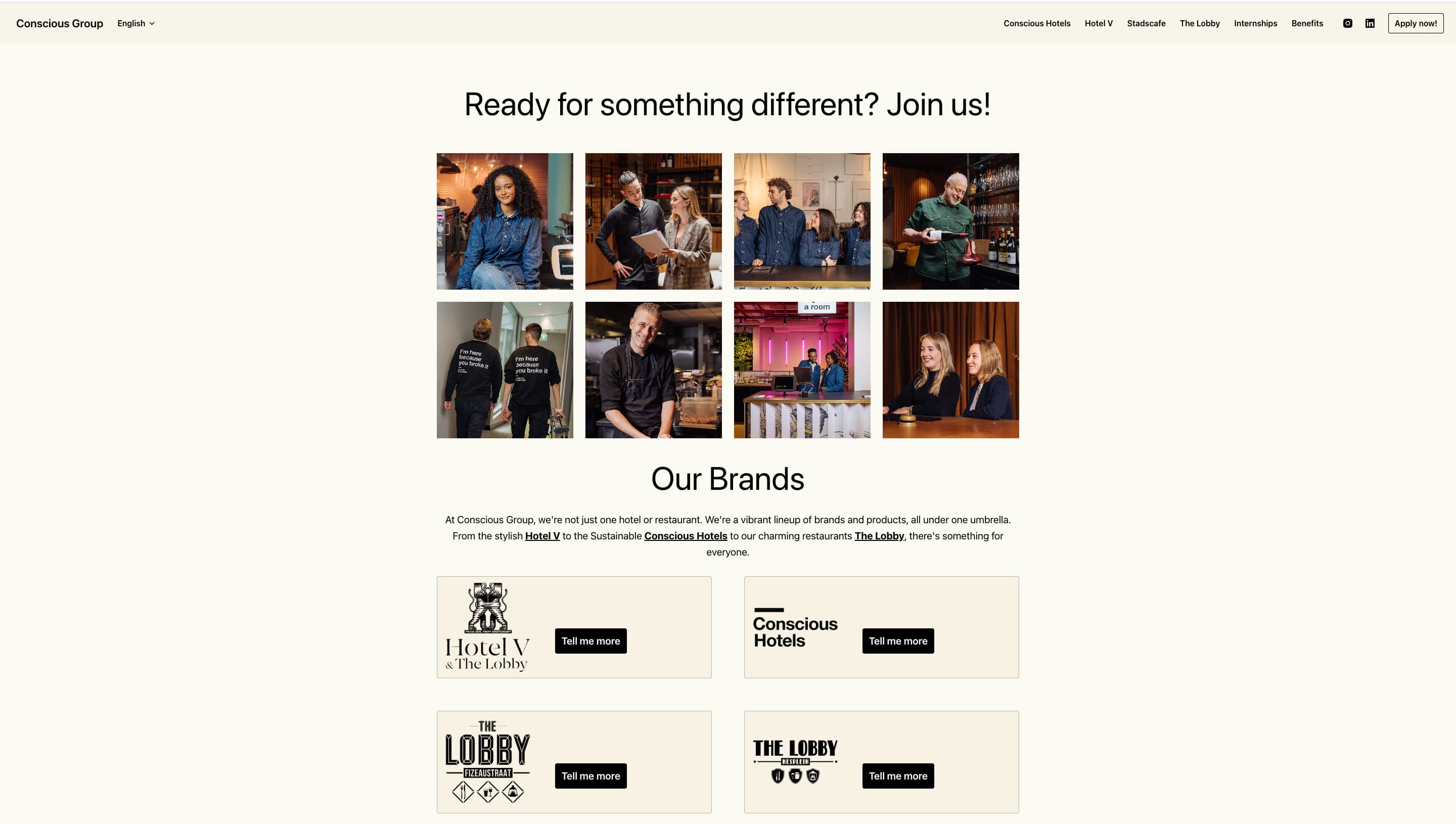
Conscious Hotel shows how a multi-brand organization can maintain a unified employer identity without flattening the distinct character of individual locations. The page leads with a clear statement of who they are and where they come from, then uses maps, culture statements, and expansion plans to show candidates where they'd fit within the larger group.
The hiring process section keeps things casual and accessible for all applicants. By the time a visitor reaches the open roles — filterable by location and department — they have enough context to make a genuinely informed choice.
7. Bunq
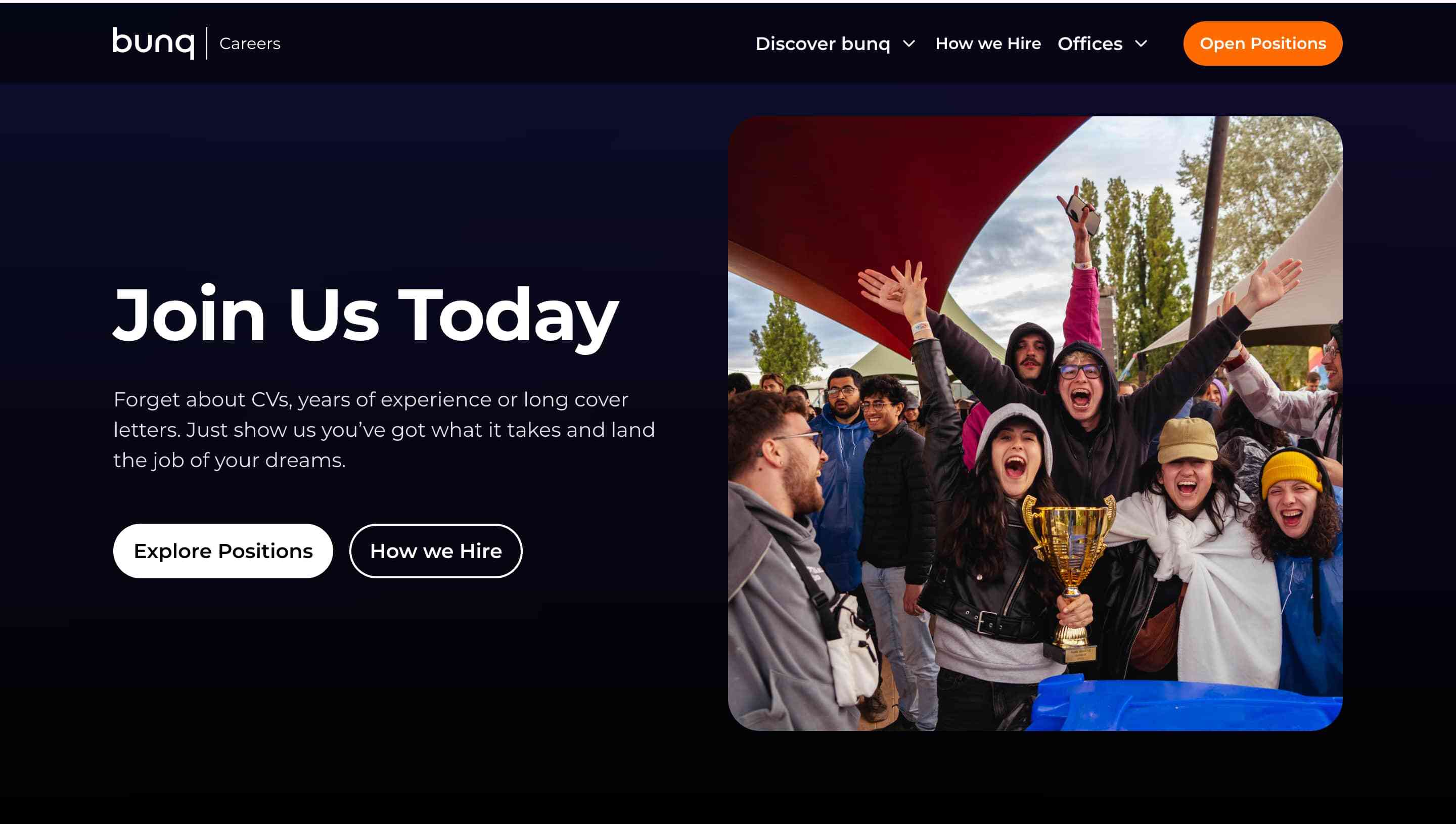
Bunq commits fully to its brand voice from the first line: "Forget about CVs, years of experience or long cover letters. Just show us you've got what it takes." The bold "Start getting s**t done from day 1 at bunq" headline on each job description leaves no ambiguity about the culture.
But the feature that genuinely sets bunq apart is salary transparency. Every job description includes a clear gross monthly salary range. This single decision eliminates a common source of late-stage drop-off and mismatched expectations — saving time for both candidates and recruiters.
8. HelloPrint
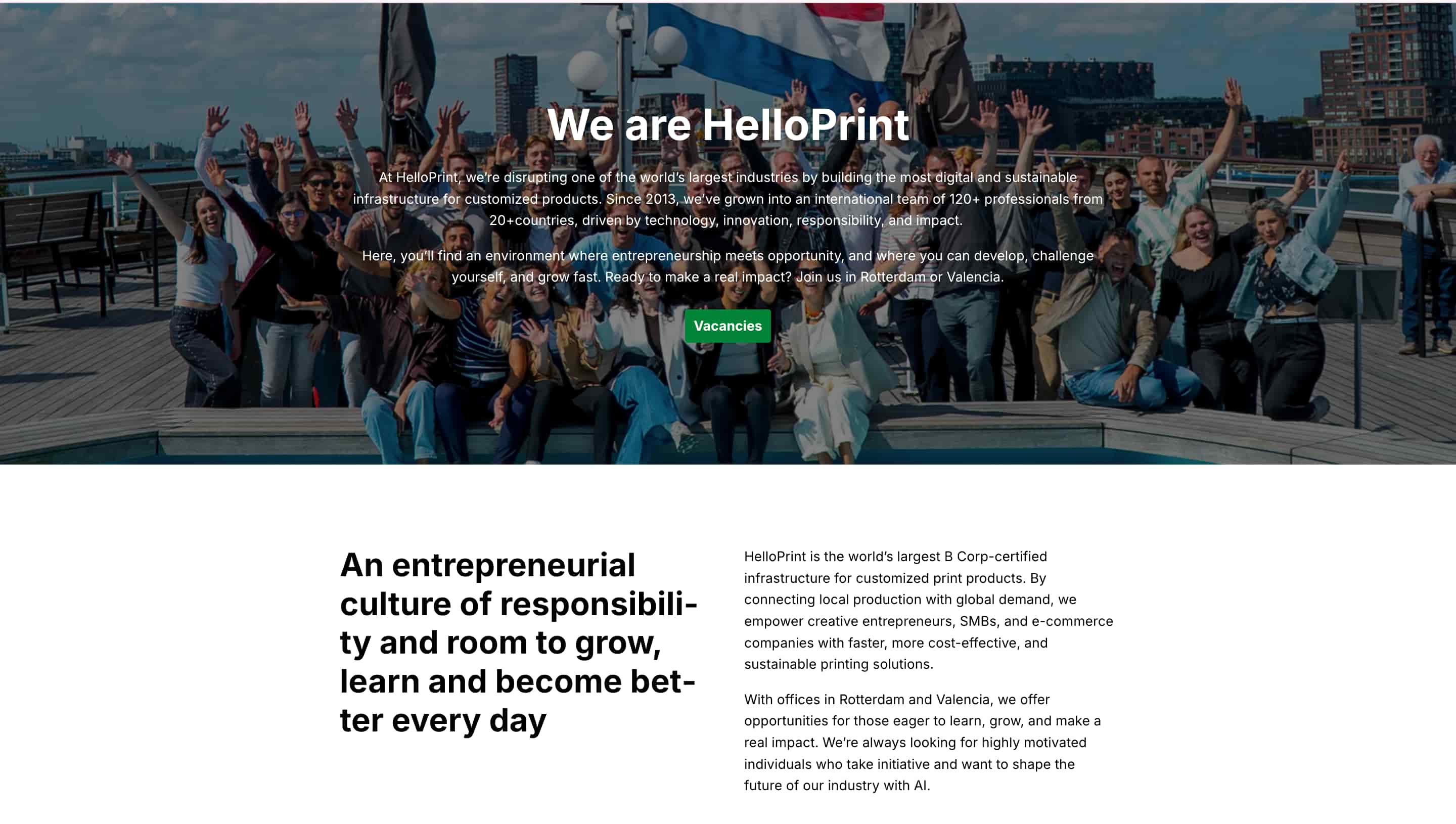
HelloPrint's careers page opens with purpose rather than perks. Their B-Corp certification and mission to create a sustainable infrastructure for customized products are front and center — because that's who they're hiring for.
The page itself is clean and minimalist. The CTA is direct ("Check out the vacancies"), and roles are neatly segmented by location (Rotterdam and Valencia). For a company with an international team, that small structural detail matters — it gets candidates to the roles relevant to them without unnecessary friction.
9. Inditex (Zara)
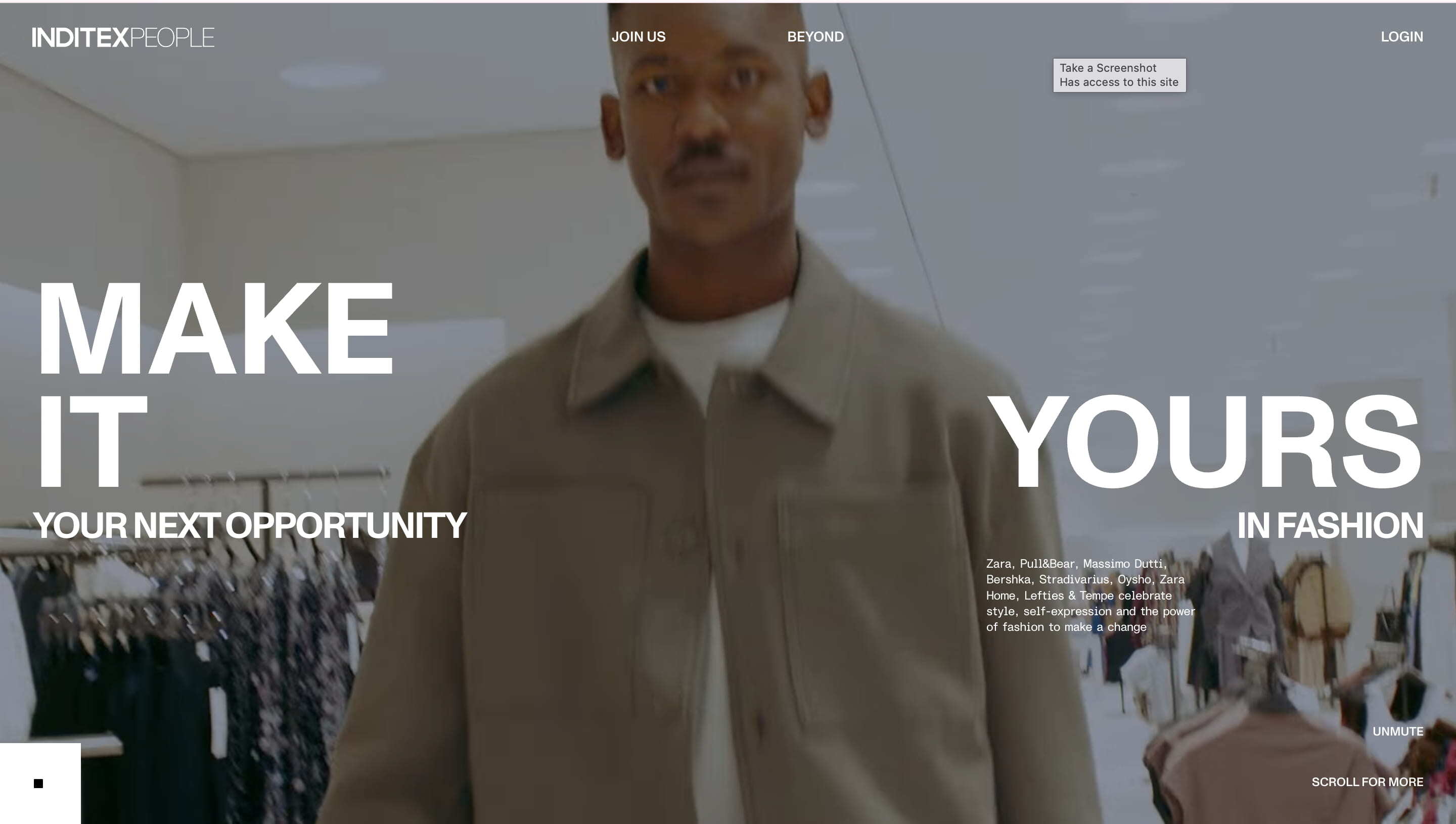
Inditex — the group behind Zara and other global retail brands — shows that scale and humanity aren't mutually exclusive on a career page. The headline "We love what we do," paired with a high-quality video featuring employees in everyday moments, creates an immediate emotional connection.
Career paths are organized into clear categories — Store, Technology, and Product — which makes navigation manageable for a company of this size. Dedicated sections on growth and learning ("Opportunities to grow," "Continuous learning") answer the questions modern candidates care about most before they've committed to applying.
10. Airbnb
Airbnb's career page has been widely cited across the recruitment marketing industry as one of the most influential examples of employer branding done well — and for good reason.
The page leads with belonging: "Creating connection and belonging in the world begins with a workplace where you're welcomed and empowered to be your authentic self." That single sentence ties the company's consumer mission directly to its employee experience, making the EVP feel earned rather than borrowed.
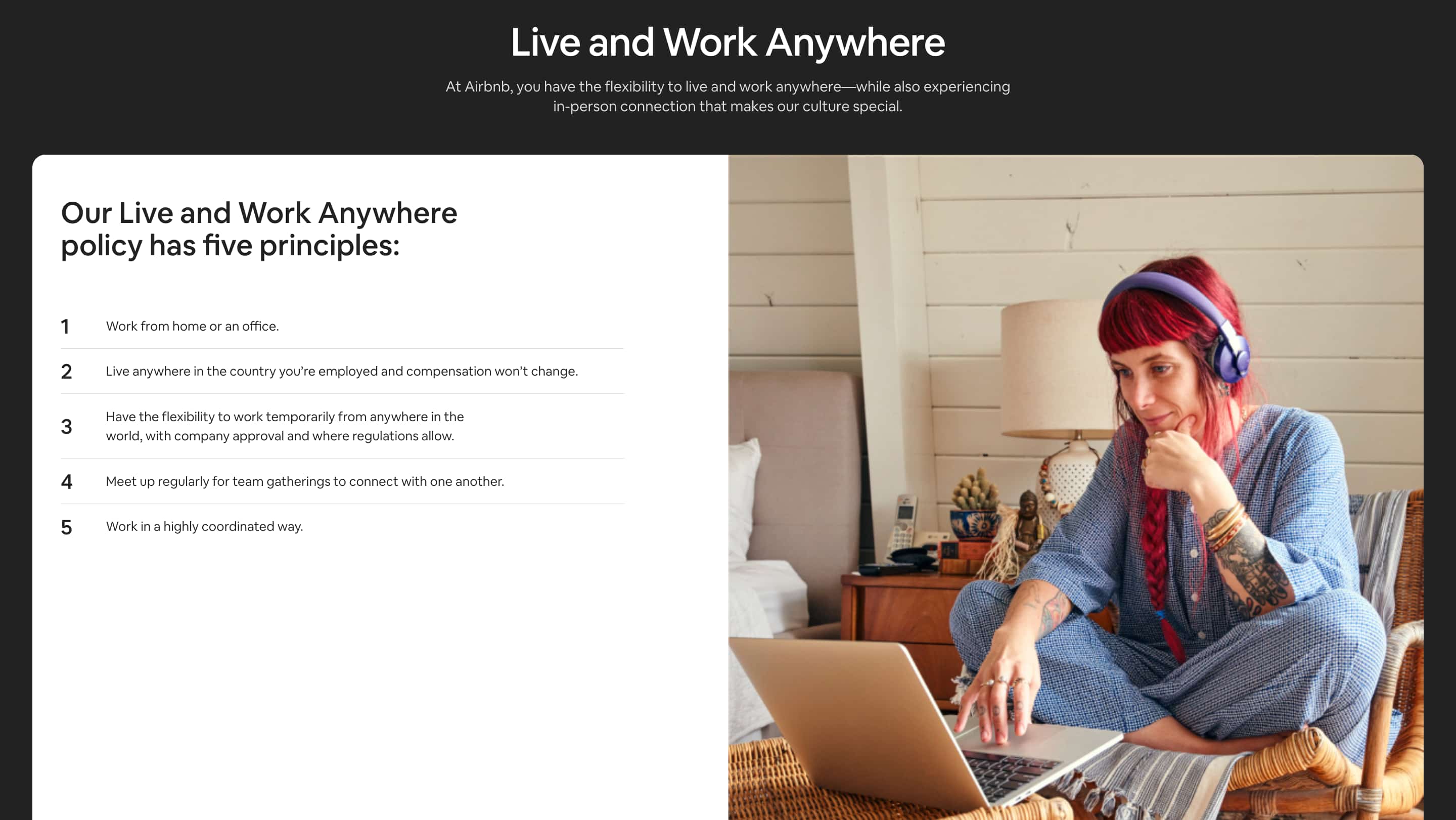
Airbnb's "Live and Work Anywhere" policy is presented not as a bullet point in a benefits list, but as a core expression of who the company is — reinforced throughout the page with real policies and employee-level specifics. Dedicated sections on diversity and inclusion go beyond statements to show programs and commitments in practice.
11. Spotify
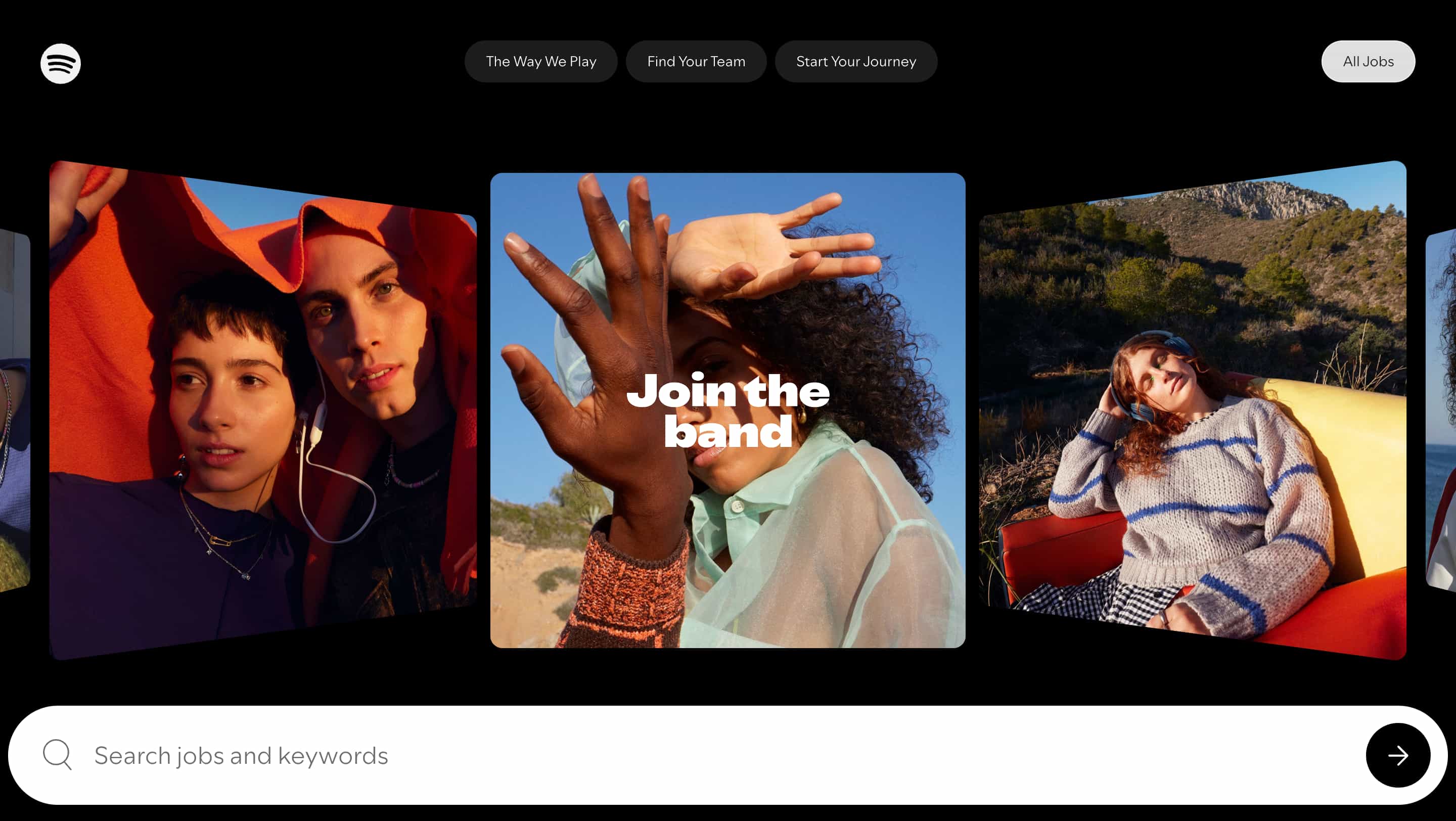
Spotify's careers page carries the brand's personality into every design decision — from the music-centric visuals to the headline "One band, no solo artists." The metaphor does exactly what a good EVP should: it tells you what it's like to work there before you've read a single job description.
The "Work From Anywhere" program is presented with genuine specificity — employees working from a garden in Mumbai or a skyscraper in Tokyo — which makes flexibility feel real rather than aspirational. Navigation by department is clean and fast, with live role counts that show candidates where the company is growing in real time.
12. Netflix
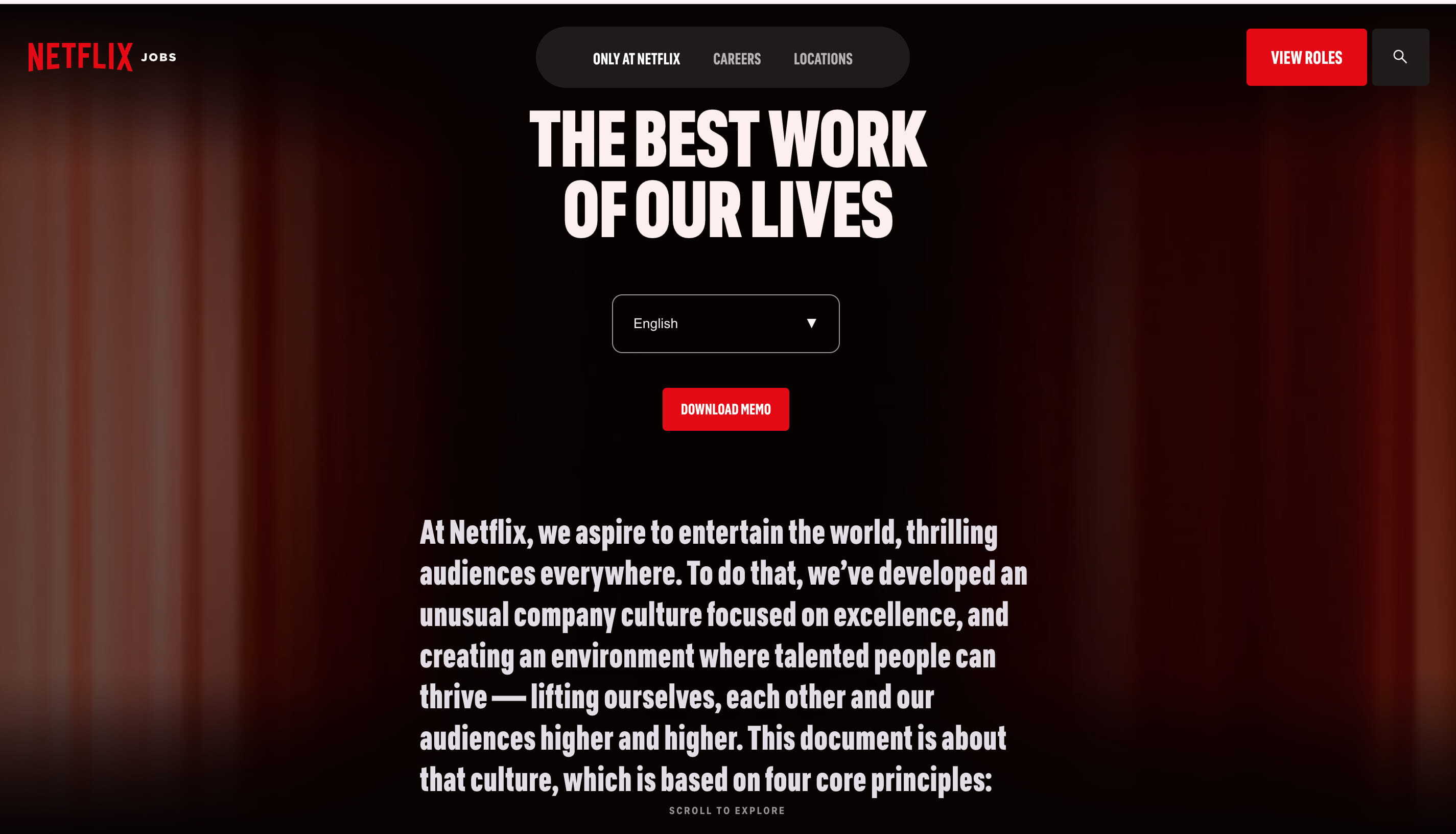
Netflix's careers page takes an approach almost no other company attempts: instead of listing perks or making promises, it publishes its full culture memo — a direct, sometimes uncomfortable document about how the company actually operates.
The culture memo is clear that Netflix is not for everyone. It describes a high-performance environment built on autonomy and accountability, covers the "Keeper Test" that managers apply to every team member, and explains pay philosophy in explicit terms. Most companies would soften or hide this content. Netflix leads with it.
The result is a career page that self-selects candidates with unusual effectiveness. The people who read the memo and still want to apply are already culturally aligned before the first conversation.
13. Tellent
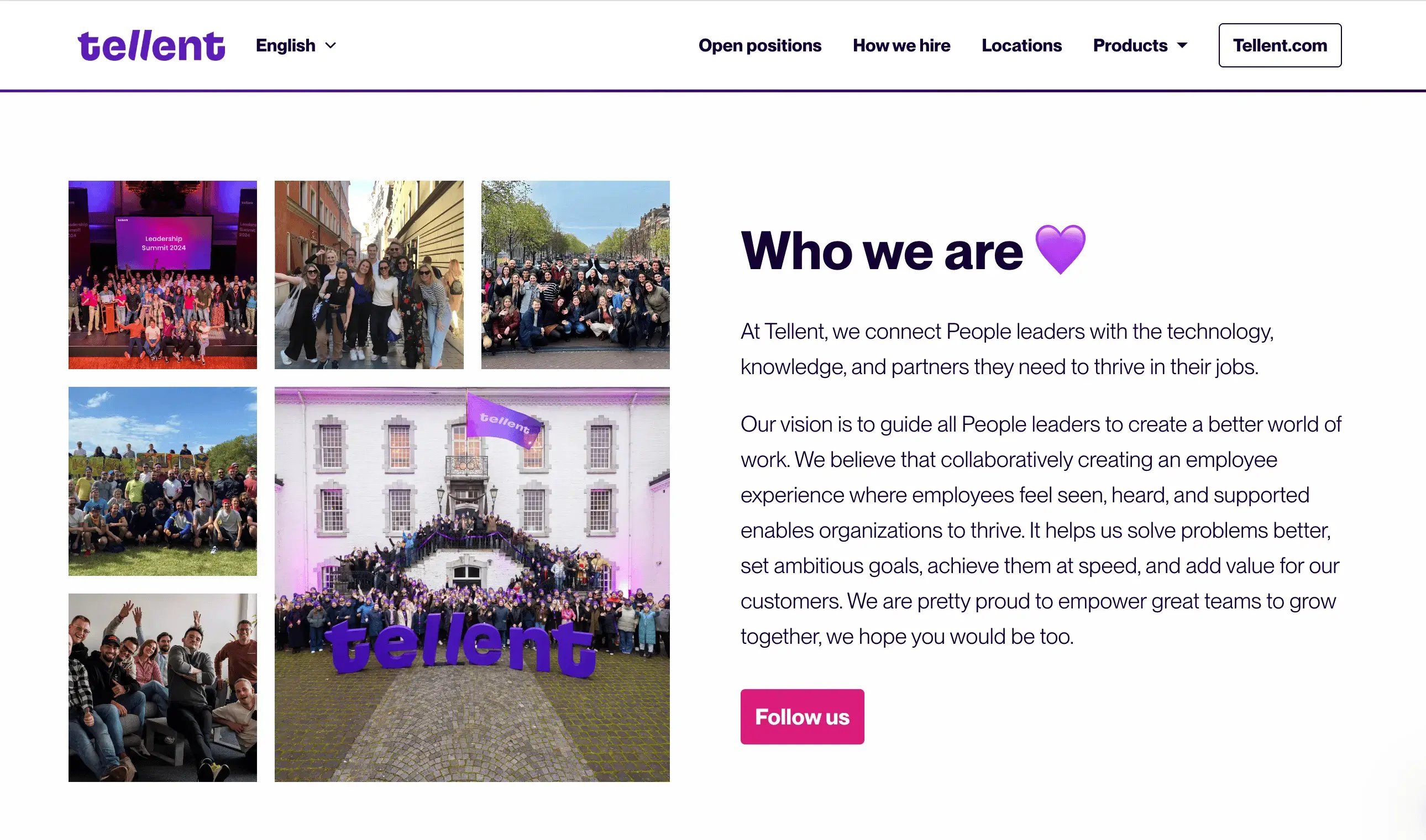
We'll put our own careers page last, and admit upfront that this one isn't unbiased.
The Tellent careers page was built to do more than list open jobs. The headlines — "Connected by community" and "Freedom to thrive" — are meant to reflect how the team actually works together, not just sound good.
One feature we're most proud of is the 3–6–12 month roadmap embedded in each job description. Rather than stopping at a list of responsibilities, each role maps out what success looks like over the first year. We built this because candidates consistently say they want clarity about growth expectations before they commit to applying.
The hiring process is laid out in four steps — from an initial "get to know you" call through to a final team meeting — which reduces candidate anxiety and improves completion rates. Roles are filtered by location and work model (hybrid, remote, or on-site), and candidates can log in to track their applications.
The whole page was built using Tellent Recruitee's CareersHub — which means it required no developer and can be updated by the People team at any time.
As Marieke Drees, VP of People at Tellent, puts it: "Employer branding only lands when it's authentic. Polished videos are nice, but real stories spread faster."
How to build your own career page
Looking at these examples, the question is: where do you start?
Building a career page that feels authentic and converts candidates doesn't require a developer or a large budget. It starts with being intentional about what you put on the page and how candidates move through it.
What every career page needs
-
Lead with your EVP. Start with a clear, specific statement about what it's really like to work at your company. Avoid generic lines like "we're a family" or "we move fast." Be honest about the kind of culture you've built.
-
Show, don't tell. Add photos, videos, or employee quotes that bring your culture to life. Candidates trust real people more than corporate copy. As Marieke Drees, VP of People at Tellent, notes: "If you want to make a start with employer branding — just start. You don't need to wait for proof, the perfect moment, or mountains of data. Start with your own employees. Why do they work for you rather than a competitor? Listen and learn from their stories."
-
Organize jobs clearly. Make it easy to filter by department, location, or work model. The goal is to reduce friction so candidates can find the right role without hunting.
-
Be transparent about your process. Include a "How we hire" section with steps and timelines. This is one of the lowest-effort, highest-impact improvements most career pages can make.
-
Use job descriptions as selling tools. Go beyond a list of responsibilities. Outline success milestones, growth opportunities, and salary ranges where possible. Bias-free, inclusive language matters here — Kamila Kashayeva, Recruiter at Tellent, notes: "Research shows that specifying years of experience like '3 to 5 years' can discourage certain groups — especially women — from applying. Moving away from that is both fairer and more effective."
-
Capture passive candidates. Job alerts and open applications build a pipeline for the future, not just today.
-
Optimize for mobile. A large share of candidates browse career pages on their phones. A responsive, fast, accessible page isn't optional.
-
Track and improve. Use careers site analytics to monitor engagement and drop-off, then iterate.
How Tellent Recruitee's CareersHub helps
Knowing what to build is one thing. Having the tools to build it without a developer is another.
Tellent Recruitee's CareersHub is a no-code platform that lets you launch a branded, professional careers site in minutes.

With CareersHub, you can:
- Customize everything without a developer. Drag-and-drop builders let you design pages for culture, perks, hiring process, and locations — all fully branded to your company.
- Make job discovery seamless. Add filters for department, location, and work model so candidates can quickly find what they're looking for.
- Show transparency up front. Use dedicated sections for "How we hire" or embed a 3–6–12 month roadmap directly into job descriptions.
- Use AI support to draft clearer, localized job ads. The Job Description Generator helps you draft localized job descriptions that use clearer, more consistent language.
- Capture more candidates. Built-in job alerts and open application flows help you build a pipeline of passive talent.
- Optimize automatically. Every job post comes with structured schema markup for better visibility in Google, and you can tailor your application flow to reduce drop-offs.
- Integrate seamlessly. With 200+ integrations — from HRIS tools to e-signatures — your careers page connects into the rest of your hiring workflow.
Your careers page should reflect who you are, not just list what you're hiring for. With the right structure and tools, it can become one of your most effective recruiting assets — attracting candidates who are genuinely aligned before your recruiter picks up the phone.