


.webp)

Every stage of your hiring process is a moment where candidates decide whether to keep going — or drop off.
When the experience is clear, consistent, and easy to navigate, the right people stay engaged. When it isn't — through friction at the application, silence after an interview, or delays at the offer stage — they leave. Often for a competitor.
There's also a less obvious cost: a broken candidate journey doesn't just slow things down. It narrows your pool and weakens the decisions your team is trying to make, because the right candidates don't make it far enough to be properly evaluated.
The data makes it concrete: according to Tellent's State of Hiring report, hiring cycles longer than 40 days see a 12% increase in candidate drop-off. Most of that delay isn't inevitable — it's the result of avoidable gaps in communication, scheduling, and process.
This guide focuses on how to optimize it. You'll learn how to reduce friction, lower drop-off, and make it easier for the right talent to move from interest to hire — without adding manual work on either side.
TL;DR — Key takeaways:
|
How to optimize your candidate journey at every stage
From the first touchpoint when candidates discover you to pre-onboarding new hires, small gaps in clarity, communication, or speed can lead to lost candidates.
Each step below maps to a stage of the candidate journey, showing you how to improve the experience and remove friction at that stage.
Here’s how to apply this across your hiring process:
- Strengthen awareness with a consistent employer brand
- Use clear job descriptions and an engaging careers page to turn interest into consideration
- Remove friction from the application step
- Confirm applications and communicate next steps automatically
- Keep candidates engaged during screening and interviews
- Make offer acceptance faster and easier
- Extend the candidate experience into pre-onboarding
Let’s dive in:
1. Strengthen awareness with a consistent employer brand
At the awareness stage, candidates actively form a first impression of your company — shaping whether they move forward or drop off early in the process.
An inconsistent employer brand, unclear messaging, or low visibility across the channels candidates already use makes it harder for the right people to find and recognize you. Here's how to fix that:
Make your employer brand clear and consistent
Candidates should quickly understand what your company does, what it's like to work there, and whether it aligns with what they're looking for. In practice, that means consistent messaging across job ads, your careers page, and channels like LinkedIn — so candidates don't encounter mixed signals as they discover you.
The key elements to align on: your tone, your employer value proposition, and how you describe the work and culture. When these are consistent, candidates arrive at your careers page already oriented.
Make it easy for candidates to find you where they already are
Most candidates don't start on your careers page. They discover roles through job boards and platforms like LinkedIn or Indeed. When listings are posted inconsistently — or not at all — you limit your reach before the process has even begun.
The practical fix is to centralize your job distribution so roles go live across all relevant channels simultaneously, without manual updates on each platform.
With Tellent Recruitee, you can publish roles across 2,900+ free and premium job boards from one place, with a single click. Listings stay consistent across channels, and your team avoids the manual overhead of updating each platform separately — so more of the right candidates find you, without more work on your end.
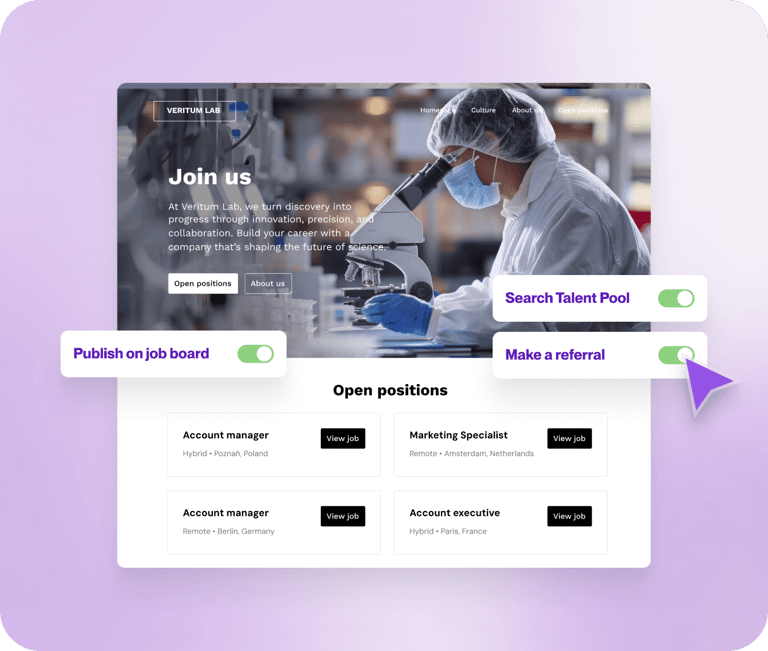
Auto-publish job descriptions across 2900+ free and premium job boards.
2. Use clear job descriptions and engaging careers page to turn interest into consideration
At the consideration stage, candidates are deciding whether your company is worth applying to. Your job descriptions and careers page play a direct role in that decision.
If job descriptions lack clarity, or your careers page is hard to navigate or light on substance, candidates lose interest before applying. In our State of Hiring research, we found that companies that optimize career sites and job postings see shorter hiring cycles and higher applicant engagement.
Write job descriptions that make candidates want to apply
Generic, requirement-heavy job descriptions are one of the most common reasons candidates disengage at this stage. Candidates lose interest when a description tells them everything the company needs but almost nothing about what the role offers.
To improve conversion:
- Keep responsibilities and expectations clear and structured
- Focus on what the candidate will do and learn — not just what they need to bring
- Highlight what makes the role and team worth joining
Create a branded careers page that helps candidates quickly assess fit
Charlène Hemery, former recruiter and founder of Talent Catcher, advises adding authentic employee stories, immersive behind-the-scenes content, and clear job insights to your career site to build trust and increase conversions.

Make sure your careers page gives visitors a clear sense of what it's like to work at your company—and structure the information so it's easy to scan.
In Tellent Recruitee, you can build this using pre-designed careers page templates that are already optimized for readability and mobile use. Customizable themes let you maintain a consistent layout with your employer brand.
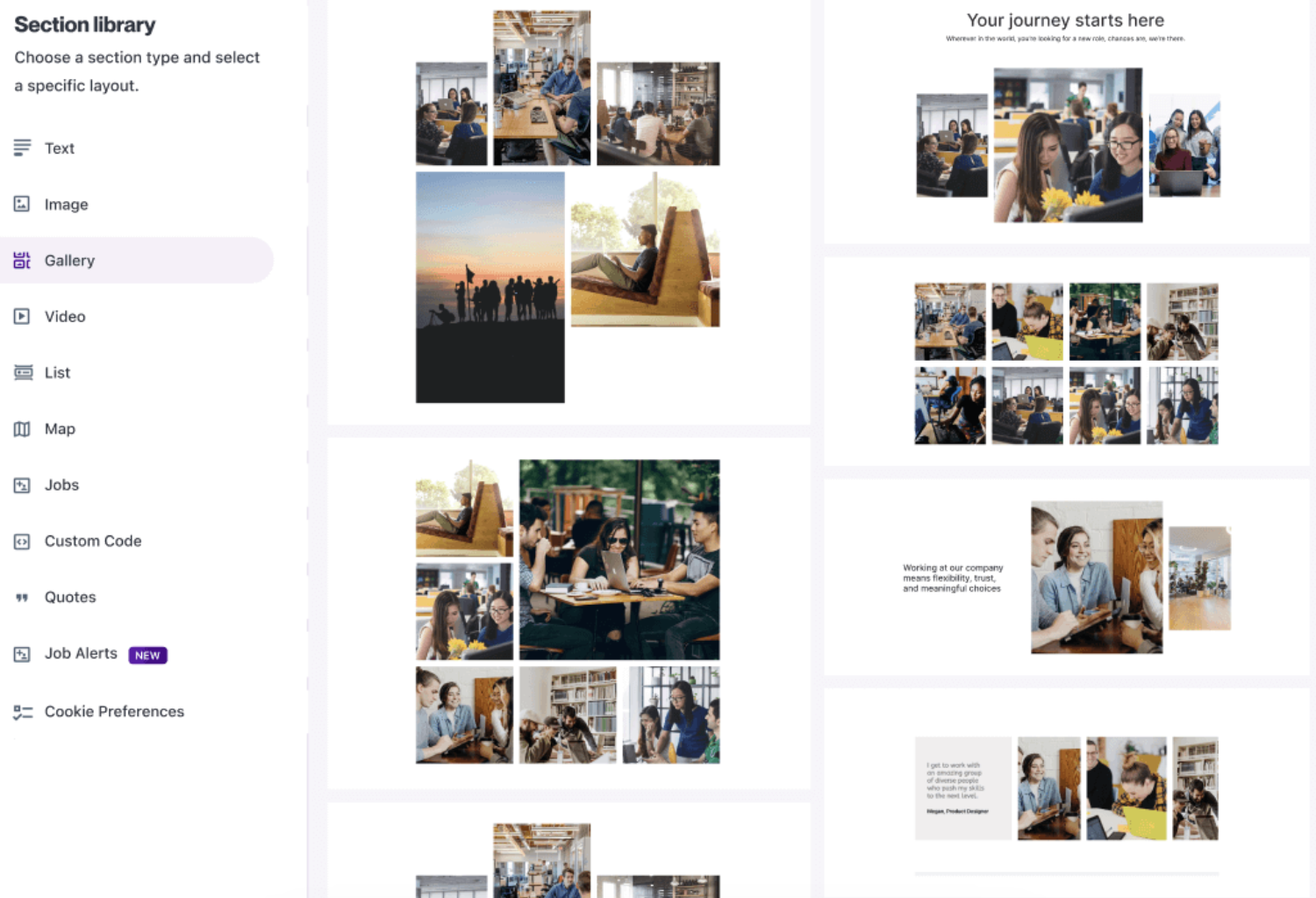
Build your career page using branded templates inside Tellent Recruitee.
3. How to reduce candidate drop-off at the application stage
At this stage, candidates have decided to apply. The only question is whether your process makes it easy or hard for them to follow through.
Even small friction points — a hard-to-find apply button, a long form, limited application options — can slow candidates down or stop them from completing the application altogether. Here's how to remove them:
Give candidates an easy way to ask questions
Candidates often need clarification before applying — about the role, the team, or the process itself. If getting that clarification requires effort (searching for contact details, sending a cold email), many candidates either delay applying or don't bother.
The fix is a low-friction channel for pre-application questions — one that candidates can use quickly without leaving the platform they're already on.
Tellent Recruitee's WhatsApp Hiring feature does exactly this. It allows candidates to:
- Ask questions through a familiar, low-friction channel
- Apply directly via WhatsApp, with screening questions you configure to collect key information upfront
- Receive timely updates as they move through the hiring process
For Van Cranenbroek, for instance, using WhatsApp Hiring reduced dropout from 60% to nearly zero. Here’s how they did it.
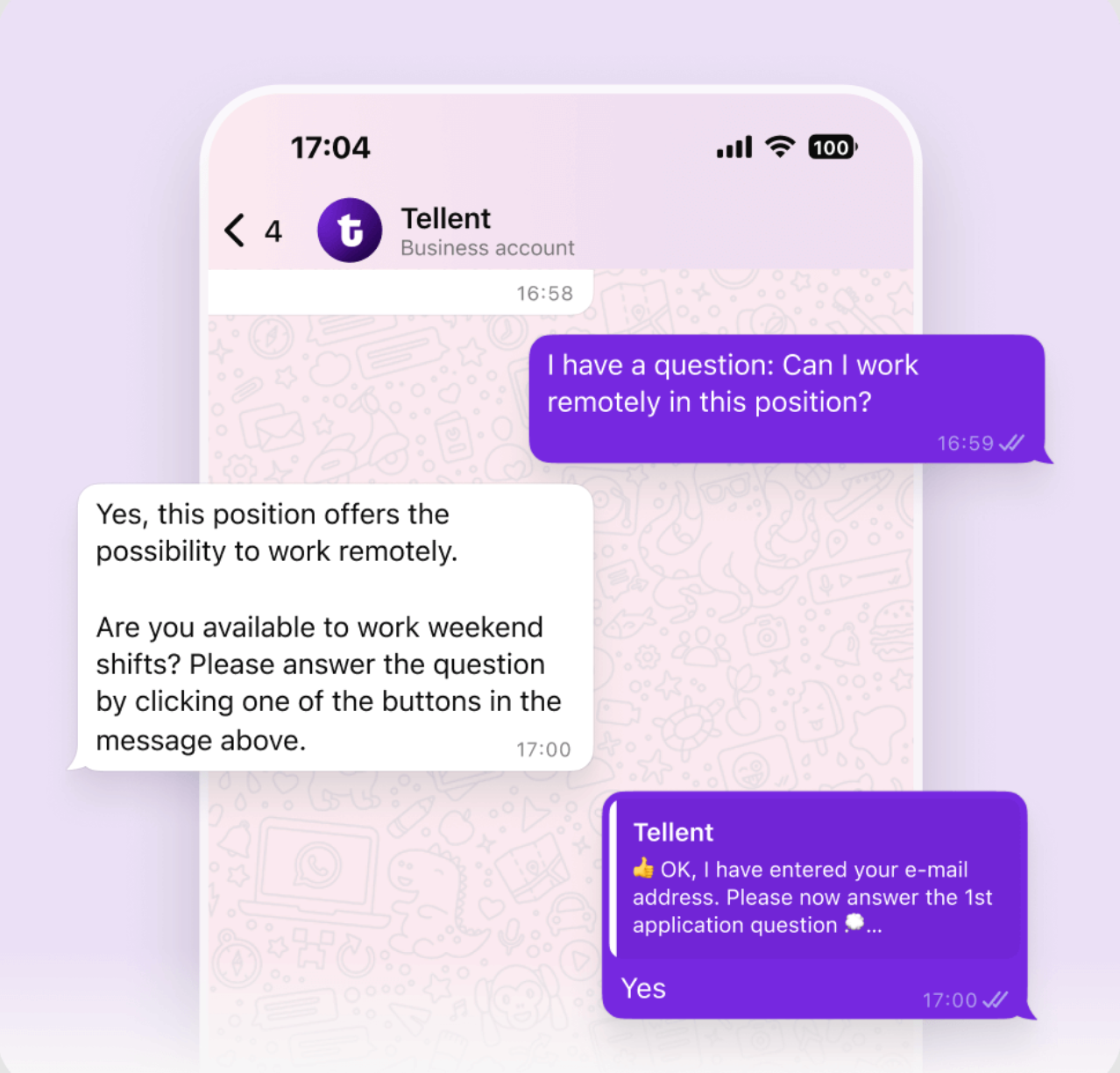
WhatsApp Hiring allows applicants to ask questions and apply via WhatsApp.
Make the apply button obvious
If the apply button is hard to find, buried in the page, or requires extra clicks, candidates are likely to hesitate — especially when applying on mobile or between tasks.
The standard to aim for: one visible, prominent call to action that requires no searching.
With the careers page you build in Tellent Recruitee's drag-and-drop editor, templates already place the apply button prominently to reduce hesitation at this critical conversion point.
Let candidates apply through channels they already use
Not every candidate wants to fill out a full application form from scratch. Offering familiar, faster ways to apply reduces effort and increases completion rates — particularly for passive candidates or those applying on mobile.
The principle: the less a candidate has to re-enter information they've already provided elsewhere, the more likely they are to complete the application.
In Tellent Recruitee, you can enable Apply with Indeed (on by default) and Apply with LinkedIn, so candidates can submit applications using their existing profile data in just a few clicks.
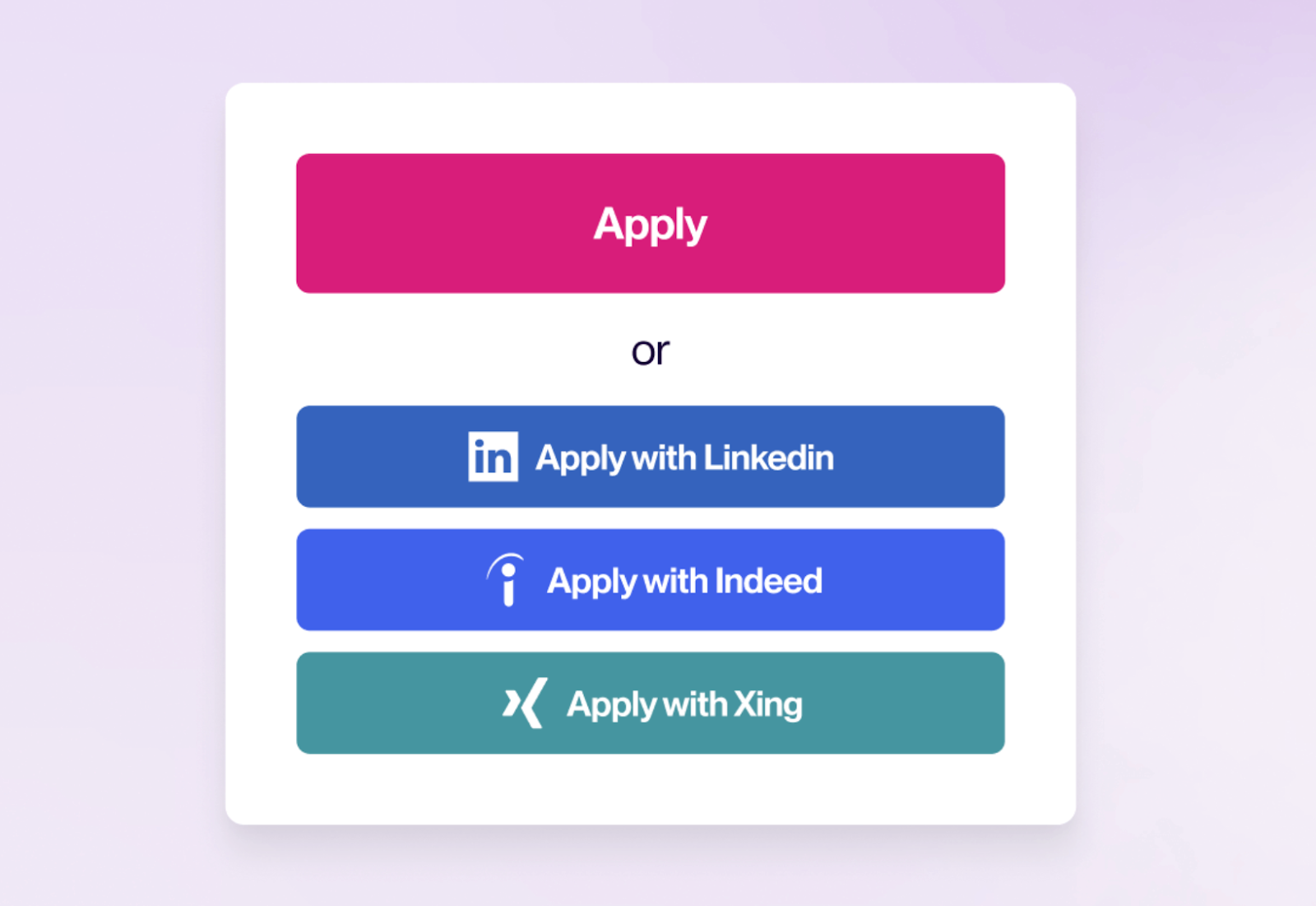
Add apply with LinkedIn or Indeed to your job application forms.
4. How to keep candidates engaged after they apply
Silence after a candidate submits an application is one of the fastest ways to lose them.
Without a confirmation or clear next steps, candidates are left uncertain about whether their application was even received — let alone what happens next. That uncertainty translates directly into disengagement.
The fix here is simple and high-leverage: automate your post-application communication so every candidate gets an immediate, consistent response.
Automate confirmation emails and set next steps
The goal of the confirmation email isn't just to confirm receipt. It's to set expectations and keep the candidate on track throughout the process.
A strong confirmation email includes:
- Confirmation that the application was successfully received
- What the next stage of the process looks like
- When the candidate can expect to hear back (a rough estimate is fine)
5. How to reduce candidate drop-off during screening and interviews
As candidates move into screening and interviews, engagement often drops — not because of lack of interest, but because of delays, unclear communication, or feedback that never comes.
Gaps between stages, back-and-forth on scheduling, or silence after interviews can make candidates assume they're no longer being considered. Often, they're right to — they've already moved on.
The goal here isn't to automate the candidate experience. It's to make sure the administrative side of your process never gets in the way of it. Recruiters and hiring managers still own every decision. What you're removing is the coordination overhead that causes delays.
Automate rejection emails
Candidates who don't meet your must-have criteria deserve a timely response — not a prolonged wait that ends in silence.
The standard to aim for: any candidate who is disqualified at screening should receive a respectful rejection within a defined, consistent timeframe. Manual follow-up at this volume isn't realistic, which means automation is the right tool.
In Tellent Recruitee, when you set up disqualifying knockout questions in your application forms (for criteria like visa requirements), you can attach an automated action: select Send an email, draft the rejection message, choose when to send it (immediately, two days later, etc.), and save.
Candidates who don't pass the initial screening receive timely closure automatically — and your team avoids the backlog.
Automate update and next steps email
Candidates shouldn't have to wonder whether they're still being considered. A simple update email when they move to a new stage costs nothing and prevents the kind of uncertainty that leads people to accept other offers.
The principle: any time a candidate's status changes, they should hear about it — without your team having to remember to tell them.
In Tellent Recruitee, set up a workflow trigger: when a team member moves a candidate to the next stage in your pipeline, the system automatically sends the corresponding email. You can use the same setup to send interview scheduling emails as candidates move through the interview process — from screening through to final rounds — so communication stays consistent and timely.
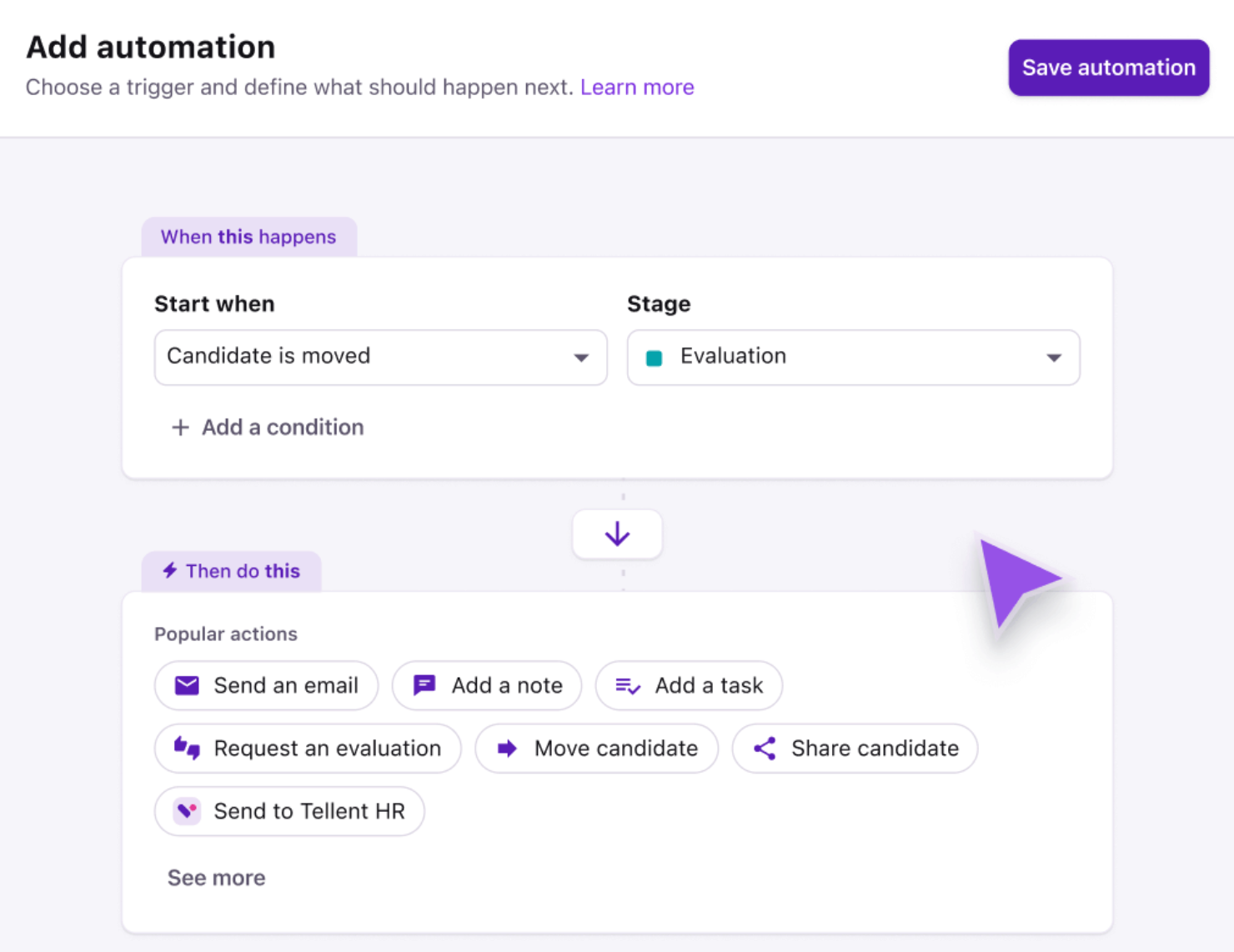
Select a trigger and action in Tellent Recruitee to create automated workflows that reduce work on you.
Reduce interview scheduling delays and back-and-forth
Every round of "does Tuesday at 3pm work for you?" is time neither side can afford. Scheduling delays slow hiring down and signal organizational friction to candidates paying close attention.
The fix is to move scheduling to a self-serve model: candidates see real availability and book the slot that works for them, without an email chain.
With Tellent Recruitee, you can connect team members' calendars and add Event Scheduler links directly to your interview emails. When candidates click the link, they go straight to a booking page to choose a time — no back-and-forth required.
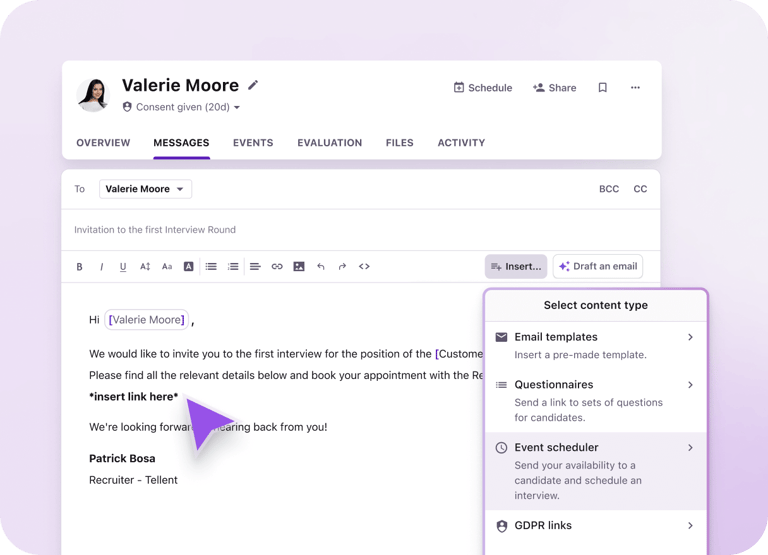
Promptly share interview feedback with candidates
Delayed or inconsistent feedback is one of the most common reasons candidates lose confidence in a process. The root cause is usually internal: no standard format, no deadline, no easy way for busy hiring managers to submit input.
Fixing the candidate-facing problem starts with fixing the internal workflow.
- Use evaluation forms to standardize feedback
Build role-specific evaluation forms in the Templates section of your Tellent Recruitee dashboard. Structured forms give interviewers consistent criteria to assess against, which makes feedback faster to write and easier to compare. In the same form, interviewers assign a final rating (Strong yes, Yes, No, Strong no) that clearly summarizes their recommendation.
Tellent Recruitee automatically aggregates those ratings into an overall evaluation score — giving you an at-a-glance view of the hiring team's position without manually consolidating responses.
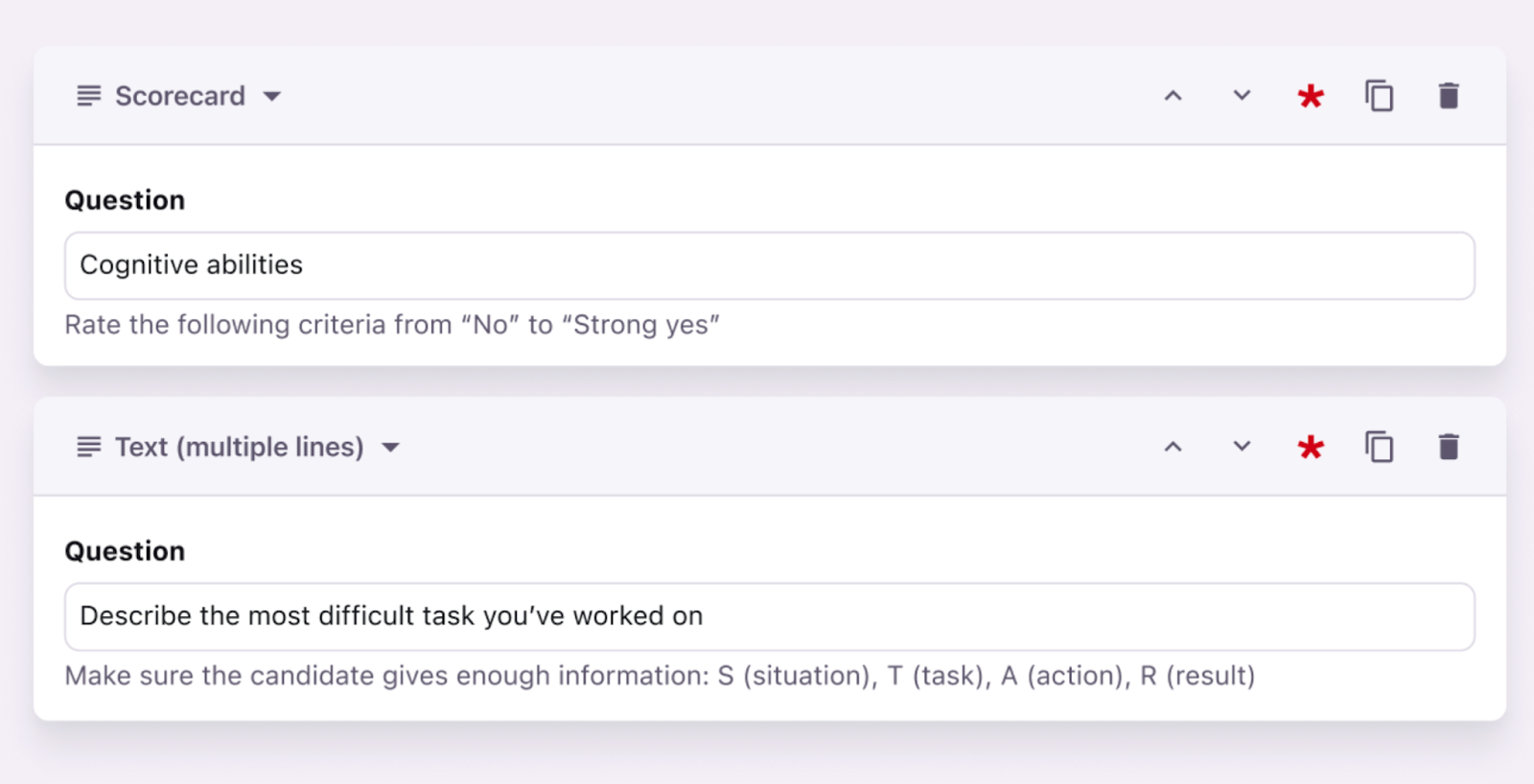
Create custom candidate evaluation forms and scorecards to gather consistent hiring feedback.
- Centralize all feedback and communication in your ATS
Instead of relying on email threads or Slack, add notes and comments directly on each candidate's profile in Tellent Recruitee. This keeps context intact, reduces time spent chasing input, and speeds up decision-making.
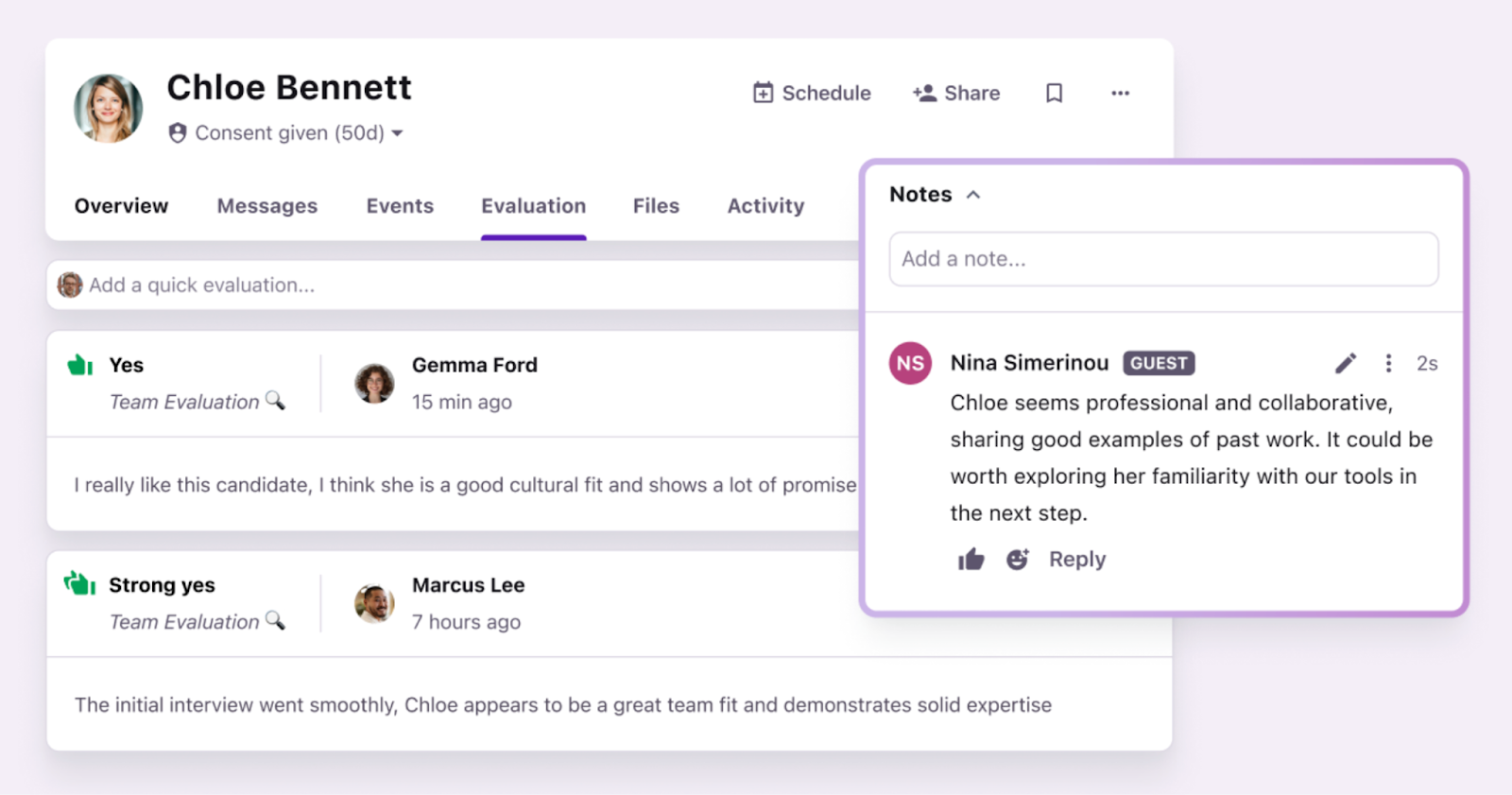
Add notes on each candidate you interview in one system.
- Use quick evaluations to submit feedback faster
For hiring managers with limited availability, enable quick evaluations: a simple thumbs up or thumbs down with a short comment. This lowers the barrier to submitting feedback and prevents the delays that come when managers feel they need to write a full assessment.
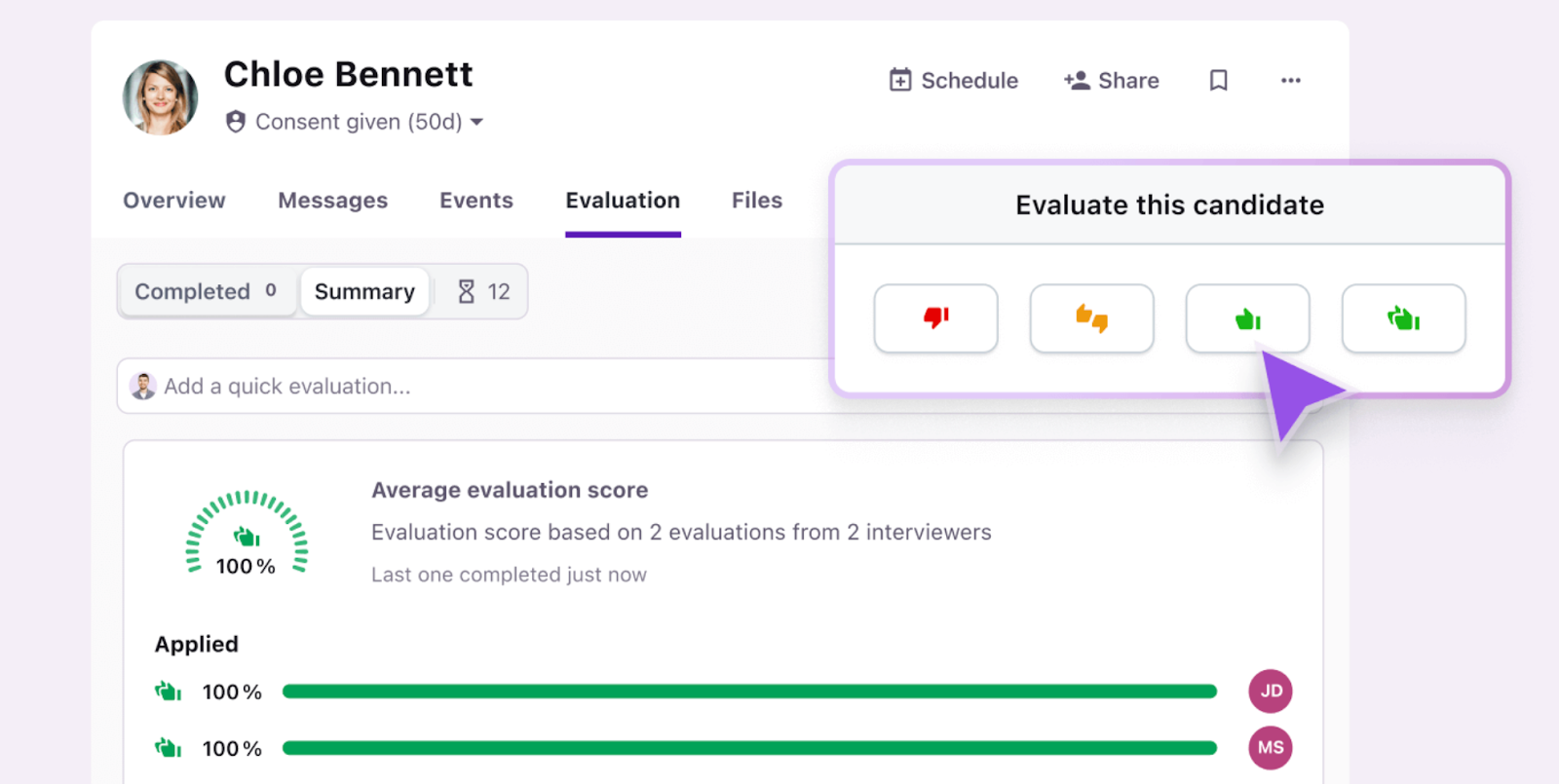
Quickly evaluate candidates with a thumbs up or down sign in Tellent Recruitee.
Once this internal feedback process is in place, you can automate candidate updates using email templates with placeholders — following the same workflow automation setup outlined in the previous section.
6. How to reduce time-to-offer and secure acceptance faster
Delays at the offer stage can quickly lead to lost talent — forcing you to restart the hiring process.
The common bottlenecks: slow offer approvals, back-and-forth on documents, or unclear next steps that give competing offers time to land. At this stage, speed and clarity are your best tools.
Send offers quickly
A clear, professional offer — delivered fast — signals that your company moves efficiently and values the candidate's time. An offer that takes a week to arrive or arrives as a plain-text email does the opposite.
The practical fix: have offer templates ready before you need them, so the only thing standing between a hiring decision and a sent offer is personalizing a few details.
In Tellent Recruitee, you can prepare personalized, branded offer pages — significantly more compelling than plain documents — directly from the candidate's pipeline stage. Select a pre-designed template or build a custom one, then include:
- A welcome message
- Contract type
- Salary and compensation details
- Number of vacation days
- Additional benefits
- Clear instructions on how to accept
Give relevant stakeholders access while controlling visibility of sensitive information, then compose the offer email with a link to the offer page. Candidates can view it without logging in. Reusable email templates for offer communications mean the only step left is adding the offer link and sending.
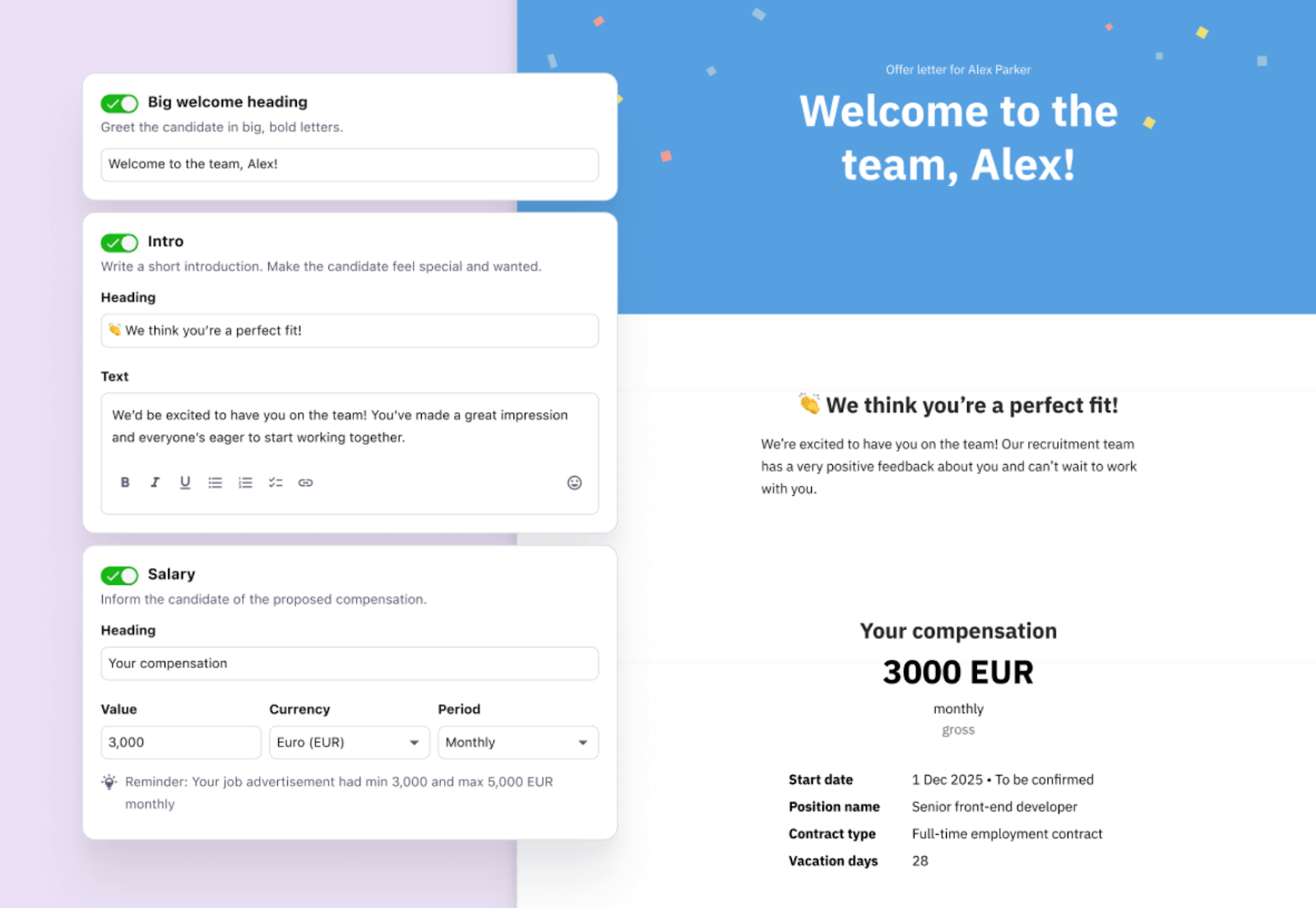
Select and customize an offer page template.
Make it easy for candidates to accept the offer
If candidates need to print, scan, or manually return documents to accept, you've introduced unnecessary friction at the worst possible moment — right when you want them to commit.
The standard to aim for: the candidate should be able to review and sign from the same device they used to check their email.
By integrating your e-signature software — such as DocuSign or Dropbox Sign — with Tellent Recruitee, you can send documents for candidates to review and sign
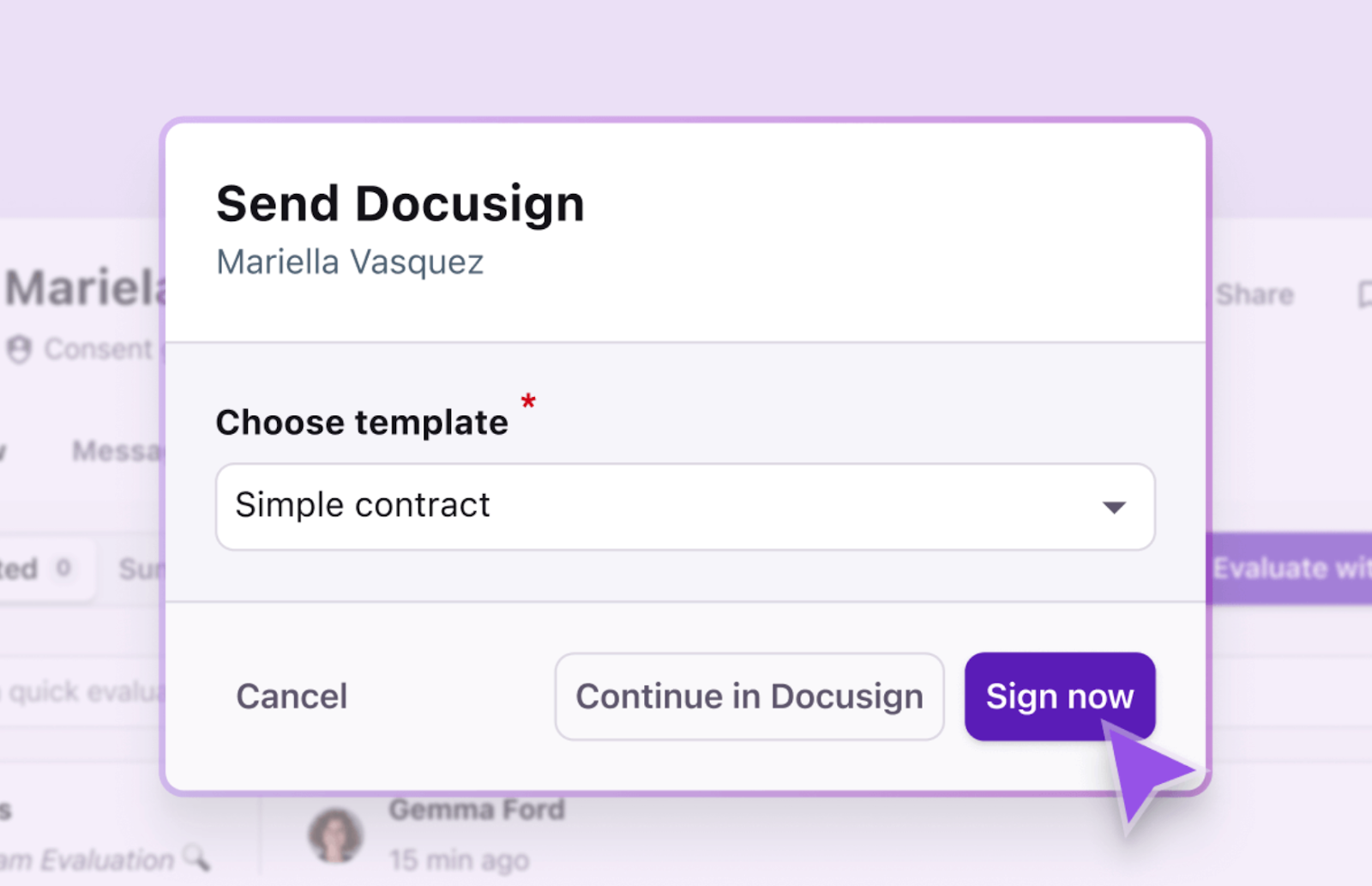
Connect your e-signature software to the ATS so selected candidates can easily sign your job offer.
7. How to improve candidate experience between offer and day one
The gap between a candidate accepting your offer and their first day is easy to overlook. It's also where momentum either holds or quietly falls apart.
Without communication, new hires are left waiting at exactly the point where they're most likely to second-guess their decision — or field a counteroffer from their current employer.
Keep candidates engaged between offer acceptance and day one
New hires should know what happens next from the moment they say yes. That means clear visibility into onboarding timelines, what they need to complete before their start date, and what their first days will look like.
Delivering this consistently — without relying on manual follow-up — requires a repeatable process.
In Tellent Recruitee, you can create a reusable pre-onboarding checklist using Journeys and send it directly to new hires' personal email. This lets you:
- Share what new hires need to complete before their start date
- Outline what their first days will look like
- Provide key information or resources in advance.
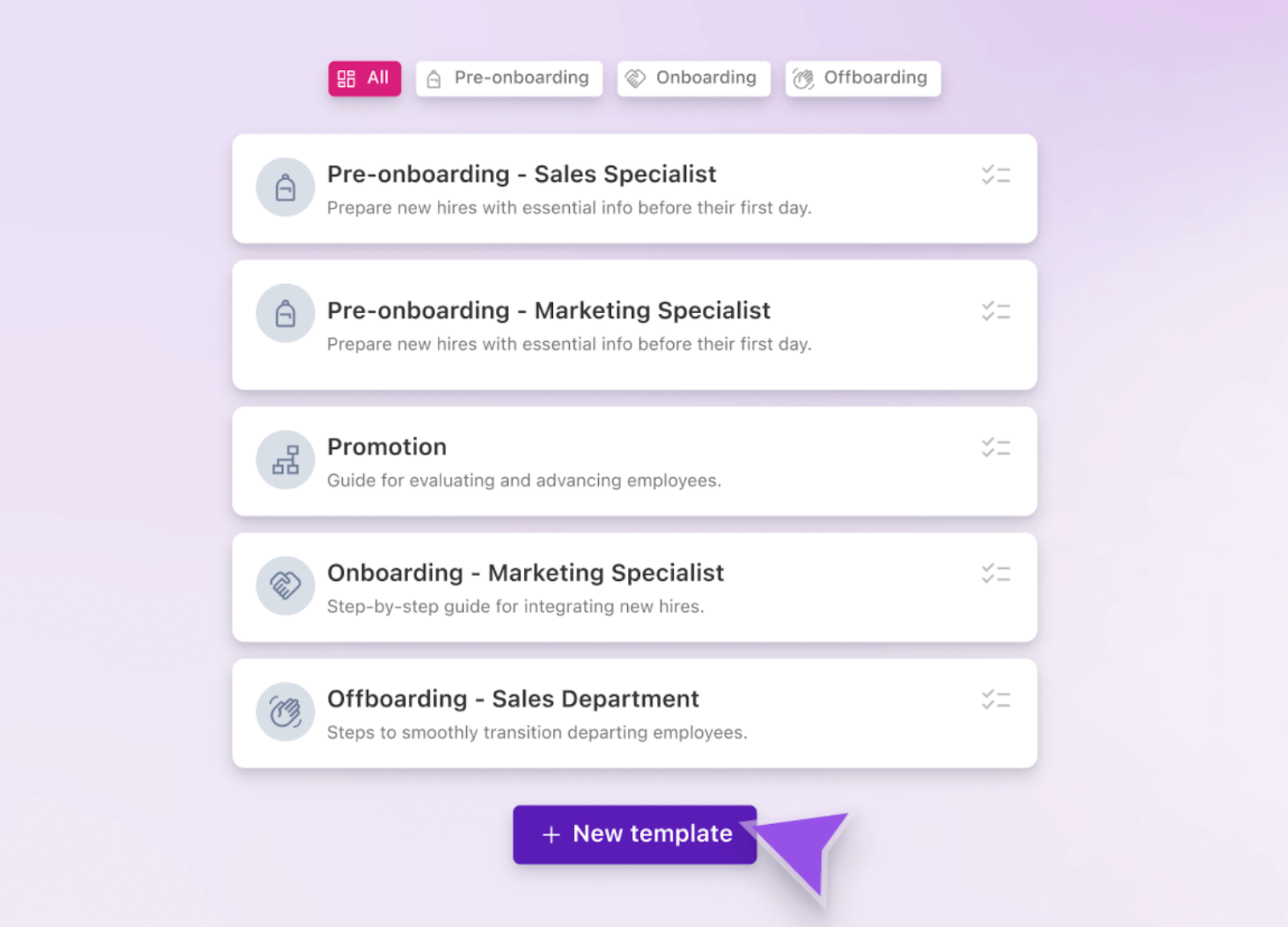
With this in place, new hires stay informed and prepared, and your team avoids last-minute gaps during onboarding.
Candidate journey optimization checklist
Use this checklist to identify where candidates are most likely to lose clarity, momentum, or confidence in your hiring process:
- Are job descriptions clear about responsibilities, expectations, benefits, and next steps?
- Is your careers page easy to navigate on desktop and mobile?
- Can candidates apply in a few minutes without re-entering unnecessary information?
- Do all applicants receive an automatic confirmation email?
- Do candidates know what happens next after each stage?
- Are rejection emails sent promptly and respectfully?
- Can candidates self-schedule interviews without back-and-forth emails?
- Are interviewers using structured feedback forms or scorecards?
- Are hiring decisions followed by fast, consistent updates?
- Is the offer process simple, branded, and easy to accept digitally?
- Do new hires receive pre-onboarding information before day one?
If the answer to any of these is “no,” that stage is a good place to start optimizing.
Turn a positive candidate experience into your competitive advantage
Improving your candidate journey doesn't require a complete overhaul. It comes down to fixing the moments where candidates lose clarity, momentum, or confidence in your process.
Start by identifying where your hiring flow slows candidates down or creates uncertainty — then make targeted improvements at those points.
Every step in this guide is built into Tellent Recruitee: from multi-channel job posting and branded careers pages to automated candidate communication, interview scheduling, and offer management. Your team sets the standard; the platform makes it consistent.
Take it from the Levieux Menuisiers team:
Working on reducing drop-off and improving how candidates experience your hiring process? It’s worth seeing how Tellent Recruitee can help achieve this — book a demo to explore it for your team.