



.webp)

Recruitment strategies are the structured plans and processes your organization uses to find, attract, and hire the right people. The best strategies don't just fill vacancies faster — they improve the quality of every hiring decision you make.
In a competitive talent market, the cost of hiring wrong is high. According to Gartner, fewer than 25% of leaders believe their organization consistently makes high-quality people decisions — and hiring is where that gap usually starts.
Every unfilled revenue-generating role costs the business daily. Every mis-hire triggers replacement costs, lost productivity, and team disruption. A clear recruitment strategy is how you close that gap before it compounds.
This guide covers 10 proven recruitment strategies, why each one works, and how to measure whether your approach is actually paying off.
What is a recruitment strategy?
A recruitment strategy is a plan that defines how your organization will identify, attract, and hire candidates for open roles. It covers sourcing channels, candidate experience, evaluation criteria, and the tools and processes that support each stage of the hiring funnel.
A strong recruitment strategy incorporates three key elements:
- Clear goals (what you're trying to achieve)
- Defined approaches (how you’ll achieve it)
- Measurable success (ways to track and assess outcomes)
Without all three, you’re running tactics, not a strategy.
Recruitment strategies also split into two broad types — internal and external — and most organizations benefit from combining both. Internal recruitment fills roles from within your existing workforce (promotions, lateral moves, transfers).
External recruitment sources candidates from outside the organization. Internal hiring is typically faster and cheaper; external hiring broadens your talent pool and brings in fresh perspectives. The right balance depends on the role, the team, and where your organization is in its growth.
1. Build candidate personas for hard-to-fill roles
A candidate persona is a research-based profile of your ideal hire for a specific role. It combines data from your applicant tracking system on past successful hires with structured input from hiring managers about the experience, motivations, and goals they're looking for.
Candidate personas are most valuable for:
- Roles you hire for frequently or in volume
- Specialist or hard-to-fill positions, such as senior tech, clinical, or niche finance roles
- Roles where previous hires have underperformed — to identify patterns and adjust
To build a persona, start with your recruitment data: where did your best hires come from? What was their career path? Why did they apply? Supplement this with structured conversations with hiring managers and top performers already in the role.
Use the persona to write sharper job descriptions, choose better sourcing channels, and screen candidates against defined criteria rather than gut feel. That shift — from impression to structure — is where decision quality starts to improve.
Why recruitment strategy is really a decision-quality problem
Most hiring problems are not caused by a lack of effort. They are caused by a lack of structure.
Hiring teams often have plenty of activity: job ads, sourcing channels, interviews, referrals, assessments, and candidate communication. But when these activities are disconnected, decision quality suffers. Managers evaluate candidates differently. Recruiters rely on incomplete pipeline data. Strong candidates drop out because the process is too slow. Hiring outcomes become inconsistent from one role or department to the next.
That is the decision quality gap in recruitment: organizations have more tools and more data, but not always clearer decisions.
A strong recruitment strategy closes that gap by creating a shared framework for how hiring decisions are made. It defines what good looks like, which signals matter, how candidates should be assessed, and how success will be measured after the hire.
This is where recruitment connects to the wider employee lifecycle. A hiring decision does not end when an offer is accepted. The quality of that decision shows up later in onboarding, performance, development, retention, and internal mobility. The more connected those signals become, the easier it is to improve hiring over time.
2. Design a candidate experience that wins top talent
Candidate experience is every interaction a candidate has with your organization — from the moment they find your job ad to the moment they receive an offer or a rejection.
A slow, disorganized process doesn't just cost you one candidate — it damages your employer brand with every person they speak to afterward. According to LinkedIn's Future of Recruiting 2025 report, only 25% of talent teams feel highly confident in their ability to measure quality of hire — in part because poor candidate experience drives dropout before meaningful data can be captured.
Practical improvements to prioritize:
- Write clear, specific job descriptions that set honest expectations about the role and its challenges
- Streamline your application process — remove any step that doesn't add information you'll actually use
- Keep candidates informed at every stage with timely, personal communication
- Handle rejections with care — a brief, respectful response protects your employer brand and leaves the door open for future roles.

Tellent Recruitee automates the repetitive parts of this process — confirmation emails, stage updates, rejection messages — so your team can focus on the conversations that matter.
3. Build a structured employee referral program
Employee referrals consistently produce higher-quality hires than most other sourcing channels. Referred candidates tend to onboard faster, stay longer, and fit the culture better — because your existing team is doing part of the vetting work before the application even lands in your pipeline.
To make referrals a reliable part of your recruitment strategy:
- Make it easy for employees to share open roles — Tellent Recruitee includes built-in social sharing directly from the platform
- Set clear expectations about what makes a strong referral for each role
- Close the loop — always tell employees the outcome of their referral, even when the answer is no
- Embed referral reminders in your onboarding process so new hires start contributing to the pipeline from day one
Focus referral efforts on your hardest-to-fill roles first. That's where the network effect has the biggest impact on reducing time-to-hire — and every additional week an unfilled revenue-generating role sits open has a real cost to the business.
4. Reduce bias in your hiring decisions
Unconscious bias is one of the most persistent sources of poor hiring decisions. A study published by the American Economic Review found that candidates with certain names received significantly fewer callbacks — even with identical qualifications. Bias doesn't just affect fairness; it narrows your talent pool and lowers the average quality of your hires over time.
Three practical ways to reduce hiring bias in your recruitment strategy:
- Audit your job language. Tools like Textio identify language in job postings that skews toward specific demographic groups. Skills-focused, neutral language broadens your applicant pool without lowering the bar — and consistently improves both the volume and quality of applications.
- Use structured interviews. First impressions and rapport heavily influence unstructured interviews — neither of which reliably predicts job performance. Structured interviews use identical questions for every candidate and score responses against defined criteria. According to TestGorilla's State of Skills-Based Hiring 2025, 94% of employers who adopt more objective evaluation methods say they're more predictive of on-the-job success than traditional approaches. Consistent criteria across every candidate is what turns interviewing from a gut check into a reliable decision-making process.
- Let your data lead. Tellent Recruitee, for example, tracks where candidates drop out of your process, which demographics advance to offer, and where your best hires originate. Reviewing this data regularly helps you identify bias patterns before they become expensive hiring habits.
5. Understand what today's candidates actually want
What candidates expect from employers has shifted considerably in recent years. Flexibility is now a baseline expectation. But the drivers of genuine candidate attraction go deeper than remote work policies.
According to LinkedIn's Global Talent Trends research, the top three factors candidates evaluate when considering a new employer are:
- Compensation and benefits that reflect their market value
- Work-life balance — including real flexibility in how, when, and where they work
- A clear sense of purpose and values alignment
For growing companies competing against larger, better-known employers for the same talent, this is where you can win. You may not have the brand recognition of a listed company, but you can offer clarity on role impact, faster career progression, and a culture that doesn't require three layers of approval to get anything done.
Make sure your careers site, job descriptions, and interview process all consistently communicate the same story about what working at your company looks like — and what it doesn't.
6. Use AI-assisted screening to hire faster without sacrificing quality
AI-powered screening is now part of every competitive recruitment strategy — but how you deploy it determines whether it helps or creates new problems.
Effective AI screening supports human decision-making. It surfaces the most relevant candidates faster, reduces time spent on administrative tasks, and flags strong matches your team might have missed in a crowded inbox. It doesn't replace the judgment calls that matter most: potential, cultural alignment, and the story behind a non-linear career path.
Tellent Recruitee's Screening Assistant uses AI to show how information in incoming applications relates to the role criteria you define, helping recruiters review applications more efficiently. All decisions remain with your team. The AI supports the review process; accountability stays human.
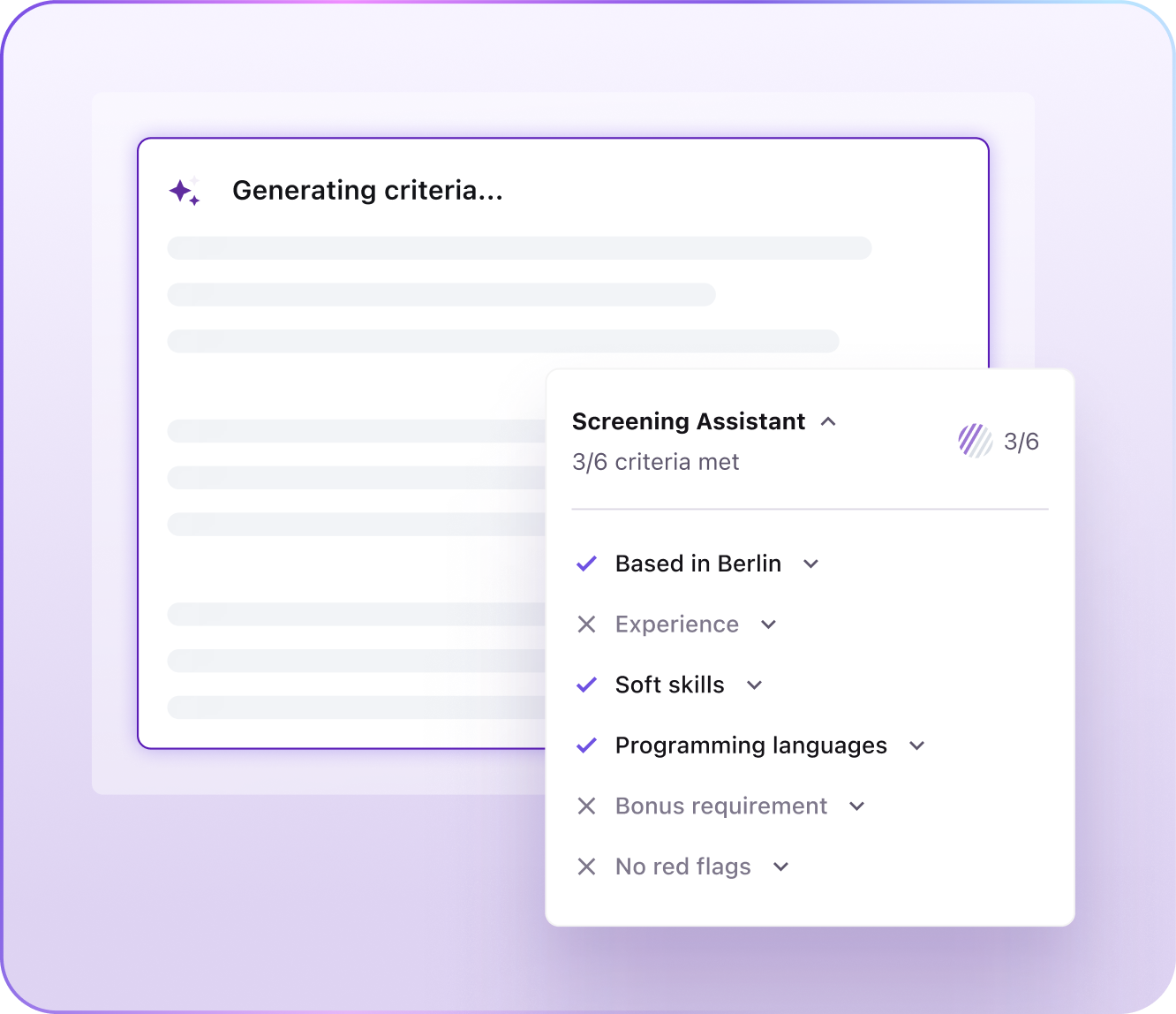
As AI becomes part of recruitment, the quality of the underlying process matters even more.
While AI applied to unclear role criteria or fragmented data can amplify noise, AI applied to structured, governed hiring workflows can improve relevance, timing, and consistency.
The difference is not whether AI is used — it is whether it operates as assistive intelligence, with human accountability built in.
7. Adopt skills-based hiring to widen your talent pool
Skills-based hiring is one of the fastest-growing shifts in recruitment right now — and one of the most practical. Instead of screening candidates by job title or degree, skills-based hiring evaluates what candidates can actually do.
According to TestGorilla's State of Skills-Based Hiring 2025 report, 85% of employers are now using some form of skills-based hiring — up from 73% in 2023. More than half (53%) have eliminated degree requirements for at least some roles.
For growing companies competing for specialist talent, this approach opens up a significantly larger pool of qualified candidates. A software engineer who learned through open-source projects and certifications may be a better fit than a graduate with a relevant degree and no practical experience. Skills-based hiring lets you evaluate that directly.
How to implement skills-based hiring:
- Replace degree and experience thresholds in job descriptions with specific, measurable skills and competencies
- Add a short skills assessment or work sample early in the process — before investing time in phone screens for candidates who won't progress
- Use a scorecard and structured evaluation criteria to make assessment results comparable across candidates
- Review your screening filters in your ATS regularly to make sure they're eliminating underqualified candidates, not qualified ones with non-traditional backgrounds
Skills-based hiring also has a compounding benefit for bias reduction: when evaluation is based on demonstrated ability rather than credentials, subjective impression plays a smaller role in who gets through to the interview.
8. Build a proactive talent pipeline
Most organizations hire reactively — a role opens, and sourcing starts from scratch. The problem with that approach is time: a reactive process means your first good candidate arrives weeks after the need becomes urgent.
A proactive talent pipeline is a pre-built network of potential candidates for your most common or business-critical roles. These are people who've expressed interest in your company, applied before but weren't the right fit at the time, or have been identified through sourcing as strong future matches.
To build and maintain an effective pipeline:
- Use your ATS, like Tellent Recruitee, to tag and save strong candidates who weren't hired — every "not now" is a potential future hire
- Set up automated nurture sequences that keep silver-medal candidates warm with relevant company updates and new openings
- Build relationships with universities, professional communities, and industry networks for your hardest-to-fill disciplines
- Monitor your hiring data to identify which roles have the longest time-to-fill — these are the pipelines worth investing in first
4CornerResources' 2026 recruitment strategy guide notes that internal candidates and employee referrals produce faster hires and stronger retention when they're part of a structured plan. The same principle applies to your external pipeline: structure beats scramble every time.
A pipeline doesn't eliminate urgency, but it shortens the distance between "we need to hire" and "we have strong candidates ready to speak to."
9. Use internal mobility as a recruitment strategy
External hiring gets most of the attention, but the strongest recruitment strategies treat internal mobility — promoting or redeploying existing employees — as a primary sourcing channel, not an afterthought.
The case for prioritizing internal candidates is straightforward: they already understand your culture, they don't require the same onboarding investment, and they're significantly less likely to leave.
According to LinkedIn's Global Talent Trends research, companies have a nearly 7% higher three-year retention rate among employees who build new skills on the job — a direct signal that internal development and mobility reduce attrition.
For growing organizations, internal mobility solves both retention and recruitment problems. When employees can see a path forward inside the company, they're less likely to look outside it.
Practical steps to make internal mobility work:
- Communicate open roles internally before or alongside external posting — give current employees a genuine first opportunity to apply
- Use Tellent Recruitee's pipeline data alongside Tellent HR - Grow's performance and engagement signals to identify employees ready for a stretch role
- Set clear criteria for internal applications so the process feels fair and transparent, not political
- Track internal hire rates as a metric — if the number is consistently low, it's a signal that internal development pathways need investment
Internal mobility is also where recruitment connects to the wider employee lifecycle. When hiring data, performance signals, and development history are joined up, the decision to hire externally, promote internally, or develop existing talent becomes an informed one — not a default.
Build internal mobility into your recruitment planning, and it becomes one of your most cost-effective sourcing channels.
10. Make data the foundation of your hiring decisions
Recruiting on instinct is expensive. Every hire that doesn't work out, every channel that consistently delivers weak candidates, and every process bottleneck that drives good applicants to drop out — these are problems that data can surface before they compound.
A data-driven recruitment strategy means regularly reviewing metrics to determine whether your process is working, and adjusting based on what you find rather than on habit or assumption.
The most useful metrics to track at each stage of your funnel:
- Top of funnel — sourcing quality: Source of hire tells you which channels (job boards, referrals, LinkedIn, direct applications) are producing candidates who actually progress through your process. A channel that generates volume but low conversion is a budget drain. Prioritize channels that produce candidates who reach the interview stage.
- Mid-funnel — process efficiency: Time-to-fill measures how long it takes to close a vacancy from the day it opens. Time-to-hire measures the candidate's journey from first application to accepted offer. Both reveal bottlenecks. A long time-to-fill in a specific department often means the role brief is unclear, the sourcing channel is wrong, or approval cycles are too slow.
- Bottom of funnel — decision quality: Offer acceptance rate shows what proportion of candidates who receive an offer say yes. A low rate signals a compensation problem, a poor candidate experience, or a mismatch between how the role was sold and how the process felt. Quality of hire — typically measured by new hire performance ratings and retention at 12 months — is the most important metric of all, though also the hardest to track consistently.
How to measure the success of your recruitment strategies
Choosing the right recruitment strategies is only half the job. Measuring whether they're actually working is what allows you to improve.
The five metrics every recruiting team should track:
|
Metric |
What it measures |
Why it matters |
|---|---|---|
|
Time-to-fill |
Days from role opening to accepted offer |
Reveals sourcing and process bottlenecks; high time-to-fill increases vacancy costs |
|
Time-to-hire |
Days from first application to accepted offer |
Measures candidate experience efficiency; long cycles lose candidates to faster-moving competitors |
|
Source of hire |
Which channels produce your successful hires |
Identifies where to invest sourcing budget; shows which channels produce quality vs. volume |
|
Offer acceptance rate |
% of offers accepted vs. extended |
Signals compensation competitiveness and candidate experience quality |
|
Quality of hire |
New hire performance and retention at 6-12 months |
The most important long-term indicator of recruitment strategy effectiveness |
A useful starting point is to benchmark your current numbers before making any changes. Once you have a baseline, you can attribute improvements (or regressions) to specific strategy changes rather than guessing at causation.
Conclusion
Effective recruitment strategies help organizations attract stronger candidates, move faster, and make better hiring decisions. But the real value is not just a shorter hiring cycle. It is a more consistent, structured, and evidence-based approach to deciding who joins your organization.
Candidate personas, structured interviews, AI-assisted screening, skills-based hiring, internal mobility, and recruitment analytics all support the same goal: improving decision quality at every stage of the hiring funnel.
That matters beyond recruitment. The quality of a hiring decision shapes onboarding, performance, development, retention, and future workforce planning. When hiring data connects with the wider employee lifecycle, organizations can move from reactive hiring to more proactive people decision-making.
With Tellent Recruitee, teams can bring structure, automation, collaboration, and reporting into one hiring workflow — helping recruiters and managers reduce bias, improve speed, and make better people decisions from the very first stage of the employee lifecycle.