



.webp)

There’s a whole lot of pressure on recruiters and businesses in 2026. Everything needs to be done better, faster, and more efficiently than ever before. In such a competitive world, hirers are investing in learning how to perfect their candidate profiles to be corporate match-makers in quick succession.
The more information you have, the better your decisions will be. In recruitment, this should be a guiding principle. Screening, interviewing, and evaluating are all done to gather more information about your candidates. But gathering the information you need to complete a comprehensive candidate profile is not always easy.
Creating a complete profile of your candidates will not only help you gather the right information but also help you and your team make a better-informed decision when making the offer. Here we’ll outline six must-haves to ensure you get the most out of your process with candidates and have all the information you need to make a selection. But first…
What is a candidate profile?
Candidate profiles are the digital CVs of applicants who apply to your jobs (usually, through your ATS). Your ATS (or team) will parse information from a candidate’s application and CV and categorize it accordingly.
They may also be called candidate briefs. Candidate profiles are often limited to just a CV. For some teams, this can be enough. For others, solely the information provided by the candidate will be insufficient to make a hiring decision. A complete profile will include a comprehensive overview of the candidates’ skills in comparison to the job.
What should I include in a candidate profile?
This may vary depending on your organization and the industry it falls under; however, as a rule of thumb, you should include the following 8 sections:
- Basic information
- Link to candidate’s socials
- Candidate ranking
- Career highlights
- Evaluations
- Last contact information
- Scheduled interviews
- Source of application
But what do each of these sections mean? And how can we assess the perfect fit based on the individual responses? Let’s break it down even further.
1. Basic information
First and foremost, you need to have your candidate’s most basic information in their candidate profile. This includes:
- Phone number
- City and country
- Basic career history
Usually, this comes in the format of a CV. And while CVs used to be absolutely mandatory, today they’re not always collected at the application stage (some even speculate that the traditional CV may be dead).
Some employers have decided to prioritize mobile applications. This means that they have done away with the immediate need to submit a CV, instead opting for candidates to leave their name, email, title, and phone number.
This way, with some basic details, they can follow up with their candidates about their interest in the position. This approach can be more time-intensive; however, it may yield better candidate selection for niche or scarce profiles.
2. Link to social profiles, particularly LinkedIn
While the idea of collecting only the bare minimum (name, phone number, email, title) seems outlandish, it becomes less so when you ask candidates to add to it with a link to a social profile, such as LinkedIn.
Having candidates provide their LinkedIn profile can be a helpful alternative to a CV or a helpful addition to it.
This can help fill out potentially blank spaces in a CV and, given the amount of candidate activity on the platform, can provide more information on their professional personality. It’s definitely an added bonus if they have former colleagues or managers offering references in the recommendation section at the bottom of their profile.
Depending on the position, it may be useful to have candidates link to additional social profiles.
For example, for technical candidates, you may be able to get better insights into their skills if they link to a GitHub account.
In contrast, for design candidates, you may want them to link to Dribble, Behance, ArtStation, or DeviantArt accounts. Additionally, these accounts can show you how active they are in their professional field, which can be a good indication of a deep interest in their industry.
This ties back to our previous statement: it depends on the organization, industry, and role. However, regardless of the platform you require, social network sites will offer a solid insight to the candidate.
3. Ranking in reference to the job description
During the candidate interview process, recruiters can collect additional information from the candidate. Usually, screening and interviews aim to reveal candidates’ motivations for applying to the company or position and to confirm their basic career history and experience.
At this stage, it’s important to record all the insights gained to a central candidate profile. However, recorded insights from conversations don’t always clearly tell you how to proceed with a candidate.
This is where ranking your candidates in reference to the job description can come in handy. You can construct this in a yes/no format or a number ranking (from 1 to 10 or 1 to 5).
Listing and structuring the necessary qualities and skills, and assigning a numerical value to each, can simplify the selection process later.
You may decide to rank a candidate on different skills at each stage of the interview process but tracking rankings in reference to a role will help you and your team make a better hiring decision.
4. Favorited career highlights
Inevitably, not everything in a candidate’s career history will be relevant to the role at hand.
It may be helpful to highlight or pull out a candidate's career highlights in the candidate record's comments section.
This can be done by the recruitment lead or by a hiring manager who may have a set idea of the necessary experience required for the role.
By systematically pulling out your favorite career highlights from a candidate’s experience, selection during a potential offer stage can be a little more straightforward, rather than relying on potentially biased preferences.
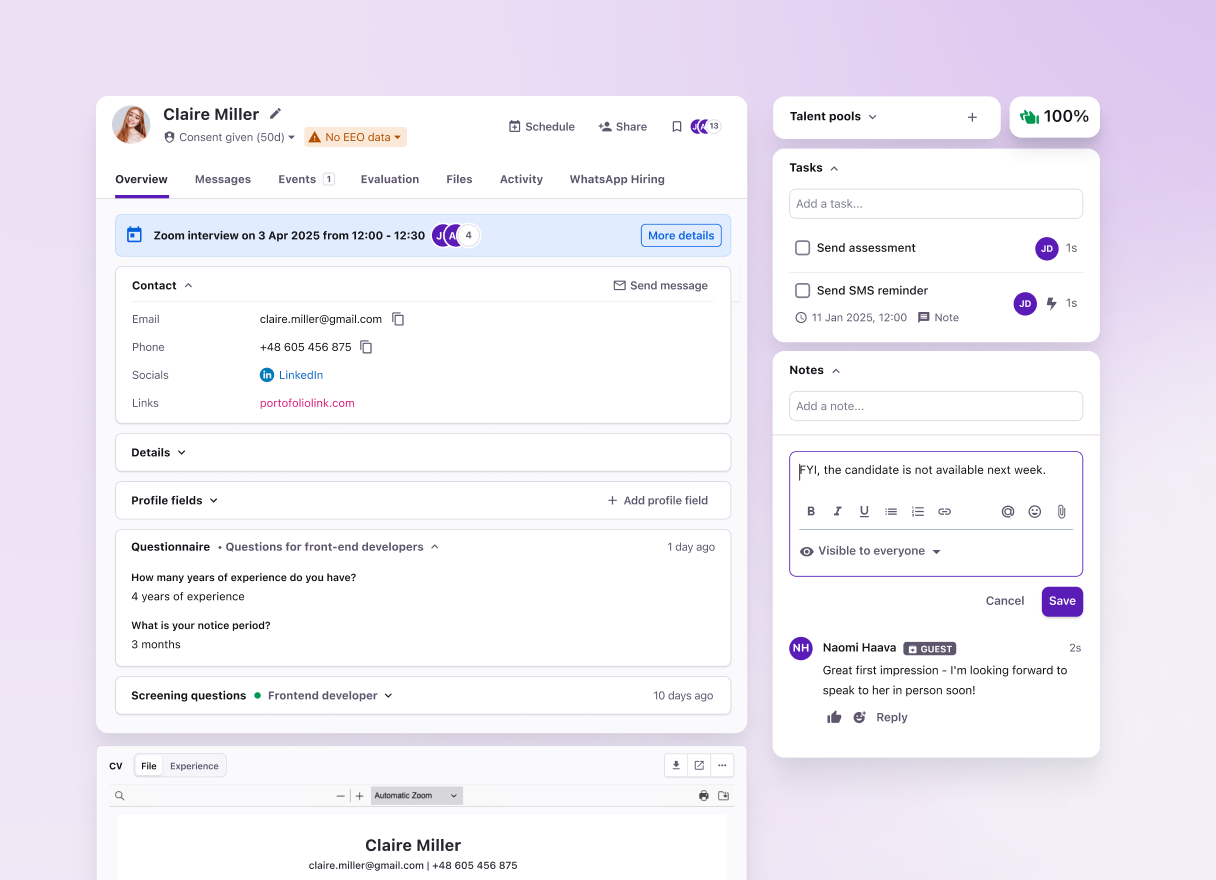
5. Evaluations from colleagues
As time goes by, companies are increasingly embracing collaborative hiring. This means that colleagues and hiring managers are involved earlier on in the process – sometimes as early as sourcing or CV screening.
Those working in a collaborative hiring environment often have colleagues involved in evaluating candidates, whether through skill rankings, skills assessments, or cultural fit trial days.
Collaborative hiring can have a massive impact on candidate profiles. With more people involved in the hiring process, it’s important that everyone can access candidate profiles.
This way, they can save recruiters and HR time in collecting feedback by leaving their evaluation information on the candidate record themselves. When evaluations from colleagues are compiled into a candidate's record, they can help make your selection process easier with more data.
6. Last contact information
Communication is the cornerstone of a great candidate experience. But with so many potential points of contact with a candidate- email, phone, text, messaging, even voice messaging!- it can be hard to keep track of your last contact.
Nevertheless, this is a crucial element to completing a comprehensive candidate profile.
Making note of every communication point made with a candidate during the hiring process is crucial for tracking valuable information.
If you have more than one person involved in the hiring process, make sure they have access to the candidate records so that they can record any phone conversations or contact they’ve had with the candidate.
Better yet, integrate your email with your ATS in order to ensure any emails are automatically synced to the candidate record.
7. Scheduled interviews or meetings
During the hiring process, there may be multiple scheduled meetings or interviews with a candidate.
Sometimes the person who schedules the meeting isn't the same as the one who attends.
To avoid confusion and missed meetings, ensure all scheduled interviews are kept in one central, accessible place: the candidate profile.
To avoid skipping a beat, either automate it in your ATS or regularly update this information.
8. Source of application
The source of application is often considered a nice-to-have compared to all the data that could be collected about a candidate’s profile.
But tagging a candidate’s application source – where they applied or were sourced from – can be a powerful tool in helping you maximize advertisements on the right social channels and eventually predict your next best hire.
All of the following can be considered sources:
- Social paid: ads on LinkedIn, Facebook, Twitter, Instagram, and other social channels.
- Social organic: free job advertisements or social sharing on LinkedIn, Facebook, Twitter, Instagram, and other social channels.
- Internal candidate referral: a candidate who is already an existing employee in another role or department.
- Employee referral: a candidate who is referred to a position by an employee.
- Careers site: A candidate who applies via your careers site directly.
- Job board: a candidate who comes from a job board like Indeed or Monster.
It’s important for categories like social or job boards that you tag based on which job board or platform they came from. This way, with a few successful hires under your belt, you may be able to see trends in which channels are producing the best candidates!
Creating an ideal candidate profile
When it comes to candidate profiles: the more information, the better. But collecting the right information and ensuring its accuracy can be time-consuming.
This is why it can be helpful to tie in colleagues and hiring managers where possible to share some of the recruiting duties. It doesn’t hurt that with more people involved in hiring, you will not only be able to gather more complete information but also avoid unconscious biases.
Creating the perfect candidate profile doesn’t need to be done alone. Ensure your ATS allows your colleagues to contribute at every step of the recruitment process, including the ability to edit and add to candidate records.
What’s the difference between a candidate profile and a job description?
These two terms can, at times, be muddled up. However, they are different things, with very different outcomes.
Ultimately, a job description revolves around the role. It describes the job in detail.
A candidate profile, however, focuses more on the characteristics of the ideal candidate.
Job descriptions will include details about the role itself, like ‘will handle complex formulas on Excel’. Candidate profiles, on the other hand, may state ‘problem-solving mindset.’
6 steps to creating an ideal candidate profile
Now you see the importance of a strong candidate profile and differentiate it from a job description, let’s break down how to create an ideal candidate profile in 6 simple steps.
1 - Understand the role in depth
The candidate profile indeed focuses on the individual candidate, while a job description revolves around the role. However, to understand the specific characteristics and qualities needed from the interviewee, you need to understand the roles and the duties they’d take on.
For example, if you were hiring a content writer, you’d need first to understand the duties of a content writer for your organization. This may include market research, social media analysis, search engine optimization research, and writing the actual content.
By understanding these requirements for the role, which will be positioned front and center in the job description, you can draw out the characteristics required from the responsibilities.
In our example above, we could infer that we’d need a highly creative candidate who enjoys the puzzle-esque style of marketing. That’d then be placed on our candidate profile.
2 - Evaluate your organization’s cultural fit and ethos
Cultural fit is crucial to bringing out the very best in your employees. When hiring, cultural fit can play a massive role in the interview process.
By incorporating it into an ideal candidate profile, you can reduce the time it takes to find your perfect match.
When exploring the duties and responsibilities of the role, we should explore the company’s culture and the central ethos upon which it was built.
Say, for example, you work in an organization that is big on sustainability – your candidate profile can reflect this. Instead of stating ‘must be sustainably aware,’ dive deeper into the ethos you want your ideal candidate to have.
3 - Observe your existing top employees
If you want to learn how to do something, you watch someone do it first. It’s the same here.
Make time to observe some of your company's top performers. Take notes on what they’re doing that makes them so high-performing, and identify the characteristics and personality traits that enable them to do so.
It’s advisable to observe your current employees when hiring, as it gives you a better understanding of the team’s dynamics and helps you analyze traits for your ideal candidate profile.
4 - List your hard and soft skills.
Knowing the required hard and soft skills is crucial for both your job description and your candidate profile.
Hard skills are skills you can teach. Things like ‘spreadsheet management’ or system training fall under the hard skills category.
Soft skills, however, are traits that reside within individuals and can help them be their very best in the workplace. For example, you can’t teach someone to be self-motivated or have a strong sense of leadership. These, then, would be soft skills.
5 - Know your candidate demographic
As with any sort of marketing, recruitment often revolves around finding the right people at the right time. To hire the best fit for your company and the role, you need to know where your candidates spend most of their time.
As we said before, communication is everything. Before reaching out by phone, consider where the candidate is usually located. If they’re active on social media and the role revolves around marketing, why not send them a direct message?
Look at their LinkedIn profile and explore the groups they are part of. This will help you evaluate the type of person you want to hire.
6 - Write your candidate profile
You’ve done your research by the time you hit this phase, and it’s most certainly going to pay off. So, now’s the time to get writing!
The key to writing an ideal candidate profile lies within the detail. The more depth you can give, the better fit and quality your applicants will be.
Remember, though, whenever you’re offering potential employees the chance to work with you, they’re assessing you just as much as you’re evaluating them.
If you want a candidate to be excited about working at your organization, you have to put effort into the candidate profile. Think carefully about the language you use, and really ‘sell’ the role.
Bottom line
An ideal candidate profile benefits everyone. While it may take longer to determine the specific characteristics, qualities, and traits that you require from a candidate, it will result in a better fit within the company and the role.
With that, you’ll find a stronger work ethic, a sense of belonging, and longer-term employees.
So, is the investment of your time worth the benefits when creating an ideal candidate profile? Absolutely, it is.